RGBWW LED Sheet 5-in-1 Chip 480x240mm (#6432)
24V · 288 LEDs
Model: 6432
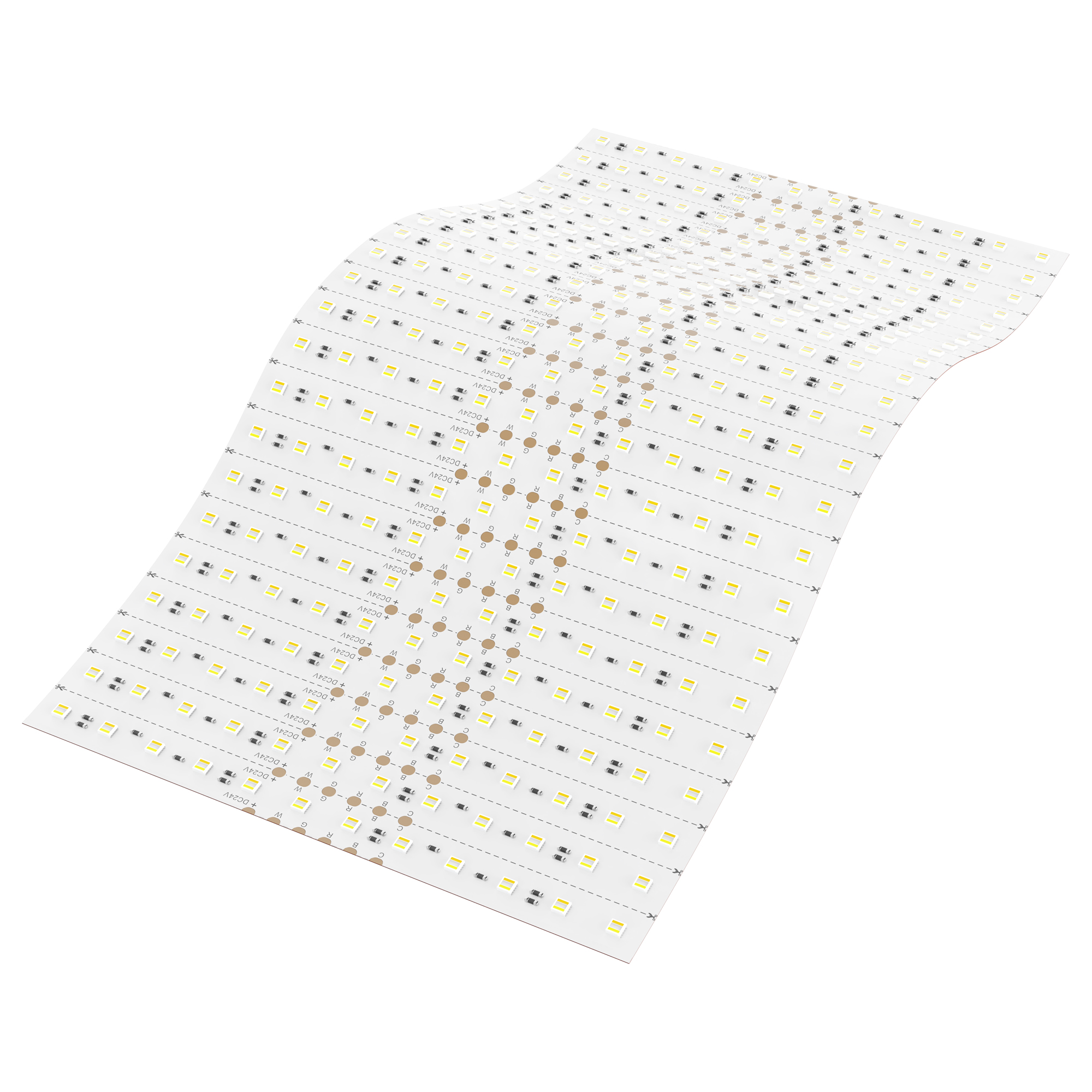
Overview
RGBWW LED Sheet 5-in-1 Chip 480x240mm | 24V | 288 LEDs | #6432 is manufactured by DENO LED, a Shenzhen-based LED lighting manufacturer with its own Foshan production base. Key data: 5050 LEDs, 288 LEDs/pcs, DC 24V, 240x480mm FPCB, 2oz copper foil, 20~110W(1pcs) power, cut unit 12LEDs/20*240mm. Built on 99.9% pure copper FPCB with 99.99% gold bonding wire and covered by a 5-year warranty, it is specified for architectural, retail, hospitality and joinery lighting. OEM and ODM builds of length, colour temperature, CRI and ingress protection are available.
Description
Integrated 5-in-1 SMD 5050 chips combine RGB and dual-white diodes in a single optical point to eliminate color fringing in architectural lighting installations. Measuring 480x240mm, this 24V constant voltage LED sheet features 288 LEDs on a 20mm pitch and provides field cuttable flexibility every 12 LEDs. Engineered with 2oz copper FPCB, each fully dimmable panel operates across a 20 to 110W range and links up to 4 sheets per feed. Factory-direct OEM and ODM production supports wholesale project supply for commercial hospitality interiors, signage backlighting, and retail display fixtures.
Specifications
| LED QTY | 288 LEDs/pcs |
|---|---|
| PART NO | DL-F50A288V24-6432-* |
| SMD TYPE | 5050 |
| CUTTABLE UNIT | 12LEDs/20*240mm |
| DIMMABLE | Yes |
| IP RATING | IP20 |
| LED PITCH | 20mm |
| LIFESPAN | 50000 |
| PCB WIDTH | 240x480mm |
| WARRANTY | 5 Years |
| RUN LENGTH | 4pcs |
| COPPER FOIL | 2oz |
| POWER RANGE | 20~110W(1pcs) |
| CIRCUIT TYPE | C.V. |
| INPUT VOLTAGE | DC 24V |
| OPERATING TEMPERATURE | -25~40°C;Tc:75°C(max) |
Applications
- Backlit stone, onyx & marble surfaces — 480×240mm modules tile behind translucent slabs to deliver even backlighting without hotspots across large countertop and wall panels.
- Shallow lightboxes & SEG frames — Sheet format keeps the illuminated cavity thin, so signage and fabric lightboxes stay slim while staying evenly lit edge to edge.
- Curved and irregular panels — The flexible sheet can be free-cut and shaped to follow non-rectangular graphics, reception desks and column cladding.
- Trade-show & retail backlit graphics — A single 24V feed lights a large backlit graphic, simplifying wiring for shopfitting and trade-show installs.
- Entertainment & media-facade colour scenes — Entertainment venues, media facades, gaming rooms and branded retail installs driven by DMX/SPI or standard RGB controllers.
Request a quotation for #6432
DENO LED is a Shenzhen-based LED strip manufacturer with its own Foshan production base. Send the run length, voltage, CCT/CRI and IP rating you need and our engineering team replies with a specification sheet, wiring plan and price — OEM/ODM and fully custom builds included.
- Warranty: 5 years
- Lead time: standard boards: samples from 1 working day · custom: 3–5 working days · new FPCB: 1–3 weeks · production 1–2 weeks after sample approval
- Compliance: CE · UL · RoHS
- Bonding wire: 99.99% pure gold
- Copper foil: 99.9% pure copper FPCB
Related models in this series
- RGBW LED Light Sheet 480x240mm (#16795)
- RGBW LED Sheet 480x240mm (#16796)
- High Density RGBW LED Light Sheet 480x240mm (#16797)
See every model in Flexible LED Sheets or narrow to Rgbw Led Sheet. Compare wattage, lumen output and run length in the ProCalc parameter library, or request OEM/ODM pricing on the custom manufacturing page.
Frequently Asked Questions
What are the key specifications of #6432?
RGBWW LED Sheet 5-in-1 Chip 480x240mm | 24V | 288 LEDs | #6432: 5050 LEDs, 288 LEDs/pcs, DC 24V, 240x480mm FPCB, 2oz copper foil, 20~110W(1pcs) power, cut unit 12LEDs/20*240mm. Photometric files, wiring diagrams and test reports are available in the downloads block on this page.
Which LED driver and run length suit #6432?
RGBWW LED Sheet 5-in-1 Chip 480x240mm | 24V | 288 LEDs | #6432 is a constant-voltage DC 24V product, so pair it with a CE or UL listed DC 24V constant-voltage LED driver rated about 20% above the connected load. Maximum single run is 4pcs. 4pcs Single / 8pcs Dual Input power. Feeding from both ends or mid-feeding halves the copper distance and roughly quarters the voltage drop.
Where can #6432 be cut on site?
Cut only on the printed cut marks: 12LEDs/20*240mm. LED pitch is 20mm. Re-solder the cut end or use a matched solderless connector, and reseal the end cap on IP-rated versions so the ingress rating is kept.
How is #6432 mounted in a lightbox or behind backlit stone?
The 480 x 240 mm sheet is a flat panel, not a strip, so it is not installed in an aluminium channel. Fix it flat to the lightbox back panel or to the substrate behind the translucent slab using the thermal adhesive backing or mechanical fixings, tiling several sheets edge to edge for larger surfaces. Mount it against a metal or aluminium-faced back panel so the panel spreads the heat, since there is no channel acting as a heat sink. Uniformity is set by the cavity depth between the sheet and the diffuser together with the LED pitch of the model, not by the wattage alone - see the tested lightbox depth and cutting comparison on this page.
Can #6432 be installed outdoors or in wet areas?
RGBWW LED Sheet 5-in-1 Chip 480x240mm | 24V | 288 LEDs | #6432 is offered in IP20. IP20 is dry indoor only, IP65 handles splashing and damp locations, and IP67 suits exposed outdoor and ground-level runs. Specify the ingress rating with the order so the correct silicone or PU coating process is applied on the line.
Engineering & selection guide
Bending limits, IP selection, voltage drop, cutting and the full buyer Q&A for this family are kept on the series page.
- RGBW LED Sheet series — RGBW LED Sheet — Buyer Questions
- LED strip engineering selection handbook
Tested lightbox depth, cutting precision and efficacy — all 10 LED sheets compared
Three numbers decide whether an LED sheet works in your cabinet: the diffuser depth it needs before the dots disappear, the smallest piece you can cut without losing a channel, and the load it puts on the driver. The table below lists all ten DENO FlexLite sheets against those three measured figures so a shallow stone lightbox, an irregular logo or a low-load SEG frame can be specified in one pass.
| Model | Family / grid | LED pitch | Tested lightbox depth | Cutting precision | Load / efficacy |
|---|---|---|---|---|---|
| #6433 | Single colour — 288 × 2835 | 20 mm | 15–25 mm | 1 LED — 20 × 20 mm, both axes | 20–138 W per sheet |
| #6600 | Tunable white 2700–6500 K — 576 × 2835 | 20 mm | 15–25 mm | 2 LEDs — 20 × 20 mm, both axes | 20–120 W per sheet · 234.8 lm/W peak |
| #6352 | RGB — 288 × 5050 | 20 mm | 15–25 mm | 12 LEDs — every 20 mm, one axis | 17.2–70 W per sheet |
| #17947 | RGB — 162 × 5050 | 26.7 mm | 30 mm and deeper | 6 LEDs — every 53.3 mm, one axis | Lower current than #6352 at the same voltage |
| #16797 | RGBW — 288 × 5050 | 19.9 mm | 15–25 mm | 12 LEDs — every 120 mm, one axis | Highest RGBW density in the range |
| #16796 | RGBW — 162 × 5050 | 26.7 mm | 30 mm and deeper | 6 LEDs — 53.3 × 80 mm, both axes | 13–50 W per sheet |
| #16795 | RGBW — 98 × 5050 | 34.3 mm | 30–40 mm | 7 LEDs — 34.3 × 240 mm, one axis | 12–26.8 W per sheet — lowest load of the bare-emitter grids |
| #6432 (this page) | RGBWW 5-in-1 — 288 × 5050 | 20 mm | 20–40 mm | 12 LEDs — 20 × 240 mm, one axis | 20–110 W per sheet |
| #6105 | Wide-angle lens, 24 V — 50 × 2835, 160° lens | 48 mm | 40–60 mm | 1 LED — 48 × 48 mm, both axes | 12–60 W per sheet — 50 LEDs cover the full sheet |
| #6710 | Wide-angle lens, 12 V — 50 × 6060, 160° lens | 48 mm | 40–60 mm | 1 LED — 48 × 48 mm, both axes | 10–60 W per sheet at 12 V |
- Diffuser depth is the air gap measured between the LED sheet and opal acrylic in our lightbox rig; a translucent stone slab counts its own thickness towards that gap.
- Cutting precision is the smallest complete unit that keeps every colour channel intact — always cut on the printed line so the reconnection pads survive.
- Plan four sheets from a single-end feed and eight with dual-end input, then size the driver at the sheet's maximum wattage plus 30 % headroom.