Dim to Warm LED Strip | 3000K to 1800K | DENO
DENO LED's dim to warm LED strip product family offers dynamic color temperature adjustment, mimicking incandescent dimming by transitioning from 3000K to 1800K as light output decreases. These 24V strips feature high CRI (Ra>90) for accurate color rendition and are available in various power densities (e.g., 9.6W/m, 14.4W/m) and IP ratings. Utilizing electroplated roll-to-roll FPCB and 1 SDCM binning, they are suitable for hospitality, residential, and architectural accent lighting applications requiring precise ambiance control.
Dim To Warm SMD Strips models & key specifications (5)
5462 — 2835 · 168 LEDs/m · 24V

LED Type: 2835 · LED Density: 168 LEDs/m · Voltage: 24V · Power: 5.8~28.8W · Cutting Unit: 14LEDs/83.33mm · PCB Width: 12mm · Copper Foil: 3oz · Circuit Type: C.C. · IP Rating: IP20
6942 — 2216 · 224 LEDs/m · 24V
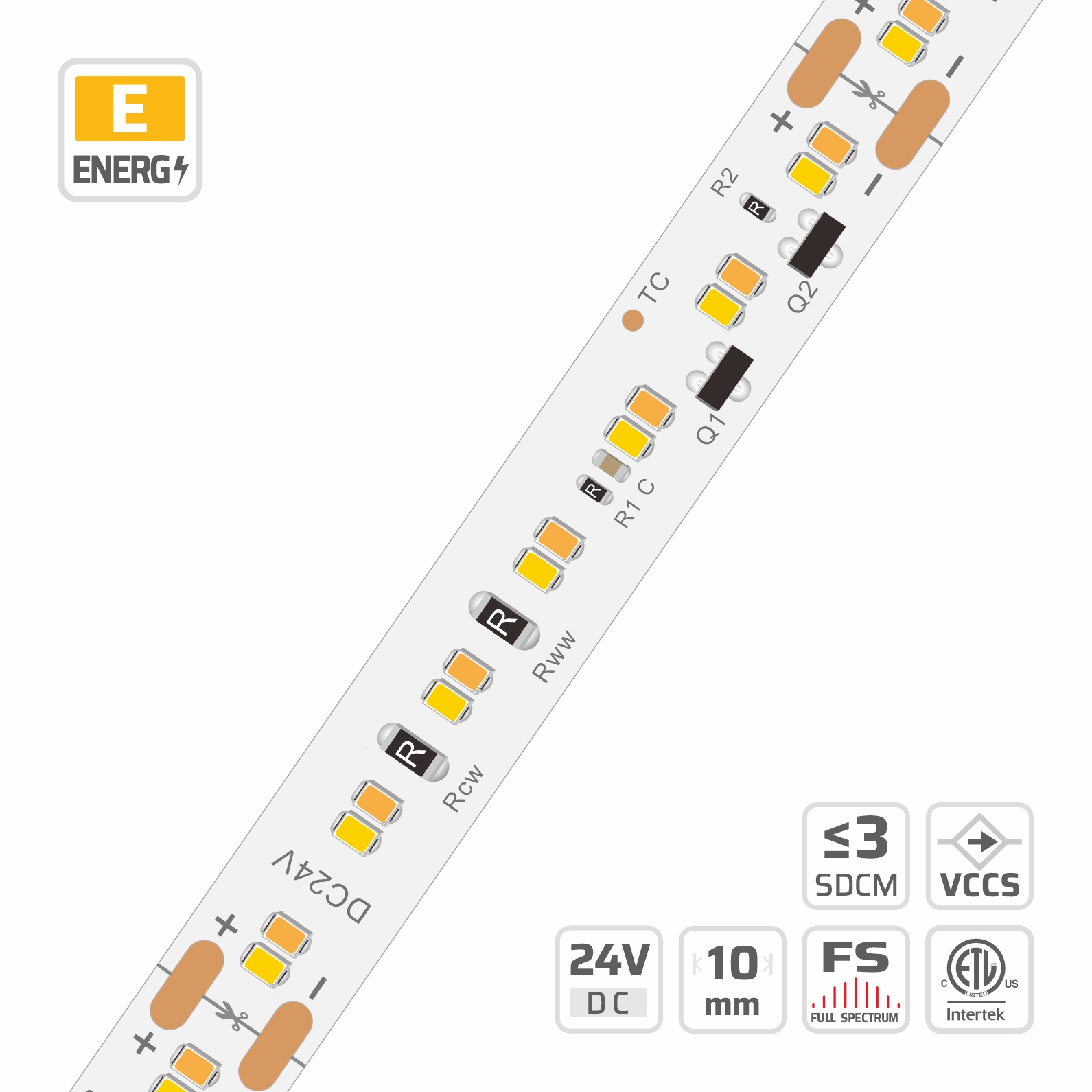
LED Type: 2216 · LED Density: 224 · Voltage: 24V · Power: 7.7~24W · Cutting Unit: 14LEDs/62.5mm · PCB Width: 10mm · Copper Foil: 2oz · Circuit Type: C.C. · IP Rating: IP20
17254 — 2216 · 224 LEDs/m · 24V

LED Type: 2216 · LED Density: 224 LEDs/m · CRI: 95 / 96 · Voltage: 24V · Power: 7.7~15.36W · Cutting Unit: 14LEDs/62.5mm · PCB Width: 6mm · Copper Foil: 3oz · Circuit Type: C.C. · IP Rating: IP20
14207-N — 2216 · 420 LEDs/m · 24V
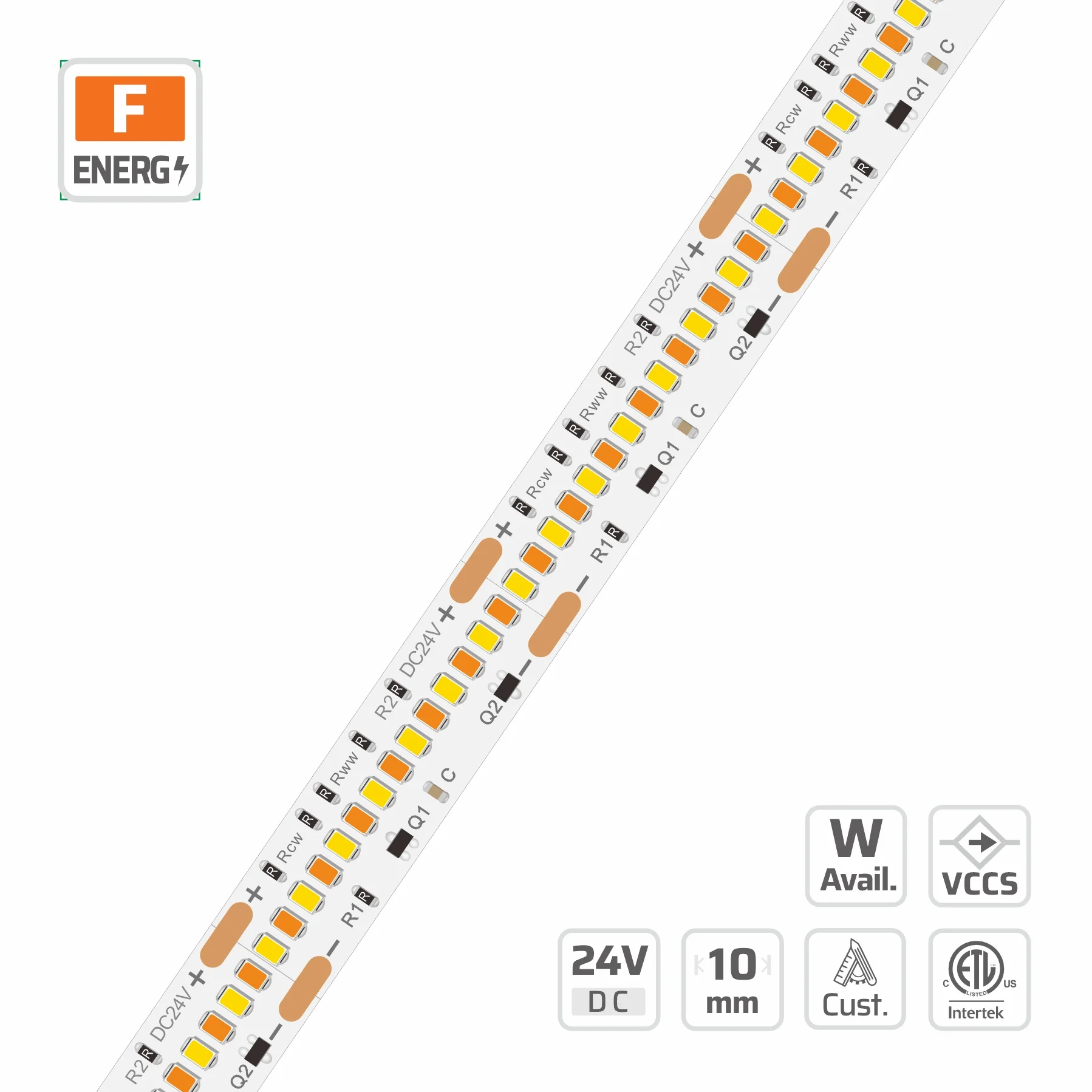
LED Type: 2216 · LED Density: 420 LEDs/m · CRI: 91 / 94 / 95 · Voltage: 24V · Power: 7.2~18W · Cutting Unit: 14LEDs/33.33mm · PCB Width: 10mm · Copper Foil: 3oz · Circuit Type: C.C. · IP Rating: IP20
14025 — 2216 · 420 LEDs/m · 24V
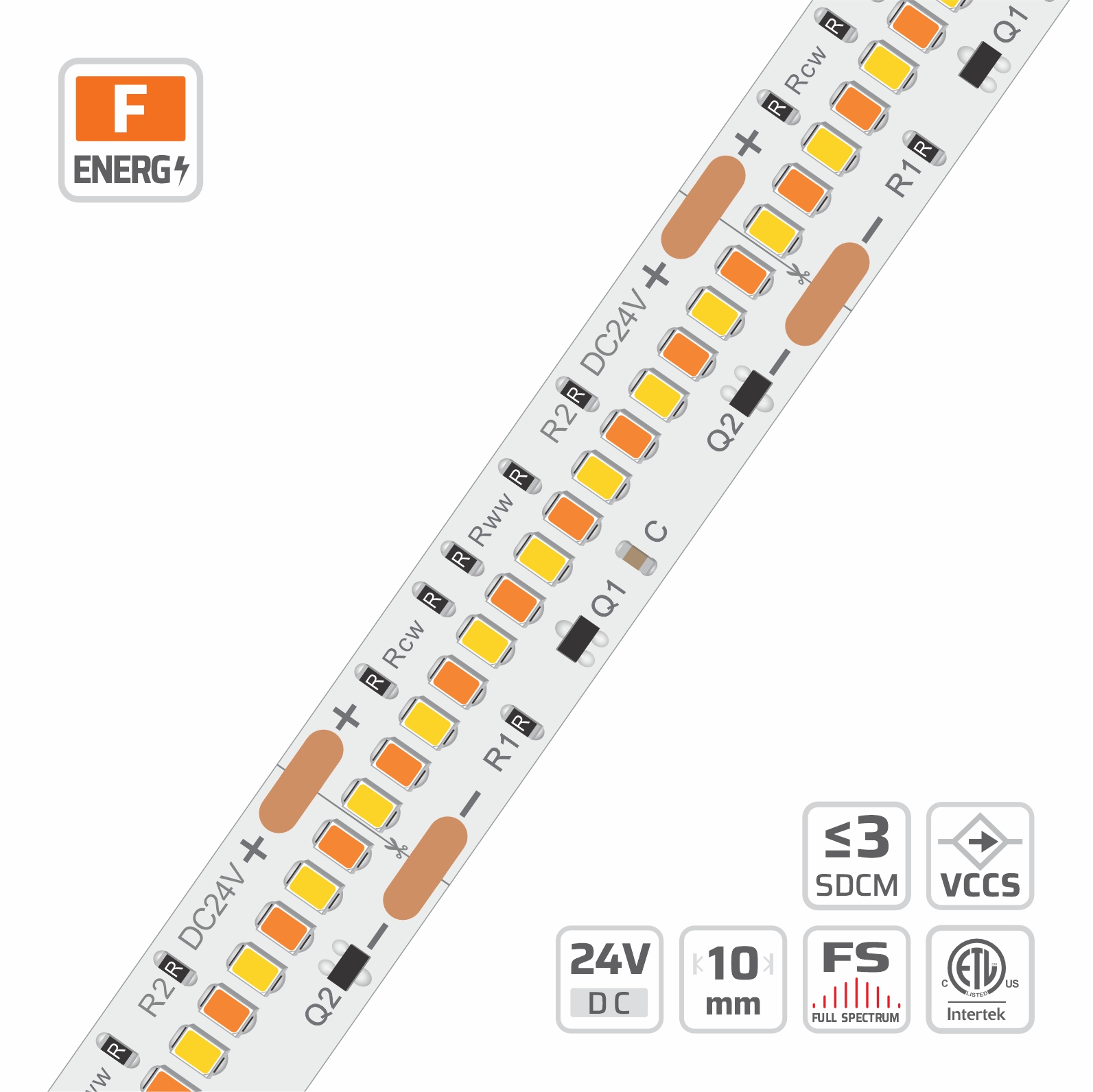
LED Type: 2216 · LED Density: 420 · Voltage: 24V · Power: 7.2~18W · Cutting Unit: 14LEDs/33.3mm · PCB Width: 10 · Copper Foil: 3oz · Circuit Type: CC · IP Rating: IP20
Other SMD LED Strip series
- 1515 SMD LED Strips
- 5054 SMD LED Strips
- 2020 SMD LED Strips
- 1608 SMD LED Strips
- 3014 SMD LED Strips
- 2835 SMD LED Strips
- 3535 SMD LED Strips
- 6060 SMD LED Strips
- 5050 SMD LED Strips
- 3528 SMD LED Strips
- 2216 SMD LED Strips
- 2110 SMD LED Strips
- 3030 SMD LED Strips
- 0807 SMD LED Strips
- 3838 SMD LED Strips
- 5630 SMD LED Strips
- Full Spectrum Violet Excitation SMD Strips
- 1 SDCM SMD Strips
- Selectable Power LED Strips
- High Efficiency LED Strips
- DENO WAP™ SMD Strips
- Full Spectrum SMD Strips
- Special SMD Strips
- Roll-to-Roll SMD Strips
- Built in IC SMD Strips
- C.C. SMD Strips (IC Regulated)
- Marine Grade SMD Strips
- High Density LED Strips
- Ultra-Narrow SMD Strips
- Wide SMD Strips
- Pixel SMD Strips
- Long LED Strip Lights
- Side Emitting LED Strips
- Automotive SMD Strip
- SMD Strips with Lenses
- S-Bend SMD Strips
- Micro-Cut SMD Strips
- Classic SMD Strips
- RGBW LED Strips
- RGB SMD Strips
- CCT SMD Strips
- CCT SMD Strips ( 1 Loop )
- 36V SMD Strips
- 48V SMD Strips
Dim to Warm LED Strip — Buyer Questions
What is a dim to warm LED strip?
It is a strip that gets warmer in colour as it is dimmed down, the way a halogen lamp or a candle does, instead of holding one fixed colour temperature. The board carries two LED types in an alternating layout — a warm 1800K and a cooler 4000K — and the driver shifts the ratio between them as brightness falls, so the light travels from roughly 3000K at full output to about 1800K at the bottom of the dimming range.
- Guide how the dual-chip circuit works
- Related series the dot-free SOB version
- Product 14025 dim to warm board
Is it the same as a CCT tunable strip?
No, and the difference matters when specifying. A tunable white strip needs a two-channel controller and lets the user set any colour temperature at any brightness. A dim to warm board follows a fixed curve tied to the dimming level: one channel, one ordinary dimmer, no separate colour control. That makes it simpler to wire into restaurants, hotel rooms and residential schemes where the client wants the warm-glow effect without teaching anyone a control system.
- Related series tunable white boards with two channels
- Related series dimmers and controllers
Which models are available and how dense are they?
Seven SMD boards cover the range. The 2216 high-density builds run 420 LEDs/m at 10 mm width (#14025, #14207-N) with a 33.3 mm cut and 7.2–18 W, or 224 LEDs/m with a 62.5 mm cut at 10 mm (#6942) and 6 mm (#17254, 7.7–15.36 W). The 2835 boards run 168 LEDs/m at 12 mm with an 83.3 mm cut (#5462 at 5.8–28.8 W, #5214 at 12–35 W). #4995 is a 12V 2216 board at 420 LEDs/m with a 14.28 mm micro-cut.
- Related series high-density 2216 boards
- Related series 6 mm narrow boards
- Product 14207-N 2216 dim to warm board
What dimmer does it need, and how low does it go?
Any standard PWM dimmer on the DC side — TRIAC, 0–10V, DALI or a phase-cut driver — because the colour shift is produced by the strip's own circuit, not by the control system. The published range is smooth dimming from 100% down to roughly 1%, with the warmest point at the bottom. Use a dimmer rated above the run's connected load and keep the PWM frequency above 3 kHz where cameras are present.
How long can one run be, and where is it usually installed?
All seven boards are rated 5 m from a single feed and 10 m fed from both ends, on 2 oz or 3 oz copper. In practice they go into hospitality and residential work where the mood changes through the evening: cove and coffer lighting, under-cabinet and shelf lines, headboard and bedside details, restaurant and bar joinery, and gallery display cases where a warm low setting flatters finishes.
- Guide plan feeds for a long cove run
- Related series channels and diffusers
- Product 5462 24V dim to warm board
Can the warm end, CRI or board width be customised?
Yes. The warm and cool chip pairing, the dimming curve's end points, CRI grade, PCB width, LED pitch, cut unit, IP class and reel length are all configurable, and the same effect is available as a dot-free SOB build (#14207) at 420 LEDs/m on a 10 mm board with a 33.33 mm cut. DENO manufactures the FPCB in-house, so a custom pairing is tooled from an existing stack-up.