What Is a Dim to Warm LED Strip Light?
By DENO LED Lighting ·
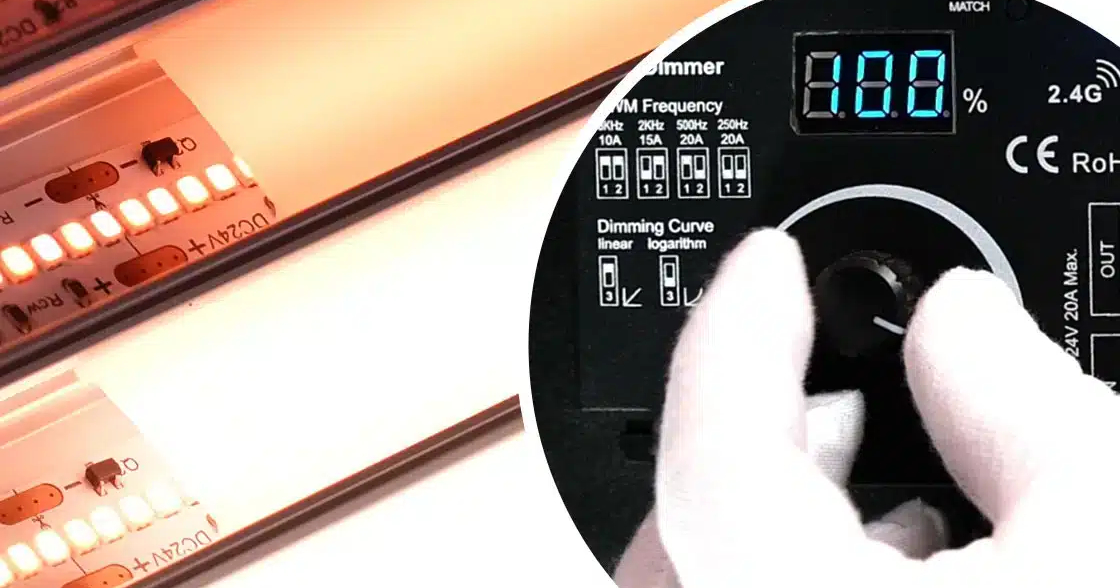
Dim to warm explained for lighting specifiers: how a dual-CCT LED strip shifts from about 3000K to 1800K as it dims, how it differs from tunable white, which DENO models exist, and what to check before ordering.

1. What dim to warm means
Dim to warm is a dimming behaviour in which the correlated colour temperature (CCT) falls together with the light level, instead of staying fixed. A DENO dim to warm LED strip runs at roughly 3000K at full output and settles near 1800K at the bottom of its dimming range. It reproduces what people already know from halogen and incandescent lamps: as the filament cools, the light becomes both dimmer and warmer.
2. How a dim to warm LED strip works
The board carries two LED types in an alternating layout — a warm 1800K LED and a cooler 4000K LED. As the dimming level drops, the circuit reduces the 4000K LEDs faster than the 1800K LEDs, so the mixed light moves from neutral-warm white toward a candle-like amber.
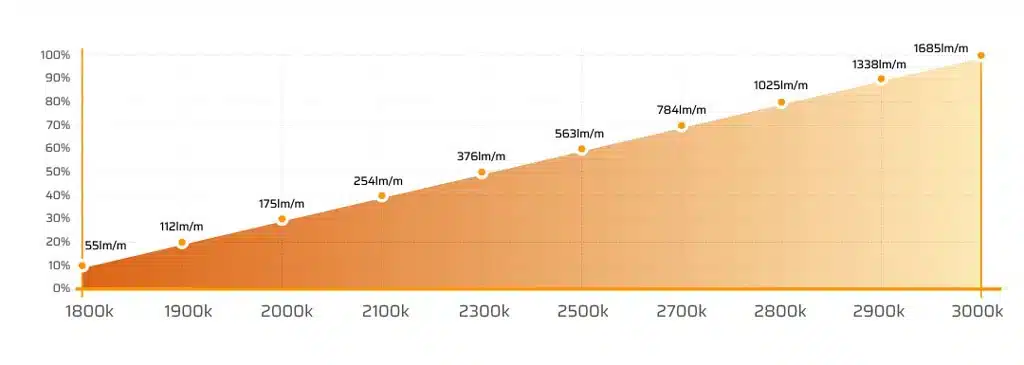
- Colour path: about 3000K at 100% output down to about 1800K at minimum.
- Dimming range: smooth from 100% down to approximately 1%.
- Lower brightness always means a lower colour temperature.
- Because both LED types sit at a short pitch, the two colours blend before the light leaves the diffuser — LED pitch and diffuser depth matter as much as the driver.
3. Dim to warm vs tunable white
| Feature | Dim to warm | Tunable white (CCT) |
|---|---|---|
| Control | Brightness and CCT linked on one fader | Brightness and CCT set independently |
| Typical CCT range | About 3000K → 1800K | Typically 2700K–6500K |
| User experience | Familiar halogen-style sunset dimming | Full control for task, circadian or photo spaces |
| Risk of wrong scene | Low — the space cannot be left at a cold CCT | Higher — an operator can leave a restaurant at 6000K |
Choose tunable white where users need independent colour control. Choose dim to warm where the client wants one simple control and a warm evening atmosphere every time.
4. DENO dim to warm LED strip models
- 2835 dim to warm LED strip — 168 LEDs/m (84 × 1800K + 84 × 4000K), 12mm PCB, 24V. Full spectrum available on this series.
- 2216 dim to warm LED strip — 224 LEDs/m (112 × 1800K + 112 × 4000K), 10mm PCB, 24V; also as a 6mm ultra-narrow version for slim profiles.
- High density dim to warm LED strip — 420 LEDs/m (210 × 1800K + 210 × 4000K), 10mm PCB, 24V, 33.33mm cut.
- SOB dim to warm LED strip — 420 LEDs/m, dot-free continuous line for shallow coves and close-range reveals.
CRI options are CRI>90 and CRI>95, plus full spectrum on the 2835 series. A custom starting CCT, for example 2700K, is available on request.
5. Where dim to warm belongs
Hospitality is the primary market: restaurants, bars, hotel guest rooms and lobbies, private dining and high-end residential spaces where the evening scene must feel warm without looking dull. It also suits retail displays of wood, leather, jewellery and warm metals, and heritage interiors whose reference light source was incandescent. It is the wrong choice for colour-critical inspection work, where a fixed high-CRI source is required.

6. Specifying and commissioning checklist
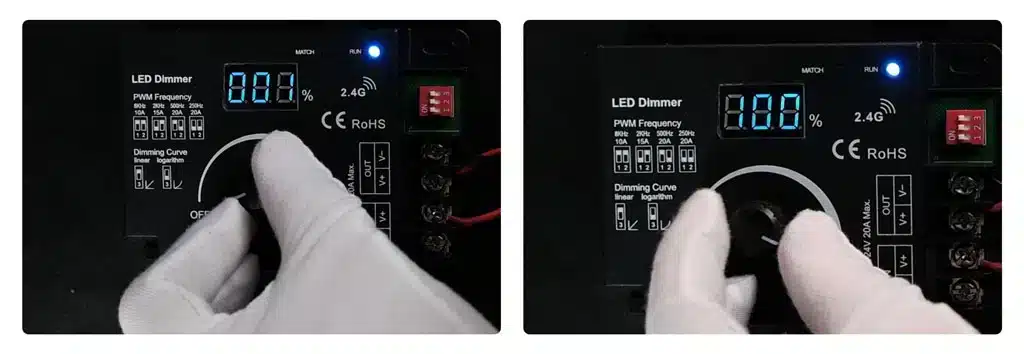
- Control protocol. Confirm the controller or driver for the exact model (for example PWM, 0-10V, DALI or phase-cut via a suitable driver). The colour curve depends on the strip and its control together, so ask DENO for the matched control list.
- Low-end behaviour. The system should dim smoothly to about 1% without visible steps or flicker. If the space will be filmed, state a flicker target.
- CRI at the warm end. For hospitality work, specify CRI>90 or higher.
- Run length and feed points. Uneven voltage drop on a long run can shift colour as well as brightness — check it in the ProCalc voltage drop calculator.
7. Common installation mistakes
- Mixing drivers or controllers from different families on adjacent runs, which causes visible colour mismatch at the same dim level.
- Using a dimmer that is not suited to the strip, which removes the warm-dim effect.
- Cutting outside the printed cut marks, which breaks one LED group and leaves a section stuck at one colour temperature.
8. Frequently asked questions
How warm does a dim to warm LED strip get?
DENO dim to warm strips reach about 1800K at minimum output.
Can the dim to warm range be customised?
Yes. A different starting CCT, such as 2700K, can be built on request.
Can a dim to warm LED strip be waterproofed?
Yes. The same silicone constructions used on single-colour strips can be applied; confirm the IP rating for the specific model.
Where can I compare all models?
See the dim to warm LED strip series and the SOB dim to warm version.
Dim to warm LED strip videos
- Dim to Warm — 0–100% Smooth Dimming — 0–100% smooth dimming with natural CCT transition. High-density design allows seamless color temperature adjustment.
- Dim to Warm Series LED Light — Two built-in LED lights: cool white and warm white. Seamlessly transition color temperature from 3000K to 1800K by adjusting brightness.
Dim to warm LED strip models
- 2835 dim to warm LED strip, 12mm, 168 LEDs/m (#5462)
- 2216 dim to warm LED strip, 10mm, 224 LEDs/m (#6942)
- 6mm ultra-narrow dim to warm strip (#17254)
- High density dim to warm strip, 420 LEDs/m (#14025)
- SOB dot-free dim to warm strip (#14207)
Samples and custom starting CCTs on request — ask for a quotation.