Dim to Warm SOB LED Strip Light (#14207)
10mm · 24V · 420LEDs · 33.33mm/cut
Model: 14207
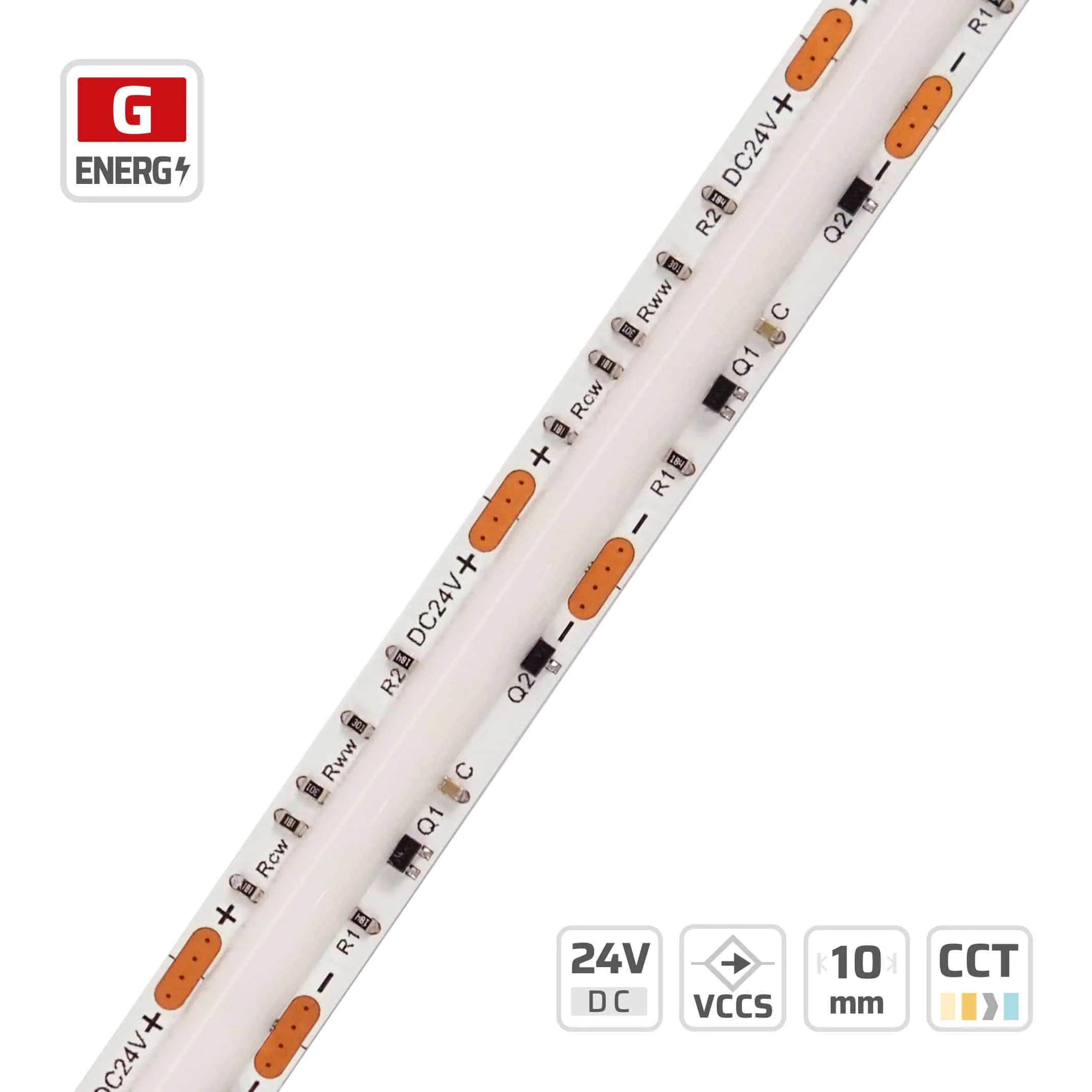
Overview
The DENO LED Model 14207 Dim to Warm SOB LED Strip is a dynamic lighting solution designed for commercial and architectural applications. Featuring 420 LEDs/m and operating at 24V, this strip seamlessly transitions color temperature from 3000K to 1800K as it dims, creating a warm, inviting ambiance reminiscent of incandescent lighting. It offers versatility with TRIAC, PWM, and 0/1-10V dimming compatibility. Ideal for accent lighting and areas requiring low clearance, enhan...
Description
This dim to warm SOB LED strip light shifts smoothly from 3000K to 1800K to replicate traditional incandescent illumination for hospitality environments. The flexible 24V strip supports smooth dimming control via standard TRIAC, PWM, and 0/1-10V dimming protocols for versatile commercial lighting integration. Engineered with a dense 420 LEDs per meter layout and a 160-degree beam angle on a 10mm 3oz copper PCB to eliminate spot-glare. Featuring a constant current circuit design with 33.33mm cutting increments, the strip operates efficiently across a 7.2W to 18W power range. Ideal for cove lighting and architectural joinery, DENO provides wholesale project supply and OEM custom configurations up to 5m run lengths.
Specifications
| LED QTY | 420 LEDs/m |
|---|---|
| PART NO | DL-FSOBA210V24-14207-* |
| SMD TYPE | SOB |
| CUTTABLE UNIT | 14LEDs/33.33mm |
| DIMMABLE | Yes |
| LED PITCH | 2.381mm |
| PCB WIDTH | 10mm |
| BEAM ANGLE | 160° |
| RUN LENGTH | 5m |
| COPPER FOIL | 3oz |
| POWER RANGE | 7.2~18W |
| CIRCUIT TYPE | C.C. |
| INPUT VOLTAGE | 24V |
Applications
- Cove, wall-wash & perimeter lighting — Coves, recesses, wall-wash details and ceiling perimeters where a continuous, uniform line of light is required.
- Showroom & hospitality display lighting — Shelving, display cases, reception desks and signage backlighting in shops, showrooms and hospitality spaces.
- Kitchen & wardrobe under-cabinet lighting — Kitchen, wardrobe and furniture task lighting where the strip stays hidden and only the light is seen.
- Hotel & residential tunable-white scenes — Hotel rooms, residential living areas and meeting spaces where warm evening light and neutral daytime light are both required from one fixture.
Recommended accessories & compatible parts
- DL-1003 — 19.1x8mm Surface Mount LED Channel — Dotless Aluminum Profile for 240 LEDs/m Strip: Accepts LED strips up to 10mm wide.
- DL-1103-1 — 16x13mm Surface Mount LED Channel — Aluminum Profile for 10mm LED Strip: Accepts LED strips up to 10mm wide.
- DL-1510 HX-F — 15x9.9mm Recessed LED Channel with Flange — Flush Mount Aluminum Profile: Accepts LED strips up to 10mm wide.
- DN-PSU-100 — 24V 100W Class-2 LED Driver · High Efficiency: Matches the 24V DC input of this strip; size the driver with at least 20% headroom over total load.
- DN-PSU-150 — 24V 150W Class-2 LED Driver · Premium: Matches the 24V DC input of this strip; size the driver with at least 20% headroom over total load.
- DN-PSU-60 — 24V 60W Class-2 LED Driver · Constant Voltage: Matches the 24V DC input of this strip; size the driver with at least 20% headroom over total load.
- V1 — 5-36VDC 1-Channel * 8A RF+Push Dimming Controller | V1: Matched by input voltage range and colour channels.
Request a quotation for #14207
DENO LED is a Shenzhen-based LED strip manufacturer with its own Foshan production base. Send the run length, voltage, CCT/CRI and IP rating you need and our engineering team replies with a specification sheet, wiring plan and price — OEM/ODM and fully custom builds included.
- Warranty: 5 years
- Lead time: standard boards: samples from 1 working day · custom: 3–5 working days · new FPCB: 1–3 weeks · production 1–2 weeks after sample approval
- Compliance: CE · UL · RoHS
- Bonding wire: 99.99% pure gold
- Copper foil: 99.9% pure copper FPCB
Photometric Performance — CCT × CRI Efficacy Matrix
Peak measured luminous efficacy: 108.8 lm/W at 3000K, Ra 90, ErP energy class F (DL · DTW C · 12W/m).
All values are measured at the stated power density and ambient 25 °C, reported as luminous efficacy in lumens per watt (lm/W), luminous flux per metre (lm/m) and the corresponding EU ErP (2019/2015) energy class.
DL · DTW C · 12W/m
| CCT (K) | Ra 80 — Luminous Efficacy (lm/W) | Ra 80 — Luminous Flux (lm/m) | Ra 80 — ErP Energy Class | Ra 90 — Luminous Efficacy (lm/W) | Ra 90 — Luminous Flux (lm/m) | Ra 90 — ErP Energy Class | Full Spectrum (Ra 95+) — Luminous Efficacy (lm/W) | Full Spectrum (Ra 95+) — Luminous Flux (lm/m) | Full Spectrum (Ra 95+) — ErP Energy Class |
|---|---|---|---|---|---|---|---|---|---|
| 3000 K | — | — | — | 108.8 lm/W | 1306 lm/m | F | — | — | — |
| 2980 K | — | — | — | 108.1 lm/W | 1112 lm/m | F | — | — | — |
| 2960 K | — | — | — | 106.9 lm/W | 927 lm/m | F | — | — | — |
| 2940 K | — | — | — | 105.3 lm/W | 752 lm/m | F | — | — | — |
| 2900 K | — | — | — | 103.4 lm/W | 590 lm/m | F | — | — | — |
| 2860 K | — | — | — | 97.2 lm/W | 426 lm/m | F | — | — | — |
| 2800 K | — | — | — | 91 lm/W | 289 lm/m | F | — | — | — |
| 2700 K | — | — | — | 84.9 lm/W | 178 lm/m | G | — | — | — |
| 2500 K | — | — | — | 48 lm/W | 57 lm/m | G | — | — | — |
| 2200 K | — | — | — | 22.3 lm/W | 10 lm/m | G | — | — | — |
| 1850 K | — | — | — | 12.4 lm/W | 1 lm/m | G | — | — | — |
DL · DTW C · 15W/m
| CCT (K) | Ra 80 — Luminous Efficacy (lm/W) | Ra 80 — Luminous Flux (lm/m) | Ra 80 — ErP Energy Class | Ra 90 — Luminous Efficacy (lm/W) | Ra 90 — Luminous Flux (lm/m) | Ra 90 — ErP Energy Class | Full Spectrum (Ra 95+) — Luminous Efficacy (lm/W) | Full Spectrum (Ra 95+) — Luminous Flux (lm/m) | Full Spectrum (Ra 95+) — ErP Energy Class |
|---|---|---|---|---|---|---|---|---|---|
| 3000 K | — | — | — | 106.5 lm/W | 1598 lm/m | F | — | — | — |
| 2980 K | — | — | — | 105.8 lm/W | 1361 lm/m | F | — | — | — |
| 2960 K | — | — | — | 104.6 lm/W | 1133 lm/m | F | — | — | — |
| 2940 K | — | — | — | 103 lm/W | 919 lm/m | F | — | — | — |
| 2900 K | — | — | — | 101.2 lm/W | 722 lm/m | F | — | — | — |
| 2860 K | — | — | — | 95.1 lm/W | 521 lm/m | F | — | — | — |
| 2800 K | — | — | — | 89.1 lm/W | 354 lm/m | F | — | — | — |
| 2700 K | — | — | — | 83.1 lm/W | 219 lm/m | G | — | — | — |
| 2500 K | — | — | — | 47 lm/W | 69 lm/m | G | — | — | — |
| 2200 K | — | — | — | 21.8 lm/W | 12 lm/m | G | — | — | — |
| 1850 K | — | — | — | 12.1 lm/W | 1 lm/m | G | — | — | — |
DL · DTW C · 18W/m
| CCT (K) | Ra 80 — Luminous Efficacy (lm/W) | Ra 80 — Luminous Flux (lm/m) | Ra 80 — ErP Energy Class | Ra 90 — Luminous Efficacy (lm/W) | Ra 90 — Luminous Flux (lm/m) | Ra 90 — ErP Energy Class | Full Spectrum (Ra 95+) — Luminous Efficacy (lm/W) | Full Spectrum (Ra 95+) — Luminous Flux (lm/m) | Full Spectrum (Ra 95+) — ErP Energy Class |
|---|---|---|---|---|---|---|---|---|---|
| 3000 K | — | — | — | 104.3 lm/W | 1877 lm/m | F | — | — | — |
| 2980 K | — | — | — | 103.6 lm/W | 1600 lm/m | F | — | — | — |
| 2960 K | — | — | — | 102.5 lm/W | 1333 lm/m | F | — | — | — |
| 2940 K | — | — | — | 100.9 lm/W | 1081 lm/m | F | — | — | — |
| 2900 K | — | — | — | 99.1 lm/W | 848 lm/m | F | — | — | — |
| 2860 K | — | — | — | 93.2 lm/W | 612 lm/m | F | — | — | — |
| 2800 K | — | — | — | 87.3 lm/W | 416 lm/m | F | — | — | — |
| 2700 K | — | — | — | 81.4 lm/W | 256 lm/m | G | — | — | — |
| 2500 K | — | — | — | 46 lm/W | 81 lm/m | G | — | — | — |
| 2200 K | — | — | — | 21.4 lm/W | 14 lm/m | G | — | — | — |
| 1850 K | — | — | — | 11.8 lm/W | 2 lm/m | G | — | — | — |
Frequently Asked Questions
What dimming protocols are compatible with this LED strip?
The Dim to Warm SOB LED Strip is compatible with TRIAC, PWM, and 0/1-10V dimming systems, offering flexible control options for various installations.
What is the color temperature range for the 'Dim to Warm' feature?
This strip delivers a seamless color temperature shift from 3000K (daylight white) down to 1800K (candle-like glow) as it dims.
What are the common applications for this SOB LED strip?
It is ideal for general accent lighting, shelving illumination, display cases, and areas with low clearance or reflective surfaces where spot-glare needs to be eliminated.
Can this product be customized for specific project lengths or requirements?
DENO LED offers customization for project-specific needs. Please contact our sales team to discuss minimum order quantities and specialized configurations.
Is this SOB strip light also called FOB, S-COB or COB Pro strip light?
Yes. Model 14207 belongs to the DENO SOB (Spot on Board) family, which the market also calls FOB strip light, S-COB strip light or COB Pro strip light. All three names describe the same dot-free chip-on-board LED strip construction, so you can quote it under whichever term your project specification uses.
Engineering & selection guide
Bending limits, IP selection, voltage drop, cutting and the full buyer Q&A for this family are kept on the series page.
- Dim-to-Warm SOB strips — Dim to Warm LED Strip — Buyer Questions
- LED strip engineering selection handbook
SOB is the upgraded generation of the COB LED strip
Every SOB board on this page starts from the classic COB recipe — one continuous phosphor line, zero visible dots — and rebuilds it with individually encapsulated, gold-wire-bonded packages soldered on thick copper of up to 105 µm or thicker. The result keeps the COB look while DENO has verified builds up to 24W/m at 24V DC (25 °C ambient, aluminum profile), with a standard binning target of SDCM ≤3; CRI, run length and cut unit are model-specific. For shorter, lower-load or cost-sensitive lines the classic COB range remains a practical choice — compare exact models under equal conditions.