2216 Long Run LED Strip Light (#14512-N)
10mm · 24V · 20mm/cut · 300LEDs
Model: 14512-N
Overview
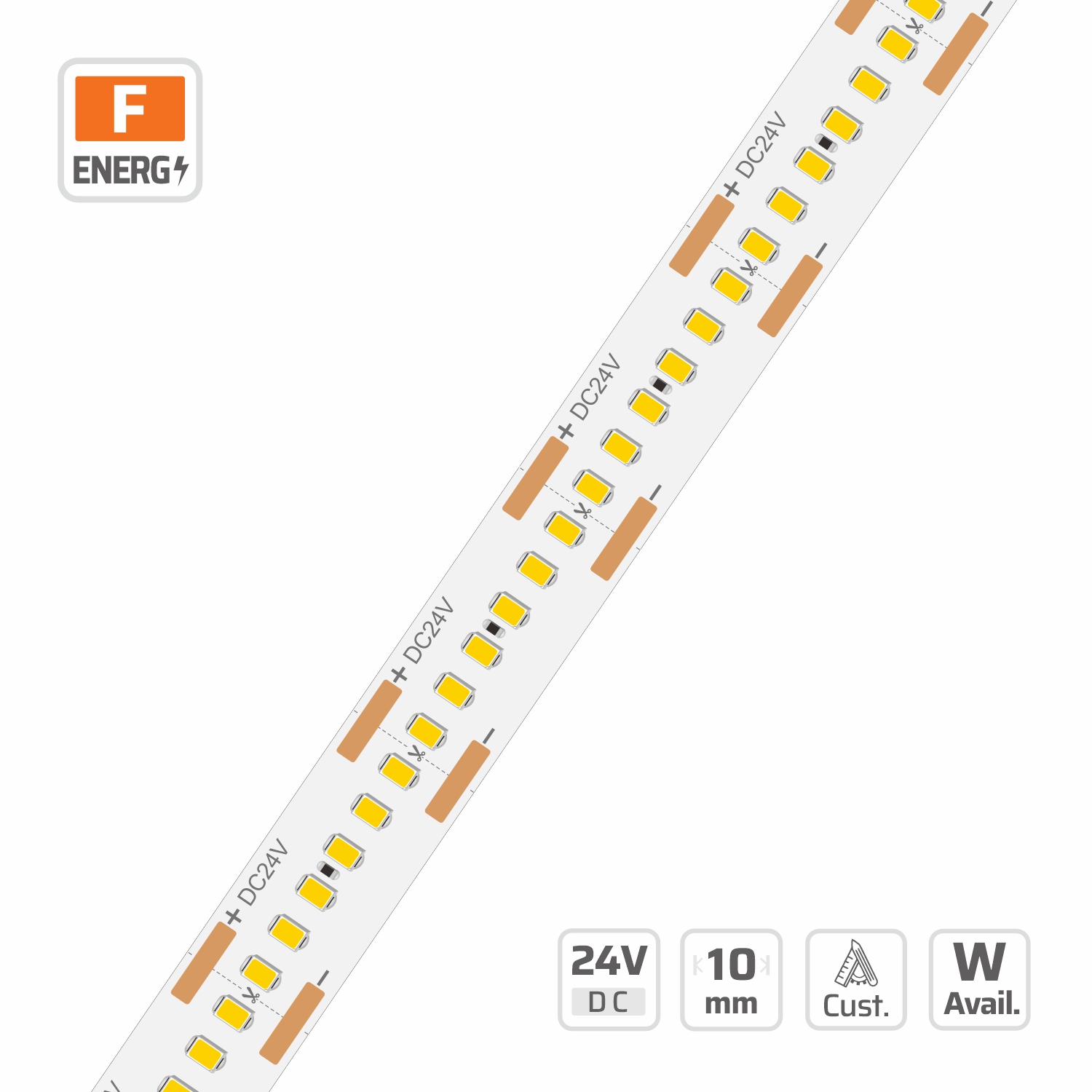
2216 Ultra-Long LED Strip Light | 10mm | 24V | 20mm/cut | 300LEDs | #14512-N is part of the DENO Ultra-Long SMD Strips series, engineered around ultra long run LED strip. Key specifications: 2216, 300 LEDs/m, DC24V, 10mm PCB, 3oz copper FPCB, cuttable 6LEDs/20mm. Every reel is produced on DENO's roll-to-roll line with 99.9% pure copper FPCB and ships CE, UL and RoHS compliant for architectural, retail and hospitality projects. OEM and ODM configurations of length, colour temperature and waterproofing are available on request.
Description
2216 long LED strip — 24V DC, 300 LEDs/m on a 10mm, 3 oz copper board, cuttable every 20mm, constant-current circuit. Buyer decision: a dot-free 300 LEDs/m line that stays uniform over a 5 m single feed or 10 m dual feed — the CC circuit removes the brightness taper that ruins long coves. Ideal where the strip is seen directly over shorter continuous runs. Custom CCT, IP rating and length — request a factory quote.
Ultra Long Run Led Strip built for ultra-long smd strips projects.
Specifications
| LED QTY | 300 LEDs/m |
|---|---|
| PART NO | DL-F22A150V24-14512-N |
| SMD TYPE | 2216 |
| CUTTABLE UNIT | 6LEDs/20mm |
| DIMMABLE | Yes |
| LED PITCH | 3.334mm |
| PCB WIDTH | 10mm |
| LENGTH MAX | 5m |
| COPPER FOIL | 3oz |
| POWER RANGE | 6~24W |
| CIRCUIT TYPE | C.C. |
| INPUT VOLTAGE | DC24V |
| OPERATING TEMPERATURE | -25~40°C; Tc: 75°C (max) |
Photometric Performance — CCT × CRI Efficacy Matrix
Peak measured luminous efficacy: 104 lm/W at 4000K, Ra 90, ErP energy class F (Grade DL (2nd Tier) · 6W/m).
All values are measured at the stated power density and ambient 25 °C, reported as luminous efficacy in lumens per watt (lm/W), luminous flux per metre (lm/m) and the corresponding EU ErP (2019/2015) energy class.
Grade DL (2nd Tier) · 6W/m
| CCT (K) | Ra 80 — Luminous Efficacy (lm/W) | Ra 80 — Luminous Flux (lm/m) | Ra 80 — ErP Energy Class | Ra 90 — Luminous Efficacy (lm/W) | Ra 90 — Luminous Flux (lm/m) | Ra 90 — ErP Energy Class | Full Spectrum (Ra 95+) — Luminous Efficacy (lm/W) | Full Spectrum (Ra 95+) — Luminous Flux (lm/m) | Full Spectrum (Ra 95+) — ErP Energy Class |
|---|---|---|---|---|---|---|---|---|---|
| 1800 K | — | — | — | 78.6 lm/W | 471.9 lm/m | G | — | — | — |
| 2300 K | — | — | — | 87.6 lm/W | 525.6 lm/m | F | — | — | — |
| 2700 K | — | — | — | 94.8 lm/W | 568.7 lm/m | F | — | — | — |
| 3000 K | — | — | — | 99.7 lm/W | 598.1 lm/m | F | — | — | — |
| 3500 K | — | — | — | 101.5 lm/W | 608.7 lm/m | F | — | — | — |
| 4000 K | — | — | — | 104 lm/W | 623.7 lm/m | F | — | — | — |
| 5000 K | — | — | — | 103.9 lm/W | 623.1 lm/m | F | — | — | — |
| 6500 K | — | — | — | 99.7 lm/W | 598.1 lm/m | F | — | — | — |
Grade DL (2nd Tier) · 12W/m
| CCT (K) | Ra 80 — Luminous Efficacy (lm/W) | Ra 80 — Luminous Flux (lm/m) | Ra 80 — ErP Energy Class | Ra 90 — Luminous Efficacy (lm/W) | Ra 90 — Luminous Flux (lm/m) | Ra 90 — ErP Energy Class | Full Spectrum (Ra 95+) — Luminous Efficacy (lm/W) | Full Spectrum (Ra 95+) — Luminous Flux (lm/m) | Full Spectrum (Ra 95+) — ErP Energy Class |
|---|---|---|---|---|---|---|---|---|---|
| 1800 K | — | — | — | 75.4 lm/W | 904.8 lm/m | G | — | — | — |
| 2300 K | — | — | — | 84 lm/W | 1007.9 lm/m | G | — | — | — |
| 2700 K | — | — | — | 90.9 lm/W | 1090.5 lm/m | F | — | — | — |
| 3000 K | — | — | — | 95.6 lm/W | 1146.9 lm/m | F | — | — | — |
| 3500 K | — | — | — | 97.3 lm/W | 1167.2 lm/m | F | — | — | — |
| 4000 K | — | — | — | 99.7 lm/W | 1196 lm/m | F | — | — | — |
| 5000 K | — | — | — | 99.6 lm/W | 1194.8 lm/m | F | — | — | — |
| 6500 K | — | — | — | 95.6 lm/W | 1146.9 lm/m | F | — | — | — |
Grade DL (2nd Tier) · 18W/m
| CCT (K) | Ra 80 — Luminous Efficacy (lm/W) | Ra 80 — Luminous Flux (lm/m) | Ra 80 — ErP Energy Class | Ra 90 — Luminous Efficacy (lm/W) | Ra 90 — Luminous Flux (lm/m) | Ra 90 — ErP Energy Class | Full Spectrum (Ra 95+) — Luminous Efficacy (lm/W) | Full Spectrum (Ra 95+) — Luminous Flux (lm/m) | Full Spectrum (Ra 95+) — ErP Energy Class |
|---|---|---|---|---|---|---|---|---|---|
| 1800 K | — | — | — | 72.3 lm/W | 1301.2 lm/m | G | — | — | — |
| 2300 K | — | — | — | 80.5 lm/W | 1449.4 lm/m | G | — | — | — |
| 2700 K | — | — | — | 87.1 lm/W | 1568.3 lm/m | F | — | — | — |
| 3000 K | — | — | — | 91.6 lm/W | 1649.3 lm/m | F | — | — | — |
| 3500 K | — | — | — | 93.3 lm/W | 1678.6 lm/m | F | — | — | — |
| 4000 K | — | — | — | 95.6 lm/W | 1720 lm/m | F | — | — | — |
| 5000 K | — | — | — | 95.5 lm/W | 1718.2 lm/m | F | — | — | — |
| 6500 K | — | — | — | 91.6 lm/W | 1649.3 lm/m | F | — | — | — |
Frequently Asked Questions
What are the key specifications of 14512-N?
14512-N: 2216, 300 LEDs/m, DC24V, 10mm PCB, 3oz copper FPCB, cuttable 6LEDs/20mm. Full photometric data, wiring diagrams and test reports are available in the downloads section of this page.
How long can a single run of this ultra long run LED strip be?
Maximum single run for this model is 5m. Feeding from both ends or using a mid-point tap halves the effective distance per segment, so a ultra long run LED strip can cover twice that length on one circuit when wired accordingly.
Can DENO customise this ultra long run LED strip for a project?
Yes. DENO manufactures the Ultra-Long SMD Strips series as an OEM and ODM supplier: reel length, colour temperature, CRI grade, PCB width, waterproofing and private labelling can all be specified. Request a quote for lead time and project pricing.
What limits how long an LED strip run can be?
Voltage drop and conductor current, not the LED itself. A long run LED strip combines low watts per metre, 2 oz or thicker copper and a higher bus voltage such as 24V, 36V or 48V to reach 20 m or more from one feed while staying inside a 3 percent drop.
Long LED Strip Lights — Buyer Questions
How long can a long LED strip run be on a single power feed?
A standard 24V constant-voltage tape is limited to about 5 m before the far end visibly dims. DENO's long-run boards combine 2 oz to 3 oz copper, 24V or 48V input and per-segment constant-current ICs, which takes a single feed to 20 m, and up to 50 m on 48V builds, with no measurable fall-off between the first and last metre.
What are the longest LED light strips DENO manufactures?
Standard reels ship at 5 m, 10 m, 15 m, 20 m and 30 m, and OEM orders are produced as one continuous 50 m board with no mid-reel solder joint. Roll-to-roll plating is what makes that possible: the copper is deposited continuously, so length is not capped by panel size the way it is on die-cut FPCB.
- Series long LED strip lights series
- Guide roll-to-roll process behind continuous long boards
- Related series roll-to-roll LED strip series
- Product 7910 long LED strip reel
Do you supply extra long LED strip lights in 65.6 ft or 100 ft?
Yes. 65.6 ft (20 m) and 100 ft (30 m) are stock run lengths, and anything longer than 32 feet is supplied as one uncut board rather than two reels joined with a connector. Joints are the usual failure point on extra long LED strip lights, so removing them is the single biggest reliability gain on a large install.
Why do long strip lights get dimmer at the far end, and how is it fixed?
Copper resistance drops the supply voltage along the tape, so LEDs near the end of the run receive less drive current. Three fixes work together: raise the voltage (24V, 36V or 48V), raise the copper weight (2 oz or 3 oz), and add a linear constant-current IC per segment so each segment holds its current regardless of the local voltage it sees.
- Series long LED strip lights series
- Related series constant current LED strip boards
- Guide copper weight and voltage drop explained
Which long outdoor LED strip lights are rated for wet locations?
Long outdoor LED strip lights are built IP65 silicone-coated, IP67 sleeved or IP68 fully potted, with DENO WAP™ conformal coating that stays clear instead of yellowing under UV. For facade and perimeter work the run length also has to survive thermal cycling, so outdoor boards use 3 oz copper and a wider PCB to spread heat.
- Series long LED strip lights series
- Related series marine grade LED strip for exposed runs
- Related series DENO WAP™ conformal coating explained
What makes long lasting LED strip lights actually last?
Lifetime is decided by junction temperature and solder-joint fatigue, not by the LED bin. DENO specifies 99.9% pure electroplated copper for lower thermal resistance, gold-wire bonding, and derated drive current — L90 at 50,000 hours on standard architectural builds, backed by a 5-year warranty.
Can a long RGB or RGBIC strip run stay colour-consistent?
It can, provided each colour channel is current-regulated. On a plain long RGB LED strip the red die drops out first as voltage falls, so the far end shifts warm; a CC-regulated 24V colour board holds the mix over 15 m to 20 m. Addressable RGBIC runs additionally need data re-amplification roughly every 5 m.
- Series long LED strip lights series
- Related series RGB LED strip lights series
- Related series pixel addressable LED strip for long data runs
Can long LED light strips be cut to an exact length for a room or kitchen?
Yes. Cut units run from 12.5 mm to 100 mm depending on voltage and density, so a run can be trimmed to a drawing dimension on site, and DENO also pre-cuts and pre-wires to length at the factory for room, cove and kitchen installations. Ask for the cut unit in the quote — it decides how closely the finished line matches the millwork.
- Series long LED strip lights series
- Related series micro cut LED strip for exact lengths
- Guide send a cut-to-length specification to DENO
- Product 8466 cut-to-length LED strip
Can you get LED strip lights longer than 32 feet in one run?
Yes — 32 feet (10 m) is where consumer tape stops, not where the physics stops. Past that the board needs constant-current regulation and 2 oz to 3 oz copper, and DENO supplies it as one uncut length with factory-fitted lead wires rather than two reels joined by a solderless connector, which would put the whole downstream current through a spring contact.
- Series long LED strip lights series
- Related series 48V boards for runs past 32 feet
- Guide OEM cut-to-length production
Should I specify a 65.6 ft or a 100 ft LED strip run?
65.6 ft (20 m) is the practical ceiling for a 24V constant-current board with 2 oz copper on a single-end feed, and it covers most cove and corridor jobs with one driver. 100 ft (30 m) moves to 36V or 48V with 3 oz copper, a bigger driver and usually a mid-point tap, because at 24V the current would be high enough for cable losses to matter.
- Series long LED strip lights series
- Guide driver sizing and current per metre
- Related series high efficacy boards for long runs
When is a long RGBW LED strip better than RGB on a long run?
Whenever the same run also has to serve as everyday white light. Mixing white from three colour dies costs roughly twice the wattage for the same lux and renders skin and timber poorly — a real penalty over 20 m. RGBW adds a dedicated Ra 90+ white die at 2700K to 6500K, so white comes from a white source and the colour channels stay reserved for scenes.
- Series long LED strip lights series
- Related series RGBW boards with a dedicated white die
- Related series tunable white for long architectural runs
Is 36V or 48V better for a long LED strip installation?
48V once a single run passes about 30 m, 36V between 20 m and 30 m or where a 48V driver is unavailable. Both stay inside SELV limits and both cut voltage drop sharply against 24V; the trade-off is the cut unit, which grows from roughly 50 mm at 24V to 100 mm at 36V and up to 166.6 mm at 48V.