Mini LED Neon Flex — 5x5mm Slim Body | DENO
Mini LED neon flex is a compact, flexible lighting solution designed for intricate architectural accentuation and signage. Operating at 24V, these products typically offer high CRI (>90) for accurate color rendition and are available with various IP ratings for indoor and outdoor applications. Featuring a small bending radius and uniform, dot-free illumination, mini LED neon flex allows for precise linear and curvilinear lighting designs in commercial, hospitality, and retail environments, with customizable cut units for project-specific lengths.
Mini Neon models & key specifications (1)
16416-5*5 — SOB · 420 LEDs/m · 24V
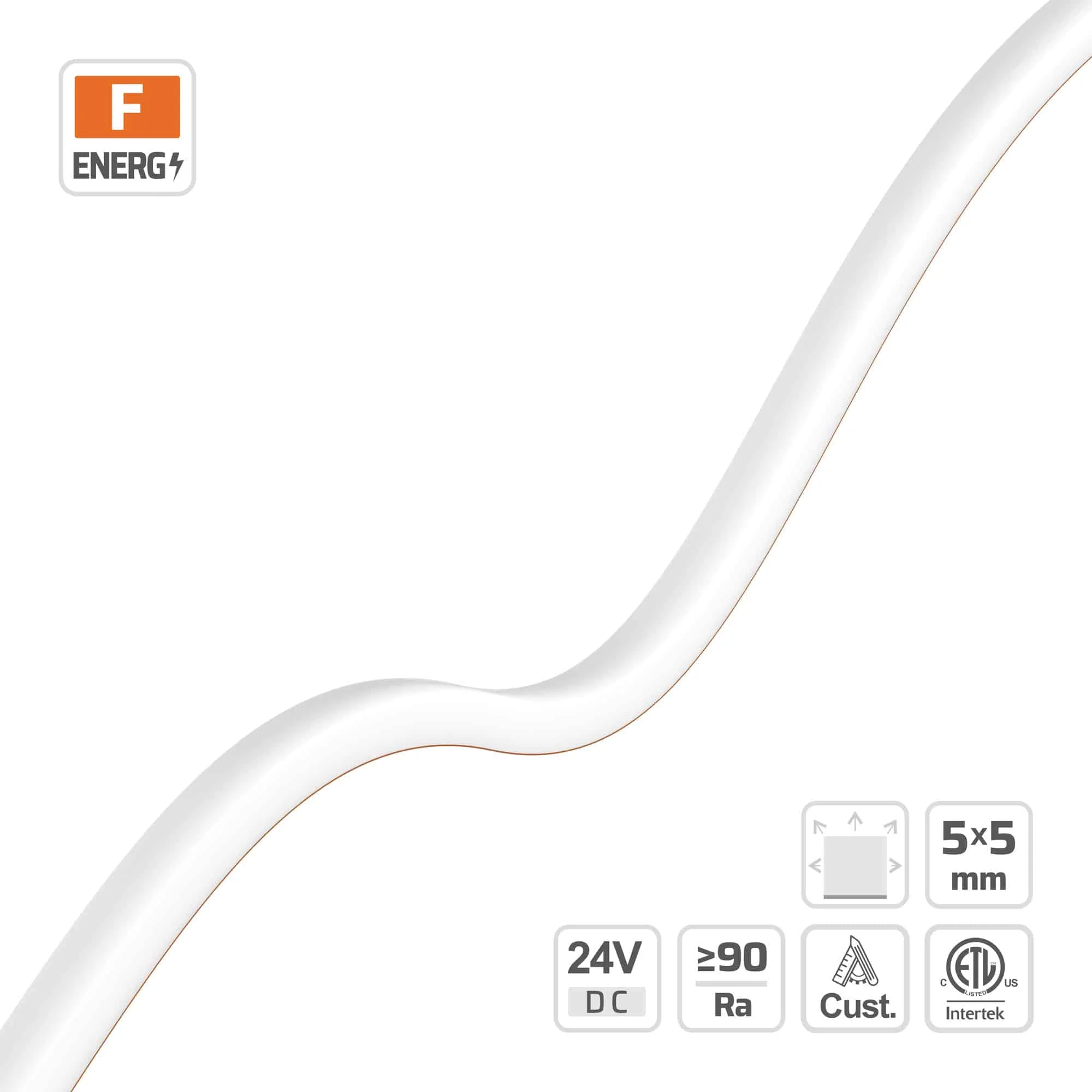
LED Type: SOB · LED Density: 420 LEDs/m · CCT: 1800–6500K · CRI: Ra≥90 · Voltage: 24V · Power: 3.6~15W · Cutting Unit: 7LEDs/16.66mm · PCB Width: 5mm · Copper Foil: 2oz · Circuit Type: CV · IP Rating: IP67
Other Neon LED Strip series
How Mini LED neon flex performs on site
Specification notes for this section low-voltage DC silicone neon: what it does outdoors, what it does around water, and how far it bends when you trace a building.
Outdoor & façade exposure
Specify for permanent exterior installation above the waterline (IP67).
The silicone is injection moulded onto the FPCB in one shot, so there is no glued cover to open up after a winter of thermal cycling — the failure mode PVC neon rope light shows in its second outdoor summer. UV-stabilised silicone keeps its colour instead of yellowing, and the body stays elastic from −30 °C to +80 °C, so a façade run installed in summer will not go brittle in a January frost. Feed with low-voltage DC and plan short runs per feed to hold end-of-run brightness across a long elevation.
- Sealed silicone body
- UV-stable silicone, −30 °C to +80 °C
- Low thermal load
Pools, spas & wet areas
Suitable for pool surrounds, spa ceilings and steam-adjacent joinery — not for submersion.
IP67 covers rain, splash, wash-down and steam — pool decks, shower reveals, sauna ceilings and spa coves — but the body is not intended to sit under water. Mount it above the waterline in an aluminium groove so condensate drains away from the feed joint, run low-voltage DC for wet-zone safety, and choose the IP68 variant where the channel can flood.
- IP67 — splash and rain, not submersion
- low-voltage DC
- Moulded end cap and feed joint
Architectural contour & signage
Bends in the direction of its slim axis at very tight radii — the right pick for small signage letters, cabinet reveals, model displays and shallow niches.
Mini LED neon flex takes its curve in the direction of its slim axis, which is what decides whether a shape is possible without cutting and re-soldering. At very tight radii the outside of the curve stays evenly lit: the LED pitch is matched to the diffuser depth so you read a continuous line of light rather than dots, even at 30 cm. Printed cut marks with indexed solder pads underneath let a sign maker shorten a letter stroke on site and re-seal it, and mounting clips, aluminium grooves and moulded bend grooves cover surface, recessed and free-form fixing.
- Compact silicone body
- Bend radius very tight radii
- Dot-free diffusion
Mini LED Neon Flex — Buyer Questions
How small can a mini LED neon flex be?
DENO's mini neon range starts at a 5×5 mm cross-section and runs through 4×10 mm, 6×12 mm and 6×13 mm bodies. At 5×5 mm the body is slim enough to follow the inside radius of a 60 mm channel letter, which is where standard 12×20 mm neon simply will not sit.
- Related series LED neon flex cross-section overview
- Related series ultra narrow LED strip boards
- Product 16416-5*5 5×5 mm mini neon flex
Is mini neon flex 24V or 12V?
24V is the default for mini neon flex 24V builds: the same wattage draws half the current, so a 5 mm-wide FPCB does not overheat and a single feed still covers 5 m. 12V mini bodies exist for vehicle, furniture and battery work where the supply is fixed, at the cost of shorter runs and tighter power-injection spacing.
- Guide compare 12V and 24V drop on a mini run
- Related series constant current boards for even brightness
How bright is an ultra thin neon flex compared with a full-size body?
A 5×5 mm mini body typically delivers 240–420 LEDs/m at 3.6–8 W/m, roughly 60–70% of the output of a 12×20 mm body, because the emitting window is narrower. For signage that is usually a benefit: the line reads crisp rather than blown out, and the lower wattage keeps the small silicone section within its thermal limit.
- Related series high density boards behind mini neon
- Related series high efficiency builds at low wattage
Which mini neon flex size suits signage letters?
Letters 60–100 mm deep take 5×5 mm or 4×10 mm bodies; 100–150 mm letters take 6×12 mm or 6×13 mm. Match the emitting window to the face aperture, then keep at least 15 mm of diffusion depth so the LEDs blend. Mini neon flex for signage is normally supplied pre-cut per letter with wire leads exiting the back.
- Related series top bend bodies for vertical letter strokes
- Guide batch pre-cut neon kits for sign makers
Can a narrow neon strip still be cut on site?
Yes, but the cut unit gets longer as the body gets smaller: a 5×5 mm mini neon at 420 LEDs/m cuts every 16.66 mm, while lower-density mini bodies cut every 50 mm. The pads are printed on the silicone so an installer can find them without stripping the body back.
- Related series micro-cut boards for short increments
- Guide ask for a factory cut list
Is mini neon flex available waterproof?
Yes — the mini range is injection-moulded in the same IP67 process as the full-size bodies, with IP68 available for immersion. That means an exterior channel letter or a handrail detail can use the same 5×5 mm body indoors and out, with only the termination specification changing.
- Related series injection moulded waterproof bodies
- Guide IP test certification