2110 High Density Ultra-Narrow PU LED Strip Light (#9677-PU)
6mm · 24V · 350LEDs · 20mm/cut
Model: 9677-PU
Overview
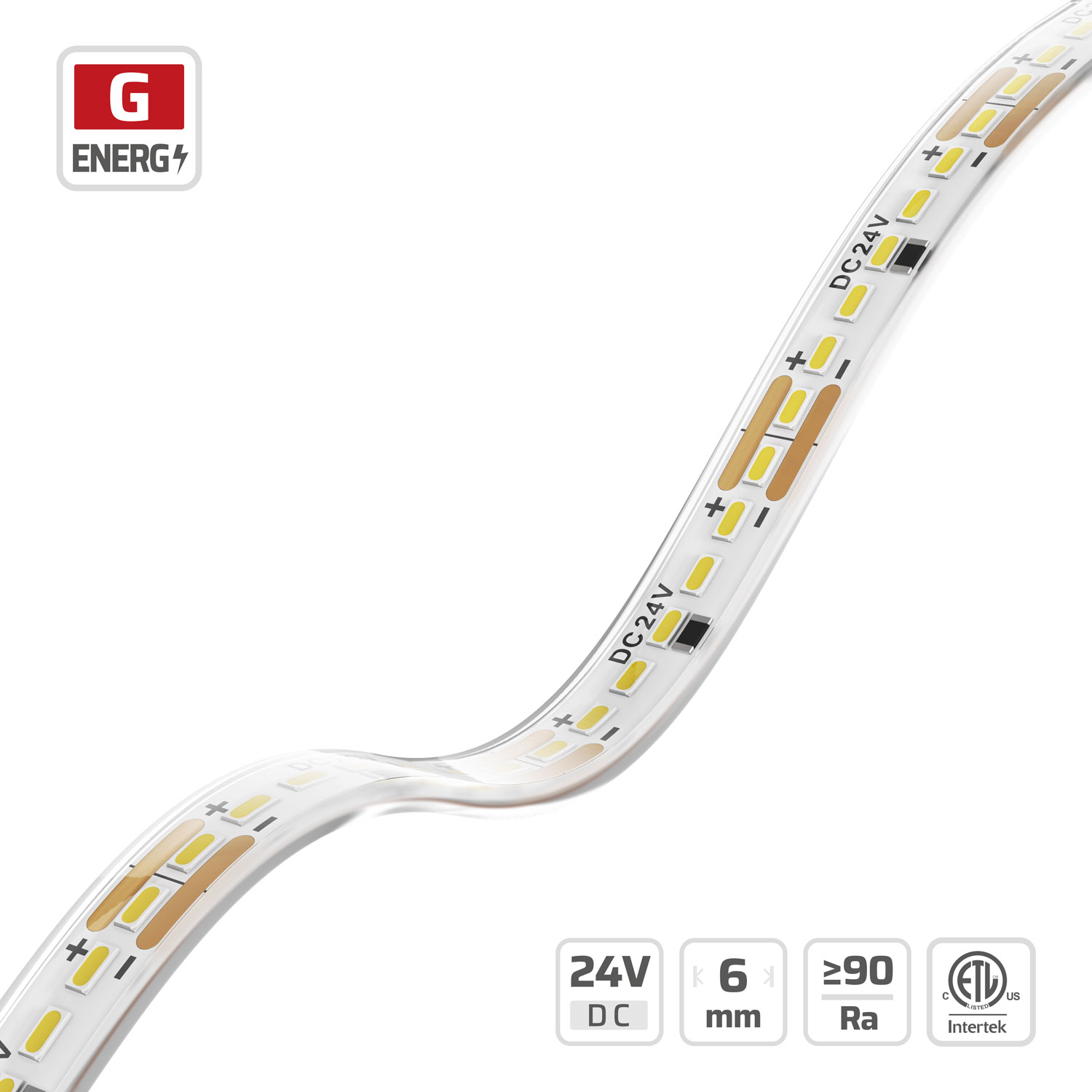
6mm | 24V | 350LEDs | 20mm/cut | #9677-PU | 2110 high density Ultra-Narrow PU LED Strip Light is part of the DENO Ultra-Narrow SMD Strips series, engineered around ultra narrow LED strip. Key specifications: 2110, 350 LEDs/m, 24V, 4mm PCB, 3oz copper FPCB, cuttable 7LEDs/20mm. Every reel is produced on DENO's roll-to-roll line with 99.9% pure copper FPCB and ships CE, UL and RoHS compliant for architectural, retail and hospitality projects. OEM and ODM configurations of length, colour temperature and waterproofing are available on request.
Description
Engineered with 350 2110 SMD LEDs per meter, this high density PU LED strip light delivers continuous linear illumination along an ultra-narrow 6mm profile. Operating on a 24V constant voltage circuit, the strip features precise 20mm cutting increments and smooth dimming for demanding architectural lighting projects. Solid polyurethane encapsulation provides complete ingress sealing while resisting ultraviolet degradation across operating temperatures ranging from minus 25 to 40 degrees Celsius. A heavy 3oz copper foil PCB ensures dependable thermal management and reliable power distribution across continuous runs up to 5 meters. Available for wholesale project supply with OEM custom lengths, this narrow flexible fixture is ideal for exterior facade lighting and landscape illumination.
Marine Grade Led Strip built for marine grade smd strips projects.
Specifications
| CRI | Ra≥90 / Ra≥95 |
|---|---|
| LED QTY | 350 LEDs/m |
| PART NO | DL-F21D175V24-9677-* |
| SMD TYPE | 2110 |
| CUTTABLE UNIT | 7LEDs/20mm |
| DIMMABLE | Yes |
| IP RATING | IP68 |
| LED PITCH | 2.8mm |
| PCB WIDTH | 4mm |
| BEAM ANGLE | 120° |
| RUN LENGTH | 5M |
| COPPER FOIL | 3oz |
| ON OFF TIMES | 10000 (test times) |
| POWER RANGE | 3~12W |
| CIRCUIT TYPE | C.V. |
| INPUT VOLTAGE | 24V |
| LUMINOUS FLUX | 505 lm/m @4000K |
| MIN BEND DIAMETER | Φ60mm |
| OPERATING TEMPERATURE | -25~40°C;Tc:75°C(max) |
Applications
- Cove, wall-wash & perimeter lighting — Coves, recesses, wall-wash details and ceiling perimeters where a continuous, uniform line of light is required.
- Showroom & hospitality display lighting — Shelving, display cases, reception desks and signage backlighting in shops, showrooms and hospitality spaces.
- Kitchen & wardrobe under-cabinet lighting — Kitchen, wardrobe and furniture task lighting where the strip stays hidden and only the light is seen.
- Facade, landscape & bathroom runs (IP68) — IP68 sealing suits facades, landscape lighting, bathrooms and other locations exposed to rain, splashing or wash-down cleaning.
- Ultra-narrow 4mm channels & shadow gaps — Fits shadow-gap details, slim profiles and joinery grooves that cannot take a standard 8–10mm strip.
Recommended accessories & compatible parts
- DL-0809HX-F — 8.89x7.79mm Mini Recessed LED Channel with Flange — Trimless Aluminum Profile for 5mm Strip: Accepts LED strips up to 5mm wide.
- DL-0909HX-M — 9x9mm Magnetic LED Channel — Tool-Free Aluminum Profile for Shelf Lighting: Accepts LED strips up to 5mm wide.
- DL-1010HX-V — 10x10mm V Shape Corner LED Channel — 45 Degree Aluminum Profile for Cabinets: Accepts LED strips up to 5mm wide.
- DN-PSU-100 — 24V 100W Class-2 LED Driver · High Efficiency: Matches the 24V DC input of this strip; size the driver with at least 20% headroom over total load.
- DN-PSU-150 — 24V 150W Class-2 LED Driver · Premium: Matches the 24V DC input of this strip; size the driver with at least 20% headroom over total load.
- DN-PSU-60 — 24V 60W Class-2 LED Driver · Constant Voltage: Matches the 24V DC input of this strip; size the driver with at least 20% headroom over total load.
- V1 — 5-36VDC 1-Channel * 8A RF+Push Dimming Controller | V1: Matched by input voltage range and colour channels.
Request a quotation for #9677-PU
DENO LED is a Shenzhen-based LED strip manufacturer with its own Foshan production base. Send the run length, voltage, CCT/CRI and IP rating you need and our engineering team replies with a specification sheet, wiring plan and price — OEM/ODM and fully custom builds included.
- Warranty: 5 years
- Lead time: standard boards: samples from 1 working day · custom: 3–5 working days · new FPCB: 1–3 weeks · production 1–2 weeks after sample approval
- Compliance: CE · UL · RoHS
- Bonding wire: 99.99% pure gold
- Copper foil: 99.9% pure copper FPCB
Photometric Performance — CCT × CRI Efficacy Matrix
Peak measured luminous efficacy: 67.3 lm/W at 4000K, Ra 90, ErP energy class G (Grade DL (2nd Tier) · 4.8W/m).
All values are measured at the stated power density and ambient 25 °C, reported as luminous efficacy in lumens per watt (lm/W), luminous flux per metre (lm/m) and the corresponding EU ErP (2019/2015) energy class.
Grade DL (2nd Tier) · 4.8W/m
| CCT (K) | Ra 80 — Luminous Efficacy (lm/W) | Ra 80 — Luminous Flux (lm/m) | Ra 80 — ErP Energy Class | Ra 90 — Luminous Efficacy (lm/W) | Ra 90 — Luminous Flux (lm/m) | Ra 90 — ErP Energy Class | Full Spectrum (Ra 95+) — Luminous Efficacy (lm/W) | Full Spectrum (Ra 95+) — Luminous Flux (lm/m) | Full Spectrum (Ra 95+) — ErP Energy Class |
|---|---|---|---|---|---|---|---|---|---|
| 1800 K | — | — | — | 50.9 lm/W | 244.3 lm/m | G | — | — | — |
| 2300 K | — | — | — | 56.7 lm/W | 272.3 lm/m | G | 45.9 lm/W | 220.2 lm/m | G |
| 2700 K | — | — | — | 61.3 lm/W | 294.4 lm/m | G | 49.8 lm/W | 238.9 lm/m | G |
| 3000 K | — | — | — | 64.6 lm/W | 310.1 lm/m | G | 52.5 lm/W | 252.1 lm/m | G |
| 3500 K | — | — | — | 65.7 lm/W | 315.5 lm/m | G | 54.1 lm/W | 259.5 lm/m | G |
| 4000 K | — | — | — | 67.3 lm/W | 322.9 lm/m | G | 55.6 lm/W | 266.9 lm/m | G |
| 5000 K | — | — | — | 67.3 lm/W | 322.9 lm/m | G | 55.7 lm/W | 267.4 lm/m | G |
| 6500 K | — | — | — | 64.5 lm/W | 309.6 lm/m | G | 53.5 lm/W | 257 lm/m | G |
Grade DL (2nd Tier) · 7.2W/m
| CCT (K) | Ra 80 — Luminous Efficacy (lm/W) | Ra 80 — Luminous Flux (lm/m) | Ra 80 — ErP Energy Class | Ra 90 — Luminous Efficacy (lm/W) | Ra 90 — Luminous Flux (lm/m) | Ra 90 — ErP Energy Class | Full Spectrum (Ra 95+) — Luminous Efficacy (lm/W) | Full Spectrum (Ra 95+) — Luminous Flux (lm/m) | Full Spectrum (Ra 95+) — ErP Energy Class |
|---|---|---|---|---|---|---|---|---|---|
| 1800 K | — | — | — | 50 lm/W | 360.3 lm/m | G | — | — | — |
| 2300 K | — | — | — | 55.8 lm/W | 401.6 lm/m | G | 45.1 lm/W | 324.7 lm/m | G |
| 2700 K | — | — | — | 60.3 lm/W | 434.2 lm/m | G | 48.9 lm/W | 352.3 lm/m | G |
| 3000 K | — | — | — | 63.5 lm/W | 457.4 lm/m | G | 51.6 lm/W | 371.9 lm/m | G |
| 3500 K | — | — | — | 64.6 lm/W | 465.4 lm/m | G | 53.2 lm/W | 382.7 lm/m | G |
| 4000 K | — | — | — | 66.1 lm/W | 476.2 lm/m | G | 54.7 lm/W | 393.6 lm/m | G |
| 5000 K | — | — | — | 66.1 lm/W | 476.2 lm/m | G | 54.8 lm/W | 394.3 lm/m | G |
| 6500 K | — | — | — | 63.4 lm/W | 456.7 lm/m | G | 52.7 lm/W | 379.1 lm/m | G |
Grade DL (2nd Tier) · 9.6W/m
| CCT (K) | Ra 80 — Luminous Efficacy (lm/W) | Ra 80 — Luminous Flux (lm/m) | Ra 80 — ErP Energy Class | Ra 90 — Luminous Efficacy (lm/W) | Ra 90 — Luminous Flux (lm/m) | Ra 90 — ErP Energy Class | Full Spectrum (Ra 95+) — Luminous Efficacy (lm/W) | Full Spectrum (Ra 95+) — Luminous Flux (lm/m) | Full Spectrum (Ra 95+) — ErP Energy Class |
|---|---|---|---|---|---|---|---|---|---|
| 1800 K | — | — | — | 49.2 lm/W | 472.3 lm/m | G | — | — | — |
| 2300 K | — | — | — | 54.8 lm/W | 526.5 lm/m | G | 44.3 lm/W | 425.8 lm/m | G |
| 2700 K | — | — | — | 59.3 lm/W | 569.3 lm/m | G | 48.1 lm/W | 461.9 lm/m | G |
| 3000 K | — | — | — | 62.5 lm/W | 599.7 lm/m | G | 50.8 lm/W | 487.5 lm/m | G |
| 3500 K | — | — | — | 63.6 lm/W | 610.1 lm/m | G | 52.3 lm/W | 501.8 lm/m | G |
| 4000 K | — | — | — | 65 lm/W | 624.4 lm/m | G | 53.8 lm/W | 516 lm/m | G |
| 5000 K | — | — | — | 65 lm/W | 624.4 lm/m | G | 53.9 lm/W | 517 lm/m | G |
| 6500 K | — | — | — | 62.4 lm/W | 598.7 lm/m | G | 51.8 lm/W | 497 lm/m | G |
Recommended LED Channels
Mount this LED strip in a DENO LED aluminum profile for heat dissipation, physical protection and diffused, dot-free output.
This strip is 4mm wide, so it needs a channel with at least 6mm inner width (4mm + 2mm clearance). Every profile below meets that.
Related models in this series
- 2110 Classic LED Strip Light (#6014)
- 2110 Micro-Cut High Density LED Strip Light (#8651)
- 2110 High Density LED Strip Light (#6016)
- 2110 High Lumen High Density Multi-Line LED Strip Light (#3702)
- 2110 Classic LED Strip Light (#5572)
- 2110 High Density LED Strip Light (#8734)
- 2110 High Density PU LED Strip Light (#5379-PU)
- 2110 High Density PU LED Strip Light (#5991-PU)
See every model in SMD LED Strip Series or narrow to 2110. Compare wattage, lumen output and run length in the ProCalc parameter library, or request OEM/ODM pricing on the custom manufacturing page.
Frequently Asked Questions
What are the key specifications of 9677-PU?
9677-PU: 2110, 350 LEDs/m, 24V, 4mm PCB, 3oz copper FPCB, cuttable 7LEDs/20mm. Full photometric data, wiring diagrams and test reports are available in the downloads section of this page.
How long can a single run of this ultra narrow LED strip be?
Maximum single run for this model is 5M. Feeding from both ends or using a mid-point tap halves the effective distance per segment, so a ultra narrow LED strip can cover twice that length on one circuit when wired accordingly.
Can DENO customise this ultra narrow LED strip for a project?
Yes. DENO manufactures the Ultra-Narrow SMD Strips series as an OEM and ODM supplier: reel length, colour temperature, CRI grade, PCB width, waterproofing and private labelling can all be specified. Request a quote for lead time and project pricing.
What makes an LED strip marine grade?
Marine LED strip lights need IP67 or IP68 encapsulation, salt-mist resistant coating, tinned copper conductors and UV stable silicone. These boat LED strip lights are built for continuous saltwater spray and vibration rather than the light splash duty a standard waterproof strip is rated for.
How narrow can a thin LED strip be?
DENO builds down to a 3 mm wide FPCB. A 3 mm LED strip fits aluminium channels, cabinet reveals, shelf edges and slim architectural slots where an 8 or 10 mm board cannot be hidden, while still carrying 2 oz copper for stable long runs.
Engineering & selection guide
Bending limits, IP selection, voltage drop, cutting and the full buyer Q&A for this family are kept on the series page.
- High Density LED Strips series — High Density LED Strip — Buyer Questions
- ultra narrow LED strip series — Ultra Narrow LED Strip — Buyer Questions
- LED strip engineering selection handbook