2018 Silicone Flexible Neon Light (#2018T-EE)
24V · 120LEDs · 50mm/cut · 20*18mm
Model: 2018T-EE
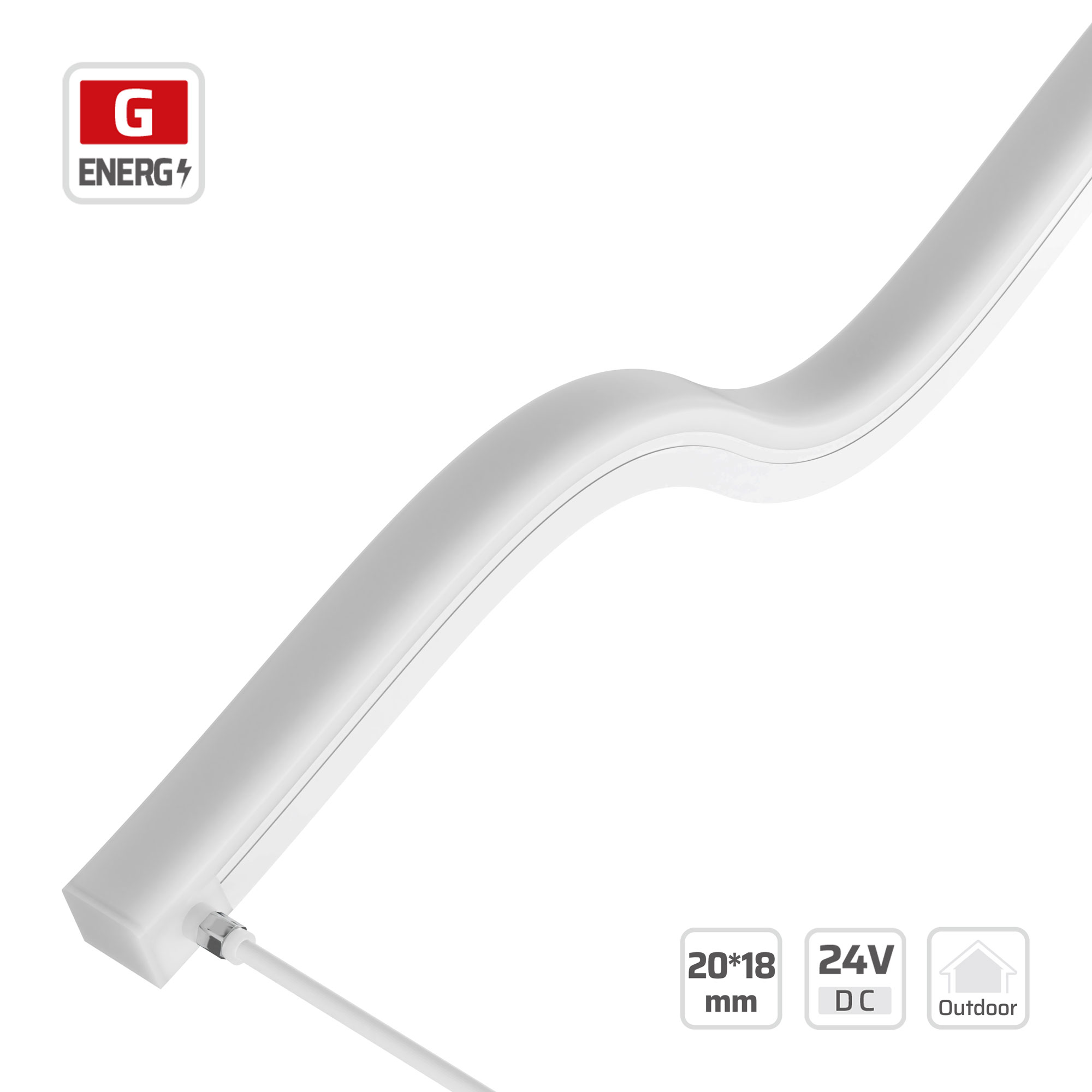
Overview
The DENO LED 2018T-EE is a high-performance 20x18mm silicone flexible neon light designed for demanding B2B applications. Featuring 120 LEDs per meter and a 24V input, it ensures uniform light distribution with no dark zones. Its robust silicone injection-moulded construction provides full encapsulation against salt, water, UV, abrasion, and chemicals, guaranteeing long-term stability and color integrity. With multi-angle bending capabilities, it is perfect for architectura...
Description
Premium 20x18mm silicone flexible neon light features full encapsulation, providing high resistance against salt, water, UV rays, abrasion, and chemical corrosion. Engineered with 120 SMD 2835 LEDs per meter on a 24V constant voltage circuit, delivering uniform light distribution with 50mm cutting increments. High-performance silicone material maintains stable molecular integrity without discoloration, while multi-angle bending performance accommodates intricate shapes and creative contours. Ideal for indoor and outdoor architectural lighting projects, this flexible neon light is available factory-direct for wholesale project supply and OEM customization.
Specifications
| LED QTY | 120 |
|---|---|
| PART NO | DL-NF28C60V24-2018T-EE-* |
| SMD TYPE | 2835 |
| CUTTABLE UNIT | 6LEDs/50mm |
| DIMMABLE | Yes |
| IP RATING | IP67 |
| LED PITCH | 8.334mm |
| LIFESPAN | 30000 |
| PCB WIDTH | 10mm |
| WARRANTY | 5 Years |
| RUN LENGTH | 5m |
| COPPER FOIL | 3oz |
| POWER RANGE | 2.8~28.8W |
| CIRCUIT TYPE | C.V. |
| INPUT VOLTAGE | 24V |
| OPERATING TEMPERATURE | -25~40°C;Tc:75°C(max) |
Applications
- Channel letters & logo signage — Silicone neon holds a continuous glow line for logos, channel letters and wayfinding without visible LED dots.
- Facade & perimeter outlining — Flexible neon bends around building edges, balconies and columns to trace architecture at night.
- Bar fronts, headboards & stair nosings — Used along stair nosings, headboards and bar fronts where a soft, uniform tube of light is wanted instead of a hard strip.
- Facade, landscape & bathroom runs (IP67) — IP67 sealing suits facades, landscape lighting, bathrooms and other locations exposed to rain, splashing or wash-down cleaning.
Request a quotation for #2018T-EE
DENO LED is a Shenzhen-based LED strip manufacturer with its own Foshan production base. Send the run length, voltage, CCT/CRI and IP rating you need and our engineering team replies with a specification sheet, wiring plan and price — OEM/ODM and fully custom builds included.
- Warranty: 5 years
- Lead time: standard boards: samples from 1 working day · custom: 3–5 working days · new FPCB: 1–3 weeks · production 1–2 weeks after sample approval
- Compliance: CE · UL · RoHS
- Bonding wire: 99.99% pure gold
- Copper foil: 99.9% pure copper FPCB
Photometric Performance — CCT × CRI Efficacy Matrix
Peak measured luminous efficacy: 89 lm/W at 4000K, Ra 80, ErP energy class G (Grade DN (1st Tier) · 9.6W/m).
All values are measured at the stated power density and ambient 25 °C, reported as luminous efficacy in lumens per watt (lm/W), luminous flux per metre (lm/m) and the corresponding EU ErP (2019/2015) energy class.
Grade DL (2nd Tier) · 9.6W/m
| CCT (K) | Ra 80 — Luminous Efficacy (lm/W) | Ra 80 — Luminous Flux (lm/m) | Ra 80 — ErP Energy Class | Ra 90 — Luminous Efficacy (lm/W) | Ra 90 — Luminous Flux (lm/m) | Ra 90 — ErP Energy Class | Full Spectrum (Ra 95+) — Luminous Efficacy (lm/W) | Full Spectrum (Ra 95+) — Luminous Flux (lm/m) | Full Spectrum (Ra 95+) — ErP Energy Class |
|---|---|---|---|---|---|---|---|---|---|
| 1800 K | 55.8 lm/W | 536 lm/m | G | 44.1 lm/W | 423.5 lm/m | G | — | — | — |
| 2300 K | 62.1 lm/W | 595.7 lm/m | G | 49.1 lm/W | 471.5 lm/m | G | 39.9 lm/W | 383.2 lm/m | G |
| 2700 K | 64.1 lm/W | 615.3 lm/m | G | 53.2 lm/W | 510.6 lm/m | G | 43.1 lm/W | 413.8 lm/m | G |
| 3000 K | 69.8 lm/W | 670.1 lm/m | G | 55.9 lm/W | 537 lm/m | G | 45.4 lm/W | 436.3 lm/m | G |
| 3500 K | 71 lm/W | 681.8 lm/m | G | 57 lm/W | 546.8 lm/m | G | 46.9 lm/W | 450 lm/m | G |
| 4000 K | 73.3 lm/W | 703.3 lm/m | G | 58.3 lm/W | 559.5 lm/m | G | 48.1 lm/W | 461.7 lm/m | G |
| 5000 K | 73.3 lm/W | 703.3 lm/m | G | 58.3 lm/W | 559.5 lm/m | G | 47.6 lm/W | 457.1 lm/m | G |
| 6500 K | 66.3 lm/W | 636.8 lm/m | G | 55.9 lm/W | 537 lm/m | G | 46.2 lm/W | 443.2 lm/m | G |
Grade DL (2nd Tier) · 12W/m
| CCT (K) | Ra 80 — Luminous Efficacy (lm/W) | Ra 80 — Luminous Flux (lm/m) | Ra 80 — ErP Energy Class | Ra 90 — Luminous Efficacy (lm/W) | Ra 90 — Luminous Flux (lm/m) | Ra 90 — ErP Energy Class | Full Spectrum (Ra 95+) — Luminous Efficacy (lm/W) | Full Spectrum (Ra 95+) — Luminous Flux (lm/m) | Full Spectrum (Ra 95+) — ErP Energy Class |
|---|---|---|---|---|---|---|---|---|---|
| 1800 K | 54.9 lm/W | 658.8 lm/m | G | 43.4 lm/W | 520.6 lm/m | G | — | — | — |
| 2300 K | 61 lm/W | 732.2 lm/m | G | 48.3 lm/W | 579.5 lm/m | G | 39.3 lm/W | 471 lm/m | G |
| 2700 K | 63 lm/W | 756.2 lm/m | G | 52.3 lm/W | 627.6 lm/m | G | 42.4 lm/W | 508.6 lm/m | G |
| 3000 K | 68.6 lm/W | 823.6 lm/m | G | 55 lm/W | 660.1 lm/m | G | 44.7 lm/W | 536.2 lm/m | G |
| 3500 K | 69.8 lm/W | 838 lm/m | G | 56 lm/W | 672.1 lm/m | G | 46.1 lm/W | 553 lm/m | G |
| 4000 K | 72 lm/W | 864.4 lm/m | G | 57.3 lm/W | 687.7 lm/m | G | 47.3 lm/W | 567.5 lm/m | G |
| 5000 K | 72 lm/W | 864.4 lm/m | G | 57.3 lm/W | 687.7 lm/m | G | 46.8 lm/W | 561.8 lm/m | G |
| 6500 K | 65.2 lm/W | 782.7 lm/m | G | 55 lm/W | 660.1 lm/m | G | 45.4 lm/W | 544.8 lm/m | G |
Grade DL (2nd Tier) · 19.2W/m
| CCT (K) | Ra 80 — Luminous Efficacy (lm/W) | Ra 80 — Luminous Flux (lm/m) | Ra 80 — ErP Energy Class | Ra 90 — Luminous Efficacy (lm/W) | Ra 90 — Luminous Flux (lm/m) | Ra 90 — ErP Energy Class | Full Spectrum (Ra 95+) — Luminous Efficacy (lm/W) | Full Spectrum (Ra 95+) — Luminous Flux (lm/m) | Full Spectrum (Ra 95+) — ErP Energy Class |
|---|---|---|---|---|---|---|---|---|---|
| 1800 K | 52.2 lm/W | 1002.2 lm/m | G | 41.2 lm/W | 791.9 lm/m | G | — | — | — |
| 2300 K | 58 lm/W | 1113.7 lm/m | G | 45.9 lm/W | 881.5 lm/m | G | 37.3 lm/W | 716.4 lm/m | G |
| 2700 K | 59.9 lm/W | 1150.3 lm/m | G | 49.7 lm/W | 954.6 lm/m | G | 40.3 lm/W | 773.6 lm/m | G |
| 3000 K | 65.2 lm/W | 1252.7 lm/m | G | 52.3 lm/W | 1004 lm/m | G | 42.5 lm/W | 815.6 lm/m | G |
| 3500 K | 66.4 lm/W | 1274.7 lm/m | G | 53.2 lm/W | 1022.3 lm/m | G | 43.8 lm/W | 841.2 lm/m | G |
| 4000 K | 68.5 lm/W | 1314.9 lm/m | G | 54.5 lm/W | 1046.1 lm/m | G | 45 lm/W | 863.2 lm/m | G |
| 5000 K | 68.5 lm/W | 1314.9 lm/m | G | 54.5 lm/W | 1046.1 lm/m | G | 44.5 lm/W | 854.5 lm/m | G |
| 6500 K | 62 lm/W | 1190.5 lm/m | G | 52.3 lm/W | 1004 lm/m | G | 43.2 lm/W | 828.7 lm/m | G |
Grade DN (1st Tier) · 9.6W/m
| CCT (K) | Ra 80 — Luminous Efficacy (lm/W) | Ra 80 — Luminous Flux (lm/m) | Ra 80 — ErP Energy Class | Ra 90 — Luminous Efficacy (lm/W) | Ra 90 — Luminous Flux (lm/m) | Ra 90 — ErP Energy Class | Full Spectrum (Ra 95+) — Luminous Efficacy (lm/W) | Full Spectrum (Ra 95+) — Luminous Flux (lm/m) | Full Spectrum (Ra 95+) — ErP Energy Class |
|---|---|---|---|---|---|---|---|---|---|
| 1800 K | 69.7 lm/W | 669.1 lm/m | G | 58.2 lm/W | 558.5 lm/m | G | — | — | — |
| 2300 K | 76 lm/W | 729.7 lm/m | G | 64.9 lm/W | 623.1 lm/m | G | 52.3 lm/W | 501.7 lm/m | G |
| 2700 K | 81.9 lm/W | 786.5 lm/m | G | 70.2 lm/W | 674 lm/m | G | 57 lm/W | 546.8 lm/m | G |
| 3000 K | 86.1 lm/W | 826.6 lm/m | G | 74.3 lm/W | 713.1 lm/m | G | 60.4 lm/W | 580.1 lm/m | G |
| 3500 K | 87.3 lm/W | 838.3 lm/m | G | 75.9 lm/W | 728.7 lm/m | G | 62.5 lm/W | 599.6 lm/m | G |
| 4000 K | 89 lm/W | 853.9 lm/m | G | 76.3 lm/W | 732.7 lm/m | G | 63 lm/W | 604.5 lm/m | G |
| 5000 K | 88.9 lm/W | 853 lm/m | G | 76.8 lm/W | 737.5 lm/m | G | 62.3 lm/W | 598.5 lm/m | G |
| 6500 K | 85.2 lm/W | 817.8 lm/m | G | 73.4 lm/W | 704.3 lm/m | G | 60.5 lm/W | 580.3 lm/m | G |
Grade DN (1st Tier) · 12W/m
| CCT (K) | Ra 80 — Luminous Efficacy (lm/W) | Ra 80 — Luminous Flux (lm/m) | Ra 80 — ErP Energy Class | Ra 90 — Luminous Efficacy (lm/W) | Ra 90 — Luminous Flux (lm/m) | Ra 90 — ErP Energy Class | Full Spectrum (Ra 95+) — Luminous Efficacy (lm/W) | Full Spectrum (Ra 95+) — Luminous Flux (lm/m) | Full Spectrum (Ra 95+) — ErP Energy Class |
|---|---|---|---|---|---|---|---|---|---|
| 1800 K | 68.5 lm/W | 822.4 lm/m | G | 57.2 lm/W | 686.5 lm/m | G | — | — | — |
| 2300 K | 74.7 lm/W | 896.9 lm/m | G | 63.8 lm/W | 765.9 lm/m | G | 51.4 lm/W | 616.7 lm/m | G |
| 2700 K | 80.6 lm/W | 966.6 lm/m | G | 69 lm/W | 828.4 lm/m | G | 56 lm/W | 672.1 lm/m | G |
| 3000 K | 84.7 lm/W | 1015.9 lm/m | G | 73 lm/W | 876.5 lm/m | G | 59.4 lm/W | 713 lm/m | G |
| 3500 K | 85.9 lm/W | 1030.4 lm/m | G | 74.6 lm/W | 895.7 lm/m | G | 61.4 lm/W | 737 lm/m | G |
| 4000 K | 87.5 lm/W | 1049.6 lm/m | G | 75 lm/W | 900.5 lm/m | G | 61.9 lm/W | 743 lm/m | G |
| 5000 K | 87.4 lm/W | 1048.4 lm/m | G | 75.5 lm/W | 906.5 lm/m | G | 61.3 lm/W | 735.6 lm/m | G |
| 6500 K | 83.8 lm/W | 1005.1 lm/m | G | 72.1 lm/W | 865.6 lm/m | G | 59.4 lm/W | 713.3 lm/m | G |
Grade DN (1st Tier) · 19.2W/m
| CCT (K) | Ra 80 — Luminous Efficacy (lm/W) | Ra 80 — Luminous Flux (lm/m) | Ra 80 — ErP Energy Class | Ra 90 — Luminous Efficacy (lm/W) | Ra 90 — Luminous Flux (lm/m) | Ra 90 — ErP Energy Class | Full Spectrum (Ra 95+) — Luminous Efficacy (lm/W) | Full Spectrum (Ra 95+) — Luminous Flux (lm/m) | Full Spectrum (Ra 95+) — ErP Energy Class |
|---|---|---|---|---|---|---|---|---|---|
| 1800 K | 65.1 lm/W | 1250.9 lm/m | G | 54.4 lm/W | 1044.2 lm/m | G | — | — | — |
| 2300 K | 71.1 lm/W | 1364.3 lm/m | G | 60.7 lm/W | 1164.9 lm/m | G | 48.9 lm/W | 938.1 lm/m | G |
| 2700 K | 76.6 lm/W | 1470.3 lm/m | G | 65.6 lm/W | 1260 lm/m | G | 53.2 lm/W | 1022.3 lm/m | G |
| 3000 K | 80.5 lm/W | 1545.3 lm/m | G | 69.4 lm/W | 1333.2 lm/m | G | 56.5 lm/W | 1084.5 lm/m | G |
| 3500 K | 81.6 lm/W | 1567.3 lm/m | G | 71 lm/W | 1362.4 lm/m | G | 58.4 lm/W | 1121 lm/m | G |
| 4000 K | 83.2 lm/W | 1596.5 lm/m | G | 71.3 lm/W | 1369.8 lm/m | G | 58.9 lm/W | 1130.2 lm/m | G |
| 5000 K | 83.1 lm/W | 1594.7 lm/m | G | 71.8 lm/W | 1378.9 lm/m | G | 58.3 lm/W | 1118.9 lm/m | G |
| 6500 K | 79.6 lm/W | 1528.9 lm/m | G | 68.6 lm/W | 1316.7 lm/m | G | 56.5 lm/W | 1085 lm/m | G |
Grade KE (3rd Tier) · 9.6W/m
| CCT (K) | Ra 80 — Luminous Efficacy (lm/W) | Ra 80 — Luminous Flux (lm/m) | Ra 80 — ErP Energy Class | Ra 90 — Luminous Efficacy (lm/W) | Ra 90 — Luminous Flux (lm/m) | Ra 90 — ErP Energy Class | Full Spectrum (Ra 95+) — Luminous Efficacy (lm/W) | Full Spectrum (Ra 95+) — Luminous Flux (lm/m) | Full Spectrum (Ra 95+) — ErP Energy Class |
|---|---|---|---|---|---|---|---|---|---|
| 1900 K | 35.6 lm/W | 341.4 lm/m | G | 27.7 lm/W | 266.1 lm/m | G | — | — | — |
| 2300 K | 39.6 lm/W | 380.5 lm/m | G | 30.9 lm/W | 296.4 lm/m | G | 25.4 lm/W | 243.6 lm/m | G |
| 2700 K | 42.8 lm/W | 410.8 lm/m | G | 33.5 lm/W | 321.8 lm/m | G | 27.1 lm/W | 260.2 lm/m | G |
| 3000 K | 44.9 lm/W | 431.4 lm/m | G | 35.6 lm/W | 341.4 lm/m | G | 28.9 lm/W | 277.8 lm/m | G |
| 3500 K | 45.5 lm/W | 437.2 lm/m | G | 36.3 lm/W | 348.2 lm/m | G | 29.9 lm/W | 286.6 lm/m | G |
| 4000 K | 46.9 lm/W | 450 lm/m | G | 37.1 lm/W | 356.1 lm/m | G | 30.6 lm/W | 293.5 lm/m | G |
| 5000 K | 46.9 lm/W | 450 lm/m | G | 37.1 lm/W | 356.1 lm/m | G | 30.3 lm/W | 290.5 lm/m | G |
| 6500 K | 44.9 lm/W | 431.4 lm/m | G | 35.6 lm/W | 341.4 lm/m | G | 29.3 lm/W | 281.7 lm/m | G |
Grade KE (3rd Tier) · 12W/m
| CCT (K) | Ra 80 — Luminous Efficacy (lm/W) | Ra 80 — Luminous Flux (lm/m) | Ra 80 — ErP Energy Class | Ra 90 — Luminous Efficacy (lm/W) | Ra 90 — Luminous Flux (lm/m) | Ra 90 — ErP Energy Class | Full Spectrum (Ra 95+) — Luminous Efficacy (lm/W) | Full Spectrum (Ra 95+) — Luminous Flux (lm/m) | Full Spectrum (Ra 95+) — ErP Energy Class |
|---|---|---|---|---|---|---|---|---|---|
| 1900 K | 35 lm/W | 419.6 lm/m | G | 27.3 lm/W | 327 lm/m | G | — | — | — |
| 2300 K | 39 lm/W | 467.7 lm/m | G | 30.4 lm/W | 364.3 lm/m | G | 24.9 lm/W | 299.4 lm/m | G |
| 2700 K | 42.1 lm/W | 505 lm/m | G | 33 lm/W | 395.5 lm/m | G | 26.7 lm/W | 319.8 lm/m | G |
| 3000 K | 44.2 lm/W | 530.2 lm/m | G | 35 lm/W | 419.6 lm/m | G | 28.5 lm/W | 341.4 lm/m | G |
| 3500 K | 44.8 lm/W | 537.4 lm/m | G | 35.7 lm/W | 428 lm/m | G | 29.4 lm/W | 352.3 lm/m | G |
| 4000 K | 46.1 lm/W | 553 lm/m | G | 36.5 lm/W | 437.6 lm/m | G | 30.1 lm/W | 360.7 lm/m | G |
| 5000 K | 46.1 lm/W | 553 lm/m | G | 36.5 lm/W | 437.6 lm/m | G | 29.8 lm/W | 357.1 lm/m | G |
| 6500 K | 44.2 lm/W | 530.2 lm/m | G | 35 lm/W | 419.6 lm/m | G | 28.9 lm/W | 346.3 lm/m | G |
Grade KE (3rd Tier) · 19.2W/m
| CCT (K) | Ra 80 — Luminous Efficacy (lm/W) | Ra 80 — Luminous Flux (lm/m) | Ra 80 — ErP Energy Class | Ra 90 — Luminous Efficacy (lm/W) | Ra 90 — Luminous Flux (lm/m) | Ra 90 — ErP Energy Class | Full Spectrum (Ra 95+) — Luminous Efficacy (lm/W) | Full Spectrum (Ra 95+) — Luminous Flux (lm/m) | Full Spectrum (Ra 95+) — ErP Energy Class |
|---|---|---|---|---|---|---|---|---|---|
| 1900 K | 33.2 lm/W | 638.2 lm/m | G | 25.9 lm/W | 497.4 lm/m | G | — | — | — |
| 2300 K | 37.1 lm/W | 711.4 lm/m | G | 28.9 lm/W | 554.1 lm/m | G | 23.7 lm/W | 455.4 lm/m | G |
| 2700 K | 40 lm/W | 768.1 lm/m | G | 31.3 lm/W | 601.7 lm/m | G | 25.3 lm/W | 486.5 lm/m | G |
| 3000 K | 42 lm/W | 806.5 lm/m | G | 33.2 lm/W | 638.2 lm/m | G | 27.1 lm/W | 519.4 lm/m | G |
| 3500 K | 42.6 lm/W | 817.5 lm/m | G | 33.9 lm/W | 651 lm/m | G | 27.9 lm/W | 535.8 lm/m | G |
| 4000 K | 43.8 lm/W | 841.2 lm/m | G | 34.7 lm/W | 665.7 lm/m | G | 28.6 lm/W | 548.6 lm/m | G |
| 5000 K | 43.8 lm/W | 841.2 lm/m | G | 34.7 lm/W | 665.7 lm/m | G | 28.3 lm/W | 543.1 lm/m | G |
| 6500 K | 42 lm/W | 806.5 lm/m | G | 33.2 lm/W | 638.2 lm/m | G | 27.4 lm/W | 526.7 lm/m | G |
Frequently Asked Questions
What are the key advantages of this silicone flexible neon light for outdoor use?
Its full silicone encapsulation offers exceptional resistance to salt, water, UV, abrasion, and chemical corrosion, making it highly durable for any outdoor environment.
Is the 2018T-EE model compatible with standard dimming systems?
Yes, the 2018T-EE is designed to be dimmable, allowing for flexible light intensity control to suit various project requirements and atmospheres.
Can the 2018T-EE be easily integrated into complex architectural designs?
Absolutely. Its multi-angle bending performance and 50mm cuttable segments allow for precise shaping, accommodating diverse and creative architectural lighting needs effortlessly.
What are the key specifications of #2018T-EE?
2018 Silicone Flexible Neon Light | 20*18mm | 24V | 120LEDs | 50mm/cut | #2018T-EE: 2835 LEDs, 120, 24V, 10mm FPCB, 3oz copper foil, 2.8~28.8W power, cut unit 6LEDs/50mm. Photometric files, wiring diagrams and test reports are available in the downloads block on this page.
Which LED driver and run length suit #2018T-EE?
2018 Silicone Flexible Neon Light | 20*18mm | 24V | 120LEDs | 50mm/cut | #2018T-EE is a constant-voltage 24V product, so pair it with a CE or UL listed 24V constant-voltage LED driver rated about 20% above the connected load. Maximum single run is 5m. 5m Single / 10m Dual Input power. Feeding from both ends or mid-feeding halves the copper distance and roughly quarters the voltage drop.
Engineering & selection guide
Bending limits, IP selection, voltage drop, cutting and the full buyer Q&A for this family are kept on the series page.
- LED neon flex selection guide — bend direction and radius, IP rating for facade, pool and wet areas, cutting and feed planning
- Top Bend Neon Flex series — Top Bending LED Neon Flex — Buyer Questions
- LED strip engineering selection handbook