16*10mm Glare-free Neon Lights 128LEDs/m (#3015-GF)
10mm · 24V · 128LEDs · 62.5mm/cut
Model: 3015-GF
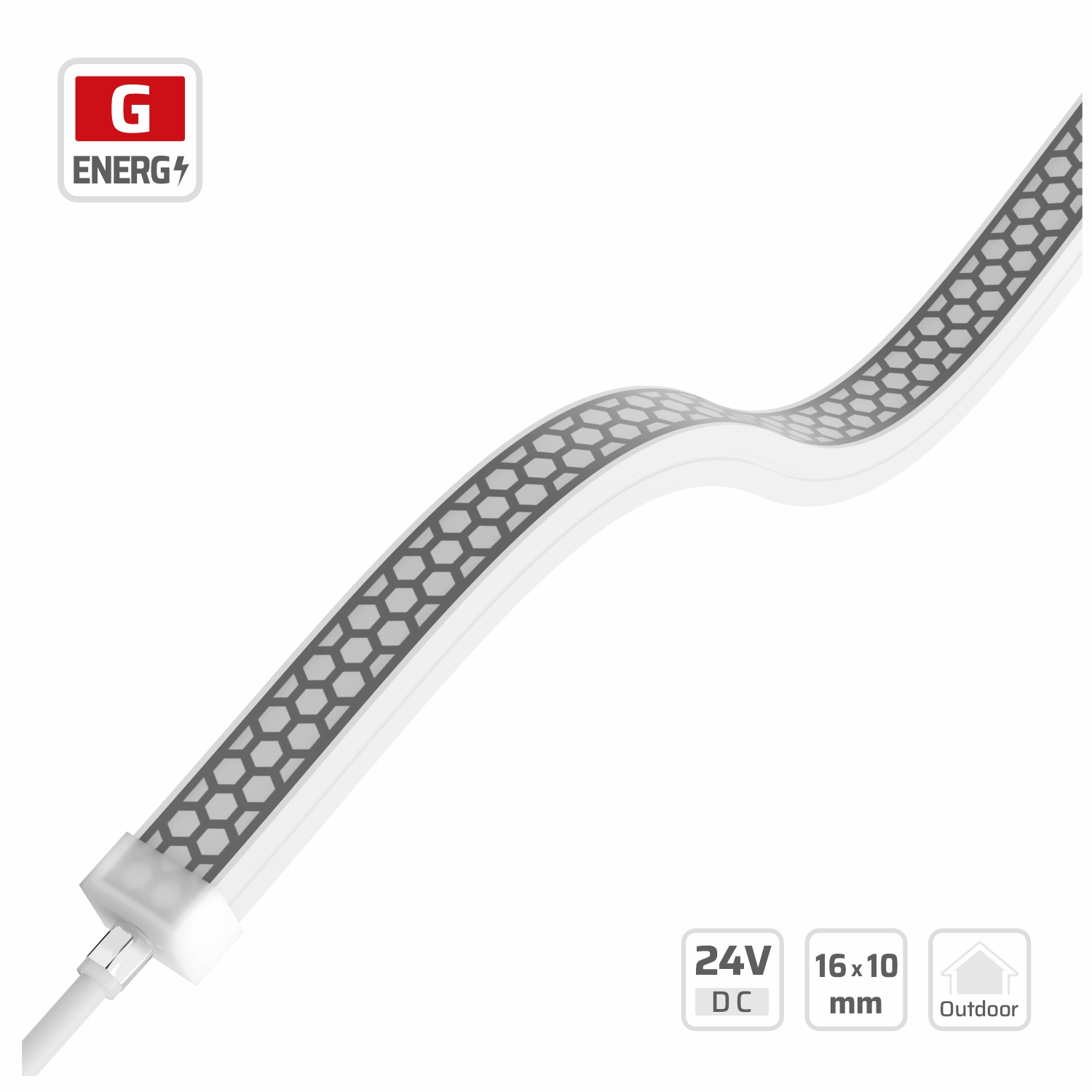
Overview
The DENO LED 3015-GF Glare-free Neon Lights provide an exceptional lighting solution with advanced optics to eliminate harsh glare, ensuring visual comfort in various B2B environments. Featuring a flexible 16x10mm silicone injection-molded design with 128 LEDs/m and a 24V input, these neon lights are ideal for applications where close observation or prolonged viewing is common. They maintain rich colors and flexible shapes, allowing for custom lines and patterns while balan...
Description
16*10mm Glare-free Neon Lights 128LEDs/m | 10mm | 24V | 128LEDs | 62.5mm/cut | #3015-GF 16*10mm silicone injection-moulded design, offering flexibility and durability. Adding micro-prism structures or soft-light coatings to the surface of the lamp tube can disperse the concentrated light beam into multi-angle soft light, reducing the brightness concentration. The light is soft and not glaring, so even prolonged direct viewing won’t cause dizziness or visual fatigue. It’s suitable for close observation or long-term stay scenarios. While eliminating glare, the neon lights still retain their rich colors and flexible shapes, allowing for customization of lines, patterns, etc., balancing aesthetics and practicality.
Specifications
| LED QTY | 128 LEDs/m |
|---|---|
| PART NO | DL-NF28C64V24-3015-1610-GF-* |
| SMD TYPE | 2835 |
| CUTTABLE UNIT | 8LEDs/62.5mm |
| DIMMABLE | Yes |
| LED PITCH | 7.8mm |
| PCB WIDTH | 10mm |
| BEAM ANGLE | 120° |
| LENGTH MAX | 5m |
| COPPER FOIL | 3oz |
| POWER RANGE | 5~23W |
| CIRCUIT TYPE | C.V. |
| INPUT VOLTAGE | DC24V |
Photometric Performance — CCT × CRI Efficacy Matrix
Peak measured luminous efficacy: 56.5 lm/W at 4000K, Ra 80, ErP energy class G (Grade DN (1st Tier) · 9.6W/m).
All values are measured at the stated power density and ambient 25 °C, reported as luminous efficacy in lumens per watt (lm/W), luminous flux per metre (lm/m) and the corresponding EU ErP (2019/2015) energy class.
Grade DL (2nd Tier) · 9.6W/m
| CCT (K) | Ra 80 — Luminous Efficacy (lm/W) | Ra 80 — Luminous Flux (lm/m) | Ra 80 — ErP Energy Class | Ra 90 — Luminous Efficacy (lm/W) | Ra 90 — Luminous Flux (lm/m) | Ra 90 — ErP Energy Class | Full Spectrum (Ra 95+) — Luminous Efficacy (lm/W) | Full Spectrum (Ra 95+) — Luminous Flux (lm/m) | Full Spectrum (Ra 95+) — ErP Energy Class |
|---|---|---|---|---|---|---|---|---|---|
| 1800 K | 28.1 lm/W | 269.4 lm/m | G | 21.5 lm/W | 206.4 lm/m | G | — | — | — |
| 2300 K | 31.1 lm/W | 298.3 lm/m | G | 24 lm/W | 230.1 lm/m | G | 19.5 lm/W | 186.7 lm/m | G |
| 2700 K | 30.6 lm/W | 294.1 lm/m | G | 25.9 lm/W | 248.7 lm/m | G | 21 lm/W | 201.2 lm/m | G |
| 3000 K | 34.8 lm/W | 334.4 lm/m | G | 27.3 lm/W | 262.1 lm/m | G | 22.1 lm/W | 212.6 lm/m | G |
| 3500 K | 35.7 lm/W | 342.6 lm/m | G | 27.7 lm/W | 266.3 lm/m | G | 22.8 lm/W | 218.8 lm/m | G |
| 4000 K | 36.8 lm/W | 353 lm/m | G | 28.4 lm/W | 272.5 lm/m | G | 23.4 lm/W | 225 lm/m | G |
| 5000 K | 36.8 lm/W | 353 lm/m | G | 28.4 lm/W | 272.5 lm/m | G | 23.2 lm/W | 222.7 lm/m | G |
| 6500 K | 32.6 lm/W | 312.7 lm/m | G | 27.2 lm/W | 261.1 lm/m | G | 22.5 lm/W | 216 lm/m | G |
Grade DL (2nd Tier) · 14.4W/m
| CCT (K) | Ra 80 — Luminous Efficacy (lm/W) | Ra 80 — Luminous Flux (lm/m) | Ra 80 — ErP Energy Class | Ra 90 — Luminous Efficacy (lm/W) | Ra 90 — Luminous Flux (lm/m) | Ra 90 — ErP Energy Class | Full Spectrum (Ra 95+) — Luminous Efficacy (lm/W) | Full Spectrum (Ra 95+) — Luminous Flux (lm/m) | Full Spectrum (Ra 95+) — ErP Energy Class |
|---|---|---|---|---|---|---|---|---|---|
| 1800 K | 27.1 lm/W | 390.6 lm/m | G | 20.8 lm/W | 299.3 lm/m | G | — | — | — |
| 2300 K | 30 lm/W | 432.6 lm/m | G | 23.2 lm/W | 333.8 lm/m | G | 18.8 lm/W | 270.8 lm/m | G |
| 2700 K | 29.6 lm/W | 426.6 lm/m | G | 25 lm/W | 360.7 lm/m | G | 20.3 lm/W | 291.9 lm/m | G |
| 3000 K | 33.7 lm/W | 484.9 lm/m | G | 26.4 lm/W | 380.2 lm/m | G | 21.4 lm/W | 308.3 lm/m | G |
| 3500 K | 34.5 lm/W | 496.9 lm/m | G | 26.8 lm/W | 386.2 lm/m | G | 22 lm/W | 317.3 lm/m | G |
| 4000 K | 35.5 lm/W | 511.9 lm/m | G | 27.4 lm/W | 395.1 lm/m | G | 22.7 lm/W | 326.3 lm/m | G |
| 5000 K | 35.5 lm/W | 511.9 lm/m | G | 27.4 lm/W | 395.1 lm/m | G | 22.4 lm/W | 323 lm/m | G |
| 6500 K | 31.5 lm/W | 453.5 lm/m | G | 26.3 lm/W | 378.7 lm/m | G | 21.8 lm/W | 313.2 lm/m | G |
Grade DL (2nd Tier) · 21W/m
| CCT (K) | Ra 80 — Luminous Efficacy (lm/W) | Ra 80 — Luminous Flux (lm/m) | Ra 80 — ErP Energy Class | Ra 90 — Luminous Efficacy (lm/W) | Ra 90 — Luminous Flux (lm/m) | Ra 90 — ErP Energy Class | Full Spectrum (Ra 95+) — Luminous Efficacy (lm/W) | Full Spectrum (Ra 95+) — Luminous Flux (lm/m) | Full Spectrum (Ra 95+) — ErP Energy Class |
|---|---|---|---|---|---|---|---|---|---|
| 1800 K | 25.9 lm/W | 543.9 lm/m | G | 19.8 lm/W | 416.8 lm/m | G | — | — | — |
| 2300 K | 28.7 lm/W | 602.2 lm/m | G | 22.1 lm/W | 464.7 lm/m | G | 18 lm/W | 377 lm/m | G |
| 2700 K | 28.3 lm/W | 593.9 lm/m | G | 23.9 lm/W | 502.2 lm/m | G | 19.3 lm/W | 406.3 lm/m | G |
| 3000 K | 32.2 lm/W | 675.2 lm/m | G | 25.2 lm/W | 529.3 lm/m | G | 20.4 lm/W | 429.3 lm/m | G |
| 3500 K | 32.9 lm/W | 691.8 lm/m | G | 25.6 lm/W | 537.6 lm/m | G | 21 lm/W | 441.8 lm/m | G |
| 4000 K | 33.9 lm/W | 712.7 lm/m | G | 26.2 lm/W | 550.1 lm/m | G | 21.6 lm/W | 454.3 lm/m | G |
| 5000 K | 33.9 lm/W | 712.7 lm/m | G | 26.2 lm/W | 550.1 lm/m | G | 21.4 lm/W | 449.7 lm/m | G |
| 6500 K | 30.1 lm/W | 631.4 lm/m | G | 25.1 lm/W | 527.2 lm/m | G | 20.8 lm/W | 436.1 lm/m | G |
Grade DN (1st Tier) · 9.6W/m
| CCT (K) | Ra 80 — Luminous Efficacy (lm/W) | Ra 80 — Luminous Flux (lm/m) | Ra 80 — ErP Energy Class | Ra 90 — Luminous Efficacy (lm/W) | Ra 90 — Luminous Flux (lm/m) | Ra 90 — ErP Energy Class | Full Spectrum (Ra 95+) — Luminous Efficacy (lm/W) | Full Spectrum (Ra 95+) — Luminous Flux (lm/m) | Full Spectrum (Ra 95+) — ErP Energy Class |
|---|---|---|---|---|---|---|---|---|---|
| 1800 K | 44.3 lm/W | 425.2 lm/m | G | 36.4 lm/W | 349.9 lm/m | G | — | — | — |
| 2300 K | 48.3 lm/W | 463.4 lm/m | G | 40.7 lm/W | 391.1 lm/m | G | 32.8 lm/W | 315.2 lm/m | G |
| 2700 K | 52 lm/W | 499.5 lm/m | G | 44 lm/W | 422.1 lm/m | G | 35.7 lm/W | 342.6 lm/m | G |
| 3000 K | 54.6 lm/W | 524.3 lm/m | G | 46.7 lm/W | 447.9 lm/m | G | 37.9 lm/W | 364.3 lm/m | G |
| 3500 K | 55.5 lm/W | 532.5 lm/m | G | 47.7 lm/W | 458.2 lm/m | G | 39.2 lm/W | 376.7 lm/m | G |
| 4000 K | 56.5 lm/W | 542.8 lm/m | G | 47.9 lm/W | 460.3 lm/m | G | 39.6 lm/W | 379.8 lm/m | G |
| 5000 K | 56.4 lm/W | 541.8 lm/m | G | 48.3 lm/W | 463.4 lm/m | G | 39.2 lm/W | 376 lm/m | G |
| 6500 K | 54.1 lm/W | 519.1 lm/m | G | 46.1 lm/W | 442.7 lm/m | G | 38 lm/W | 364.6 lm/m | G |
Grade DN (1st Tier) · 14.4W/m
| CCT (K) | Ra 80 — Luminous Efficacy (lm/W) | Ra 80 — Luminous Flux (lm/m) | Ra 80 — ErP Energy Class | Ra 90 — Luminous Efficacy (lm/W) | Ra 90 — Luminous Flux (lm/m) | Ra 90 — ErP Energy Class | Full Spectrum (Ra 95+) — Luminous Efficacy (lm/W) | Full Spectrum (Ra 95+) — Luminous Flux (lm/m) | Full Spectrum (Ra 95+) — ErP Energy Class |
|---|---|---|---|---|---|---|---|---|---|
| 1800 K | 42.8 lm/W | 616.7 lm/m | G | 35.2 lm/W | 507.4 lm/m | G | — | — | — |
| 2300 K | 46.7 lm/W | 672 lm/m | G | 39.4 lm/W | 567.3 lm/m | G | 31.7 lm/W | 457.2 lm/m | G |
| 2700 K | 50.3 lm/W | 724.4 lm/m | G | 42.5 lm/W | 612.2 lm/m | G | 34.5 lm/W | 496.9 lm/m | G |
| 3000 K | 52.8 lm/W | 760.3 lm/m | G | 45.1 lm/W | 649.6 lm/m | G | 36.7 lm/W | 528.3 lm/m | G |
| 3500 K | 53.6 lm/W | 772.3 lm/m | G | 46.1 lm/W | 664.5 lm/m | G | 37.9 lm/W | 546.3 lm/m | G |
| 4000 K | 54.7 lm/W | 787.3 lm/m | G | 46.4 lm/W | 667.5 lm/m | G | 38.2 lm/W | 550.8 lm/m | G |
| 5000 K | 54.6 lm/W | 785.8 lm/m | G | 46.7 lm/W | 672 lm/m | G | 37.9 lm/W | 545.3 lm/m | G |
| 6500 K | 52.3 lm/W | 752.9 lm/m | G | 44.6 lm/W | 642.1 lm/m | G | 36.7 lm/W | 528.8 lm/m | G |
Grade DN (1st Tier) · 21W/m
| CCT (K) | Ra 80 — Luminous Efficacy (lm/W) | Ra 80 — Luminous Flux (lm/m) | Ra 80 — ErP Energy Class | Ra 90 — Luminous Efficacy (lm/W) | Ra 90 — Luminous Flux (lm/m) | Ra 90 — ErP Energy Class | Full Spectrum (Ra 95+) — Luminous Efficacy (lm/W) | Full Spectrum (Ra 95+) — Luminous Flux (lm/m) | Full Spectrum (Ra 95+) — ErP Energy Class |
|---|---|---|---|---|---|---|---|---|---|
| 1800 K | 40.9 lm/W | 858.5 lm/m | G | 33.6 lm/W | 706.4 lm/m | G | — | — | — |
| 2300 K | 44.6 lm/W | 935.6 lm/m | G | 37.6 lm/W | 789.8 lm/m | G | 30.3 lm/W | 636.5 lm/m | G |
| 2700 K | 48 lm/W | 1008.6 lm/m | G | 40.6 lm/W | 852.3 lm/m | G | 32.9 lm/W | 691.8 lm/m | G |
| 3000 K | 50.4 lm/W | 1058.6 lm/m | G | 43.1 lm/W | 904.4 lm/m | G | 35 lm/W | 735.6 lm/m | G |
| 3500 K | 51.2 lm/W | 1075.3 lm/m | G | 44.1 lm/W | 925.2 lm/m | G | 36.2 lm/W | 760.6 lm/m | G |
| 4000 K | 52.2 lm/W | 1096.1 lm/m | G | 44.3 lm/W | 929.4 lm/m | G | 36.5 lm/W | 766.9 lm/m | G |
| 5000 K | 52.1 lm/W | 1094 lm/m | G | 44.6 lm/W | 935.6 lm/m | G | 36.2 lm/W | 759.2 lm/m | G |
| 6500 K | 49.9 lm/W | 1048.2 lm/m | G | 42.6 lm/W | 894 lm/m | G | 35.1 lm/W | 736.2 lm/m | G |
Grade KE (3rd Tier) · 9.6W/m
| CCT (K) | Ra 80 — Luminous Efficacy (lm/W) | Ra 80 — Luminous Flux (lm/m) | Ra 80 — ErP Energy Class | Ra 90 — Luminous Efficacy (lm/W) | Ra 90 — Luminous Flux (lm/m) | Ra 90 — ErP Energy Class | Full Spectrum (Ra 95+) — Luminous Efficacy (lm/W) | Full Spectrum (Ra 95+) — Luminous Flux (lm/m) | Full Spectrum (Ra 95+) — ErP Energy Class |
|---|---|---|---|---|---|---|---|---|---|
| 1900 K | 6.9 lm/W | 66.1 lm/m | G | 4.4 lm/W | 42.3 lm/m | G | — | — | — |
| 2300 K | 7.6 lm/W | 73.3 lm/m | G | 4.9 lm/W | 47.5 lm/m | G | 4.2 lm/W | 40.3 lm/m | G |
| 2700 K | 8.3 lm/W | 79.5 lm/m | G | 5.3 lm/W | 50.6 lm/m | G | 4.2 lm/W | 40.2 lm/m | G |
| 3000 K | 8.7 lm/W | 83.6 lm/m | G | 5.8 lm/W | 55.7 lm/m | G | 4.7 lm/W | 45.4 lm/m | G |
| 3500 K | 8.8 lm/W | 84.6 lm/m | G | 5.9 lm/W | 56.8 lm/m | G | 4.9 lm/W | 47.5 lm/m | G |
| 4000 K | 9 lm/W | 86.7 lm/m | G | 6.1 lm/W | 58.8 lm/m | G | 5.1 lm/W | 48.5 lm/m | G |
| 5000 K | 9 lm/W | 86.7 lm/m | G | 6.1 lm/W | 58.8 lm/m | G | 5 lm/W | 48 lm/m | G |
| 6500 K | 8.7 lm/W | 83.6 lm/m | G | 5.8 lm/W | 55.7 lm/m | G | 4.9 lm/W | 46.6 lm/m | G |
Grade KE (3rd Tier) · 14.4W/m
| CCT (K) | Ra 80 — Luminous Efficacy (lm/W) | Ra 80 — Luminous Flux (lm/m) | Ra 80 — ErP Energy Class | Ra 90 — Luminous Efficacy (lm/W) | Ra 90 — Luminous Flux (lm/m) | Ra 90 — ErP Energy Class | Full Spectrum (Ra 95+) — Luminous Efficacy (lm/W) | Full Spectrum (Ra 95+) — Luminous Flux (lm/m) | Full Spectrum (Ra 95+) — ErP Energy Class |
|---|---|---|---|---|---|---|---|---|---|
| 1900 K | 6.7 lm/W | 95.8 lm/m | G | 4.3 lm/W | 61.4 lm/m | G | — | — | — |
| 2300 K | 7.4 lm/W | 106.3 lm/m | G | 4.8 lm/W | 68.8 lm/m | G | 4.1 lm/W | 58.4 lm/m | G |
| 2700 K | 8 lm/W | 115.2 lm/m | G | 5.1 lm/W | 73.3 lm/m | G | 4.1 lm/W | 58.4 lm/m | G |
| 3000 K | 8.4 lm/W | 121.2 lm/m | G | 5.6 lm/W | 80.8 lm/m | G | 4.6 lm/W | 65.9 lm/m | G |
| 3500 K | 8.5 lm/W | 122.7 lm/m | G | 5.7 lm/W | 82.3 lm/m | G | 4.8 lm/W | 68.8 lm/m | G |
| 4000 K | 8.7 lm/W | 125.7 lm/m | G | 5.9 lm/W | 85.3 lm/m | G | 4.9 lm/W | 70.3 lm/m | G |
| 5000 K | 8.7 lm/W | 125.7 lm/m | G | 5.9 lm/W | 85.3 lm/m | G | 4.8 lm/W | 69.6 lm/m | G |
| 6500 K | 8.4 lm/W | 121.2 lm/m | G | 5.6 lm/W | 80.8 lm/m | G | 4.7 lm/W | 67.5 lm/m | G |
Grade KE (3rd Tier) · 21W/m
| CCT (K) | Ra 80 — Luminous Efficacy (lm/W) | Ra 80 — Luminous Flux (lm/m) | Ra 80 — ErP Energy Class | Ra 90 — Luminous Efficacy (lm/W) | Ra 90 — Luminous Flux (lm/m) | Ra 90 — ErP Energy Class | Full Spectrum (Ra 95+) — Luminous Efficacy (lm/W) | Full Spectrum (Ra 95+) — Luminous Flux (lm/m) | Full Spectrum (Ra 95+) — ErP Energy Class |
|---|---|---|---|---|---|---|---|---|---|
| 1900 K | 6.4 lm/W | 133.4 lm/m | G | 4.1 lm/W | 85.4 lm/m | G | — | — | — |
| 2300 K | 7 lm/W | 148 lm/m | G | 4.6 lm/W | 95.9 lm/m | G | 3.9 lm/W | 81.3 lm/m | G |
| 2700 K | 7.6 lm/W | 160.5 lm/m | G | 4.9 lm/W | 102.1 lm/m | G | 3.9 lm/W | 81.3 lm/m | G |
| 3000 K | 8 lm/W | 168.8 lm/m | G | 5.4 lm/W | 112.5 lm/m | G | 4.4 lm/W | 91.7 lm/m | G |
| 3500 K | 8.1 lm/W | 170.9 lm/m | G | 5.5 lm/W | 114.6 lm/m | G | 4.6 lm/W | 95.9 lm/m | G |
| 4000 K | 8.3 lm/W | 175 lm/m | G | 5.7 lm/W | 118.8 lm/m | G | 4.7 lm/W | 97.9 lm/m | G |
| 5000 K | 8.3 lm/W | 175 lm/m | G | 5.7 lm/W | 118.8 lm/m | G | 4.6 lm/W | 97 lm/m | G |
| 6500 K | 8 lm/W | 168.8 lm/m | G | 5.4 lm/W | 112.5 lm/m | G | 4.5 lm/W | 94 lm/m | G |
How Top bending LED neon flex 3015-GF performs on site
Specification notes for 16x10mm section 24V DC silicone neon: what it does outdoors, what it does around water, and how far it bends when you trace a building.
Outdoor & façade exposure
Specify for permanent exterior installation above the waterline (IP67).
The silicone is injection moulded onto the FPCB in one shot, so there is no glued cover to open up after a winter of thermal cycling — the failure mode PVC neon rope light shows in its second outdoor summer. UV-stabilised silicone keeps its colour instead of yellowing, and the body stays elastic from −30 °C to +80 °C, so a façade run installed in summer will not go brittle in a January frost. Feed with 24V DC and plan 5m per feed to hold end-of-run brightness across a long elevation.
- Sealed silicone body
- UV-stable silicone, −30 °C to +80 °C
- 5W/m load
Pools, spas & wet areas
Suitable for pool surrounds, spa ceilings and steam-adjacent joinery — not for submersion.
IP67 covers rain, splash, wash-down and steam — pool decks, shower reveals, sauna ceilings and spa coves — but the body is not intended to sit under water. Mount it above the waterline in an aluminium groove so condensate drains away from the feed joint, run 24V DC for wet-zone safety, and choose the IP68 variant where the channel can flood.
- IP67 — splash and rain, not submersion
- 24V DC
- Moulded end cap and feed joint
Architectural contour & signage
Bends vertically, over and under the emitting face at about R30mm — the right pick for channel letters, logos, arches, domes and cove crests.
Top bending LED neon flex takes its curve vertically, over and under the emitting face, which is what decides whether a shape is possible without cutting and re-soldering. At about R30mm the outside of the curve stays evenly lit: 128 LEDs/m is matched to the diffuser depth so you read a continuous line of light rather than dots, even at 30 cm. Printed cut marks with indexed solder pads underneath let a sign maker shorten a letter stroke on site and re-seal it, and mounting clips, aluminium grooves and moulded bend grooves cover surface, recessed and free-form fixing.
- Cross-section 16x10mm
- Bend radius about R30mm
- 128 LEDs/m, dot-free
Frequently Asked Questions
What makes the 3015-GF Glare-free Neon Lights suitable for extended viewing?
These neon lights incorporate micro-prism structures or soft-light coatings to disperse light, eliminating glare and preventing visual fatigue during prolonged direct viewing, making them ideal for long-term stay scenarios.
Can these neon lights be customized for specific project designs?
Yes, their flexible design allows for customization of lines and patterns, enabling unique aesthetic integrations into various architectural and commercial lighting projects without compromising light quality.
Are these glare-free neon lights dimmable?
Yes, the 3015-GF Glare-free Neon Lights are fully dimmable, offering precise control over light intensity to create the desired ambiance for any B2B application.
What are the common applications for this product?
These lights are ideal for architectural outlines, retail displays, hospitality venues, offices, and any commercial space where visual comfort, aesthetic appeal, and flexible lighting solutions are required.
Top Bending LED Neon Flex — Buyer Questions
What is a top bending LED neon flex?
A top bend neon strip flexes up and down, perpendicular to the emitting face, so it can crest over an edge, follow a dome or climb a vertical stroke while the light window keeps facing the viewer. It is the most common neon body type and covers cove lighting, step nosing, signage letters and handrails.
- Series Top Bend Neon Flex series
- Related series LED neon strip and neon flex family
- Related series side bend bodies for planar curves
Which top bend neon size should I specify?
Cross-sections run 5×11 mm, 10×10 mm, 12×12 mm, 16×16 mm, 20×18 mm, 20×20 mm and 25×25 mm. Small sections suit letters and slim reveals; 16×16 mm and above give the deep, saturated neon line specified for façade and feature work. Match the emitting window to the visible aperture of the channel and keep the LED pitch at 120 LEDs/m or denser for a dot-free result.
- Series Top Bend Neon Flex series
- Related series high density boards for dot-free neon
- Related series mini bodies below 8 mm
- Product 1010T-EE sized top bend body
What bend radius does vertical bending neon flex hold?
Typical top bend bodies hold R30–R50 mm; taller sections such as 25×25 mm need R100 mm or more. Bending tighter than the rating stretches the outer silicone wall, which shows as a pale band and, over time, as a stress line at the FPCB solder pads.
- Series Top Bend Neon Flex series
- Guide FPCB construction behind the bend rating
- Related series round bodies for free-form geometry
Is top bend neon flex suitable for letters and logos?
Yes — vertical strokes, dome tops and the crests of script letters are exactly what a top bend body is for. Fabricators normally combine top bend for the strokes with side bend for the horizontal curves, or use a mini top bend body throughout on letters under 100 mm deep.
- Series Top Bend Neon Flex series
- Related series mini neon flex for channel letters
- Guide signage OEM programmes
- Product DL-T0511A signage top bend neon
Does a dome top LED neon strip look different from a flat top?
A dome top scatters light over a wider angle and hides the LED line better at close viewing distance, which is why it is preferred for exposed runs and lettering. A flat top concentrates output forward and reads sharper inside a channel or under a coving lip.
- Series Top Bend Neon Flex series
- Related series wide-window builds for higher output
- Guide beam distribution reference
Can a top bend neon strip be used outdoors?
Yes, with an IP67 injection-moulded silicone body and sealed end caps. Outdoor top bend runs are standard on cornices, parapets, canopy edges and stair nosings; specify UV-stabilised silicone and a 105 μm copper FPCB so the run survives sun load and winter cycling without colour shift.
- Series Top Bend Neon Flex series
- Related series injection moulded IP67 construction
- Guide IP67 versus IP68 outdoors
- Product 1212T-EE outdoor top bend neon