17x7mm PIR Motion Sensor Lighting For Furniture & Cabinets (#DL-PM 1205)
DL-PM 1205
Model: DL-PM 1205
Overview
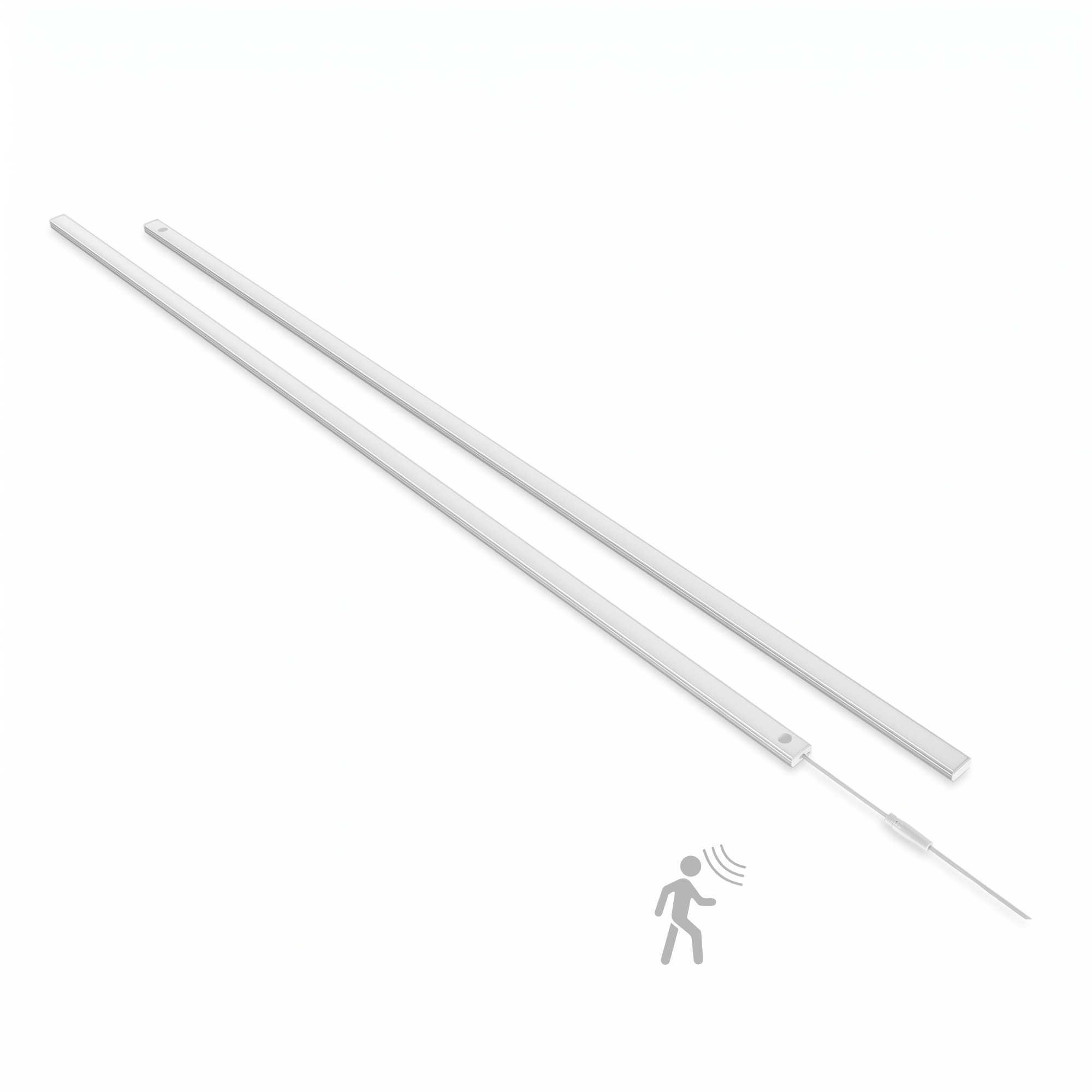
The DL-PM 1205 is a 17x7mm PIR motion sensor light for cabinets, wardrobes and furniture. It is dimmable and can be built to custom lengths up to 3 m, and DENO supplies it as an OEM/ODM product rather than a fixed catalogue item.
Description
Integrated PIR motion sensor accurately detects movement within a 3–5-meter range and provides touchless automatic illumination with an intelligent 30-second turn-off delay. The compact 17x7mm anodized aluminum profile delivers effective thermal dissipation to protect the internal LED light source and supports seamless concealed installation. A high-transmittance frosted PC diffuser eliminates visible diode spotting to produce uniform, glare-free output with dimmable functionality for premium cabinet lighting. Supplied in OEM custom lengths up to 3 meters, this fixture is optimized for wholesale project integration into wardrobes, stair treads, and display showcases.
Specifications
| DIMMABLE | Yes |
|---|---|
| RUN LENGTH | 3M(Custom) |
Applications
- Cove, wall-wash & perimeter lighting — Coves, recesses, wall-wash details and ceiling perimeters where a continuous, uniform line of light is required.
- Showroom & hospitality display lighting — Shelving, display cases, reception desks and signage backlighting in shops, showrooms and hospitality spaces.
- Kitchen & wardrobe under-cabinet lighting — Kitchen, wardrobe and furniture task lighting where the strip stays hidden and only the light is seen.
Request a quotation for #DL-PM 1205
DENO LED is a Shenzhen-based LED strip manufacturer with its own Foshan production base. Send the run length, voltage, CCT/CRI and IP rating you need and our engineering team replies with a specification sheet, wiring plan and price — OEM/ODM and fully custom builds included.
- Warranty: 5 years
- Lead time: standard boards: samples from 1 working day · custom: 3–5 working days · new FPCB: 1–3 weeks · production 1–2 weeks after sample approval
- Compliance: CE · UL · RoHS
- Bonding wire: 99.99% pure gold
- Copper foil: 99.9% pure copper FPCB
Photometric Performance — CCT × CRI Efficacy Matrix
Peak measured luminous efficacy: 74.3 lm/W at 4000K, Ra 90, ErP energy class G (Grade DL (2nd Tier) · 9.6W/m).
All values are measured at the stated power density and ambient 25 °C, reported as luminous efficacy in lumens per watt (lm/W), luminous flux per metre (lm/m) and the corresponding EU ErP (2019/2015) energy class.
Grade DL (2nd Tier) · 9.6W/m
| CCT (K) | Ra 80 — Luminous Efficacy (lm/W) | Ra 80 — Luminous Flux (lm/m) | Ra 80 — ErP Energy Class | Ra 90 — Luminous Efficacy (lm/W) | Ra 90 — Luminous Flux (lm/m) | Ra 90 — ErP Energy Class | Full Spectrum (Ra 95+) — Luminous Efficacy (lm/W) | Full Spectrum (Ra 95+) — Luminous Flux (lm/m) | Full Spectrum (Ra 95+) — ErP Energy Class |
|---|---|---|---|---|---|---|---|---|---|
| 1800 K | — | — | — | 56.1 lm/W | 539 lm/m | G | — | — | — |
| 2300 K | — | — | — | 62.6 lm/W | 600.5 lm/m | G | — | — | — |
| 2700 K | — | — | — | 67.6 lm/W | 649.3 lm/m | G | — | — | — |
| 3000 K | — | — | — | 71.2 lm/W | 683.5 lm/m | G | — | — | — |
| 3500 K | — | — | — | 72.5 lm/W | 696.2 lm/m | G | — | — | — |
| 4000 K | — | — | — | 74.3 lm/W | 712.8 lm/m | G | — | — | — |
| 5000 K | — | — | — | 74.3 lm/W | 712.8 lm/m | G | — | — | — |
| 6500 K | — | — | — | 71.2 lm/W | 683.5 lm/m | G | — | — | — |
Grade DL (2nd Tier) · 12W/m
| CCT (K) | Ra 80 — Luminous Efficacy (lm/W) | Ra 80 — Luminous Flux (lm/m) | Ra 80 — ErP Energy Class | Ra 90 — Luminous Efficacy (lm/W) | Ra 90 — Luminous Flux (lm/m) | Ra 90 — ErP Energy Class | Full Spectrum (Ra 95+) — Luminous Efficacy (lm/W) | Full Spectrum (Ra 95+) — Luminous Flux (lm/m) | Full Spectrum (Ra 95+) — ErP Energy Class |
|---|---|---|---|---|---|---|---|---|---|
| 1800 K | — | — | — | 55.2 lm/W | 662.5 lm/m | G | — | — | — |
| 2300 K | — | — | — | 61.5 lm/W | 738.1 lm/m | G | — | — | — |
| 2700 K | — | — | — | 66.5 lm/W | 798.1 lm/m | G | — | — | — |
| 3000 K | — | — | — | 70 lm/W | 840.1 lm/m | G | — | — | — |
| 3500 K | — | — | — | 71.3 lm/W | 855.7 lm/m | G | — | — | — |
| 4000 K | — | — | — | 73 lm/W | 876.1 lm/m | G | — | — | — |
| 5000 K | — | — | — | 73 lm/W | 876.1 lm/m | G | — | — | — |
| 6500 K | — | — | — | 70 lm/W | 840.1 lm/m | G | — | — | — |
Grade DL (2nd Tier) · 19.2W/m
| CCT (K) | Ra 80 — Luminous Efficacy (lm/W) | Ra 80 — Luminous Flux (lm/m) | Ra 80 — ErP Energy Class | Ra 90 — Luminous Efficacy (lm/W) | Ra 90 — Luminous Flux (lm/m) | Ra 90 — ErP Energy Class | Full Spectrum (Ra 95+) — Luminous Efficacy (lm/W) | Full Spectrum (Ra 95+) — Luminous Flux (lm/m) | Full Spectrum (Ra 95+) — ErP Energy Class |
|---|---|---|---|---|---|---|---|---|---|
| 1800 K | — | — | — | 52.5 lm/W | 1007.7 lm/m | G | — | — | — |
| 2300 K | — | — | — | 58.5 lm/W | 1122.7 lm/m | G | — | — | — |
| 2700 K | — | — | — | 63.2 lm/W | 1214 lm/m | G | — | — | — |
| 3000 K | — | — | — | 66.6 lm/W | 1277.9 lm/m | G | — | — | — |
| 3500 K | — | — | — | 67.8 lm/W | 1301.6 lm/m | G | — | — | — |
| 4000 K | — | — | — | 69.4 lm/W | 1332.7 lm/m | G | — | — | — |
| 5000 K | — | — | — | 69.4 lm/W | 1332.7 lm/m | G | — | — | — |
| 6500 K | — | — | — | 66.6 lm/W | 1277.9 lm/m | G | — | — | — |
Related models in this series
See every model in Linear Light Series or narrow to Motion Sensor Light. Compare wattage, lumen output and run length in the ProCalc parameter library, or request OEM/ODM pricing on the custom manufacturing page.
Frequently Asked Questions
What does the DL-PM 1205 PIR motion sensor do in an LED strip circuit?
The DL-PM 1205 sits between the driver and the LED strip and switches the low-voltage DC output when it detects body heat moving inside its field of view. It is used for wardrobe, cabinet, stair and corridor lighting where the light should only run while someone is present.
Is the DL-PM 1205 dimmable and how is the level set?
Yes. The DL-PM 1205 is the dimmable version: it fades the strip up on detection and fades it down when the hold time expires, instead of hard switching, and the brightness level is set on the unit itself. Fading also reduces the inrush seen by the driver.
Which LED strips and drivers work with the DL-PM 1205?
It works with constant-voltage DC LED strip on a matching constant-voltage driver, within the sensor rated voltage and current printed on its label. Keep the connected load below that current rating; for longer runs, split the run across more than one sensor or use it to drive a relay.
Where should the sensor be mounted for reliable detection?
Mount the lens with a clear line of sight to the area being covered, away from the aluminium profile fins and away from direct heat sources or airflow, which can cause false triggering. Detection range and angle fall off when the lens is recessed behind a diffuser.
Engineering & selection guide
Bending limits, IP selection, voltage drop, cutting and the full buyer Q&A for this family are kept on the series page.
- Motion sensor linear light selection guide — housing and mounting options, aiming and optics, driver and dimming selection for this fixture family
- LED strip engineering selection handbook