2835 Two-Row 48V Constant Current LED Strip Light (#19810)
20mm · 48V · 280LEDs · 50mm/cut
Model: 19810
Overview
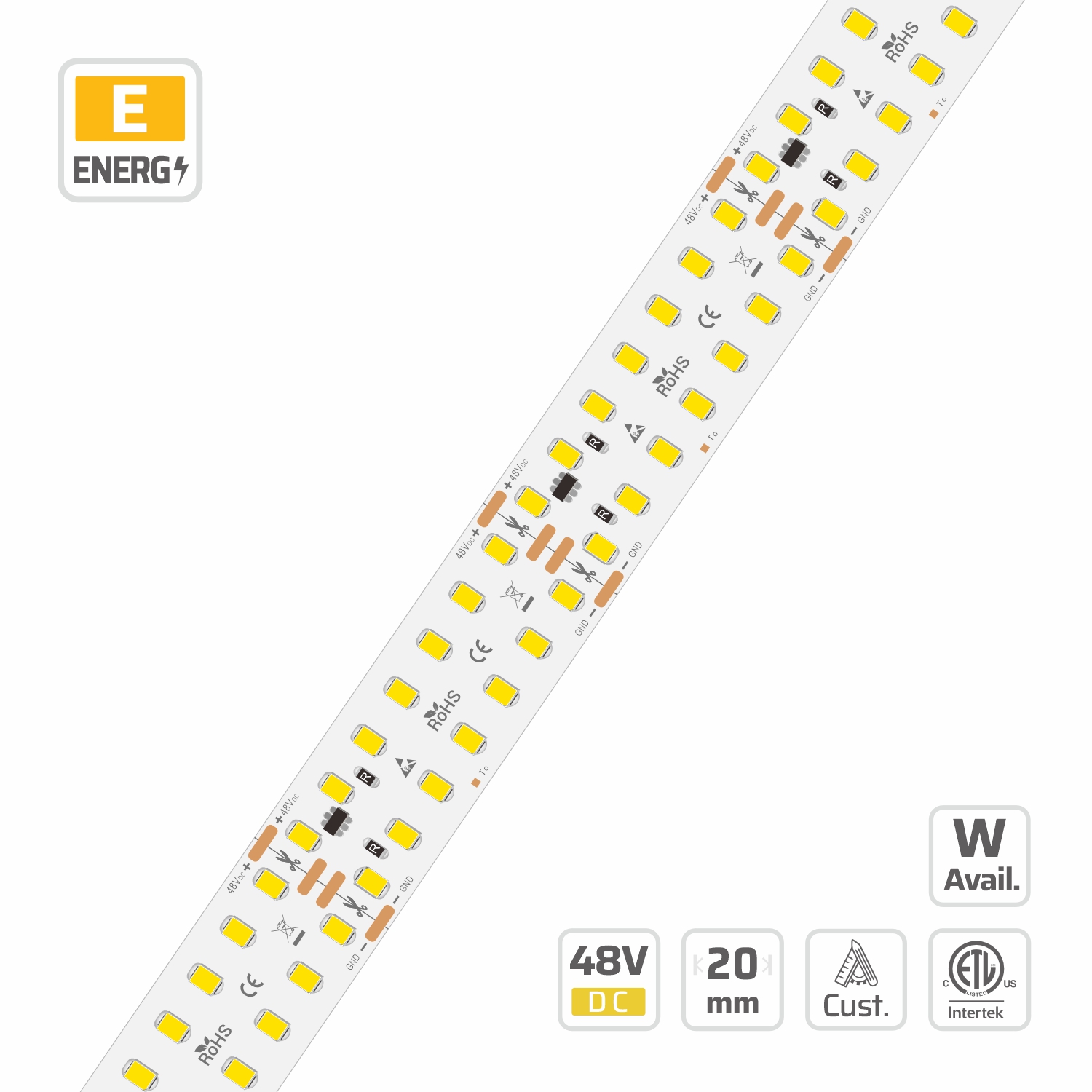
20mm | 48V | 280LEDs | 50mm/cut | #19810 | 2835 Two-Row 48V Constant Current LED Strip Light is part of the DENO Wide SMD Strips series, engineered around wide PCB LED strip. Key specifications: 2835, 280, DC 48V, 20mm PCB, 3oz copper FPCB, cuttable 14LEDs/50mm. Every reel is produced on DENO's roll-to-roll line with 99.9% pure copper FPCB and ships CE, UL and RoHS compliant for architectural, retail and hospitality projects. OEM and ODM configurations of length, colour temperature and waterproofing are available on request.
Description
20mm | 48V | 280LEDs | 50mm/cut | #19810 | 2835 Two-Row 48V Constant Current LED Strip Light Features a dense arrangement of 280LEDs/m in a 20mm double-row layout, ensuring a uniform and continuous light output suitable for wide-profile lighting. The flexible design of LED strips allows for bright lighting almost any space you can imagine, dimmable with compatible controller or dimmable constant voltage LED driver. Special heat resistant PCB layout that makes sure lower voltage drop and excellent heat dissipation. Ultra long can be used in up to 10m runs with a single power feed with no voltage drop. Applications:It is commonly used by architects and lighting designers in professional installations.
48v Led Strip Lights built for 48v smd strips projects.
Specifications
| LED QTY | 280 |
|---|---|
| PART NO | DL-F28A140V48-19810 |
| SMD TYPE | 2835 |
| CUTTABLE UNIT | 14LEDs/50mm |
| DIMMABLE | Yes |
| LED PITCH | 7.143mm |
| PCB WIDTH | 20mm |
| LENGTH MAX | 10m |
| COPPER FOIL | 3oz |
| POWER RANGE | 4.8~38W |
| CIRCUIT TYPE | C.C. |
| INPUT VOLTAGE | DC 48V |
Photometric Performance — CCT × CRI Efficacy Matrix
Peak measured luminous efficacy: 162 lm/W at 4000K, Ra 80, ErP energy class D (Grade DN (1st Tier) · 14.4W/m).
All values are measured at the stated power density and ambient 25 °C, reported as luminous efficacy in lumens per watt (lm/W), luminous flux per metre (lm/m) and the corresponding EU ErP (2019/2015) energy class.
Grade DL (2nd Tier) · 14.4W/m
| CCT (K) | Ra 80 — Luminous Efficacy (lm/W) | Ra 80 — Luminous Flux (lm/m) | Ra 80 — ErP Energy Class | Ra 90 — Luminous Efficacy (lm/W) | Ra 90 — Luminous Flux (lm/m) | Ra 90 — ErP Energy Class | Full Spectrum (Ra 95+) — Luminous Efficacy (lm/W) | Full Spectrum (Ra 95+) — Luminous Flux (lm/m) | Full Spectrum (Ra 95+) — ErP Energy Class |
|---|---|---|---|---|---|---|---|---|---|
| 1800 K | 115.2 lm/W | 1658.8 lm/m | E | 92.2 lm/W | 1327 lm/m | F | — | — | — |
| 2300 K | 128.2 lm/W | 1845.5 lm/m | E | 102.7 lm/W | 1478.2 lm/m | F | 83.2 lm/W | 1198.1 lm/m | G |
| 2700 K | 134.9 lm/W | 1942.7 lm/m | E | 111 lm/W | 1598.6 lm/m | E | 90 lm/W | 1296.2 lm/m | F |
| 3000 K | 144.2 lm/W | 2077 lm/m | D | 116.9 lm/W | 1683.5 lm/m | E | 95 lm/W | 1368.7 lm/m | F |
| 3500 K | 146.5 lm/W | 2109.4 lm/m | D | 118.9 lm/W | 1712.8 lm/m | E | 97.9 lm/W | 1410.4 lm/m | F |
| 4000 K | 151.1 lm/W | 2175.7 lm/m | D | 121.8 lm/W | 1754.5 lm/m | E | 100.5 lm/W | 1447.4 lm/m | F |
| 5000 K | 151 lm/W | 2174.2 lm/m | D | 121.7 lm/W | 1752.9 lm/m | E | 100.4 lm/W | 1445.8 lm/m | F |
| 6500 K | 138.1 lm/W | 1989 lm/m | D | 116.8 lm/W | 1681.9 lm/m | E | 96.9 lm/W | 1395.4 lm/m | F |
Grade DL (2nd Tier) · 19.2W/m
| CCT (K) | Ra 80 — Luminous Efficacy (lm/W) | Ra 80 — Luminous Flux (lm/m) | Ra 80 — ErP Energy Class | Ra 90 — Luminous Efficacy (lm/W) | Ra 90 — Luminous Flux (lm/m) | Ra 90 — ErP Energy Class | Full Spectrum (Ra 95+) — Luminous Efficacy (lm/W) | Full Spectrum (Ra 95+) — Luminous Flux (lm/m) | Full Spectrum (Ra 95+) — ErP Energy Class |
|---|---|---|---|---|---|---|---|---|---|
| 1800 K | 111.4 lm/W | 2138.4 lm/m | E | 89.1 lm/W | 1710.7 lm/m | F | — | — | — |
| 2300 K | 123.9 lm/W | 2379.1 lm/m | E | 99.3 lm/W | 1905.6 lm/m | F | 80.4 lm/W | 1543.7 lm/m | G |
| 2700 K | 130.4 lm/W | 2504.4 lm/m | E | 107.3 lm/W | 2060.8 lm/m | F | 87 lm/W | 1670.9 lm/m | F |
| 3000 K | 139.5 lm/W | 2677.5 lm/m | D | 113 lm/W | 2170.2 lm/m | E | 91.9 lm/W | 1764.4 lm/m | F |
| 3500 K | 141.6 lm/W | 2719.2 lm/m | D | 115 lm/W | 2208 lm/m | E | 94.7 lm/W | 1818.1 lm/m | F |
| 4000 K | 146.1 lm/W | 2804.8 lm/m | D | 117.8 lm/W | 2261.7 lm/m | E | 97.2 lm/W | 1865.9 lm/m | F |
| 5000 K | 146 lm/W | 2802.8 lm/m | D | 117.7 lm/W | 2259.7 lm/m | E | 97.1 lm/W | 1864.3 lm/m | F |
| 6500 K | 133.5 lm/W | 2564.1 lm/m | E | 112.9 lm/W | 2168.2 lm/m | E | 93.7 lm/W | 1799 lm/m | F |
Grade DL (2nd Tier) · 24W/m
| CCT (K) | Ra 80 — Luminous Efficacy (lm/W) | Ra 80 — Luminous Flux (lm/m) | Ra 80 — ErP Energy Class | Ra 90 — Luminous Efficacy (lm/W) | Ra 90 — Luminous Flux (lm/m) | Ra 90 — ErP Energy Class | Full Spectrum (Ra 95+) — Luminous Efficacy (lm/W) | Full Spectrum (Ra 95+) — Luminous Flux (lm/m) | Full Spectrum (Ra 95+) — ErP Energy Class |
|---|---|---|---|---|---|---|---|---|---|
| 1800 K | 107.7 lm/W | 2584.4 lm/m | F | 86.1 lm/W | 2067.5 lm/m | F | — | — | — |
| 2300 K | 119.8 lm/W | 2875.2 lm/m | E | 96 lm/W | 2303.1 lm/m | F | 77.7 lm/W | 1864.8 lm/m | G |
| 2700 K | 126.1 lm/W | 3026.7 lm/m | E | 103.8 lm/W | 2490.6 lm/m | F | 84.1 lm/W | 2019.4 lm/m | G |
| 3000 K | 134.8 lm/W | 3235.9 lm/m | E | 109.3 lm/W | 2622.8 lm/m | F | 88.8 lm/W | 2132.4 lm/m | F |
| 3500 K | 136.9 lm/W | 3286.3 lm/m | D | 111.2 lm/W | 2668.5 lm/m | E | 91.6 lm/W | 2197.3 lm/m | F |
| 4000 K | 141.2 lm/W | 3389.7 lm/m | D | 113.9 lm/W | 2733.4 lm/m | E | 94 lm/W | 2255 lm/m | F |
| 5000 K | 141.1 lm/W | 3387.3 lm/m | D | 113.8 lm/W | 2731 lm/m | E | 93.9 lm/W | 2253.6 lm/m | F |
| 6500 K | 129.1 lm/W | 3098.8 lm/m | E | 109.2 lm/W | 2620.4 lm/m | F | 90.6 lm/W | 2174.4 lm/m | F |
Grade DL (2nd Tier) · 28.8W/m
| CCT (K) | Ra 80 — Luminous Efficacy (lm/W) | Ra 80 — Luminous Flux (lm/m) | Ra 80 — ErP Energy Class | Ra 90 — Luminous Efficacy (lm/W) | Ra 90 — Luminous Flux (lm/m) | Ra 90 — ErP Energy Class | Full Spectrum (Ra 95+) — Luminous Efficacy (lm/W) | Full Spectrum (Ra 95+) — Luminous Flux (lm/m) | Full Spectrum (Ra 95+) — ErP Energy Class |
|---|---|---|---|---|---|---|---|---|---|
| 1800 K | 104.1 lm/W | 2998.4 lm/m | F | 83.3 lm/W | 2398.7 lm/m | G | — | — | — |
| 2300 K | 115.8 lm/W | 3335.9 lm/m | E | 92.8 lm/W | 2672.1 lm/m | F | 75.2 lm/W | 2165.8 lm/m | G |
| 2700 K | 121.9 lm/W | 3511.6 lm/m | E | 100.3 lm/W | 2889.6 lm/m | F | 81.4 lm/W | 2342.9 lm/m | G |
| 3000 K | 130.4 lm/W | 3754.3 lm/m | E | 105.7 lm/W | 3043 lm/m | F | 85.9 lm/W | 2474 lm/m | F |
| 3500 K | 132.4 lm/W | 3812.8 lm/m | E | 107.5 lm/W | 3096 lm/m | F | 88.5 lm/W | 2549.3 lm/m | F |
| 4000 K | 136.6 lm/W | 3932.8 lm/m | D | 110.1 lm/W | 3171.3 lm/m | E | 90.8 lm/W | 2616.3 lm/m | F |
| 5000 K | 136.5 lm/W | 3930 lm/m | D | 110 lm/W | 3168.5 lm/m | E | 90.8 lm/W | 2615 lm/m | F |
| 6500 K | 124.8 lm/W | 3595.3 lm/m | E | 105.6 lm/W | 3040.2 lm/m | F | 87.6 lm/W | 2522.9 lm/m | F |
Grade DN (1st Tier) · 14.4W/m
| CCT (K) | Ra 80 — Luminous Efficacy (lm/W) | Ra 80 — Luminous Flux (lm/m) | Ra 80 — ErP Energy Class | Ra 90 — Luminous Efficacy (lm/W) | Ra 90 — Luminous Flux (lm/m) | Ra 90 — ErP Energy Class | Full Spectrum (Ra 95+) — Luminous Efficacy (lm/W) | Full Spectrum (Ra 95+) — Luminous Flux (lm/m) | Full Spectrum (Ra 95+) — ErP Energy Class |
|---|---|---|---|---|---|---|---|---|---|
| 1800 K | 127 lm/W | 1828.5 lm/m | E | 106.8 lm/W | 1538.4 lm/m | F | — | — | — |
| 2300 K | 138.4 lm/W | 1993.6 lm/m | E | 119.2 lm/W | 1715.9 lm/m | E | 96.5 lm/W | 1389.6 lm/m | F |
| 2700 K | 149.3 lm/W | 2149.5 lm/m | D | 129 lm/W | 1857.8 lm/m | E | 104.6 lm/W | 1506 lm/m | F |
| 3000 K | 156.8 lm/W | 2257.5 lm/m | D | 136.2 lm/W | 1961.2 lm/m | E | 110.8 lm/W | 1595.5 lm/m | F |
| 3500 K | 159 lm/W | 2289.9 lm/m | D | 139.2 lm/W | 2004.4 lm/m | E | 114.6 lm/W | 1649.5 lm/m | F |
| 4000 K | 162 lm/W | 2333.1 lm/m | D | 139.9 lm/W | 2015.2 lm/m | E | 115.5 lm/W | 1663.4 lm/m | F |
| 5000 K | 161.8 lm/W | 2330 lm/m | D | 140.8 lm/W | 2027.6 lm/m | E | 116.2 lm/W | 1673.3 lm/m | F |
| 6500 K | 155.2 lm/W | 2234.3 lm/m | D | 134.6 lm/W | 1938.1 lm/m | E | 111.7 lm/W | 1608.5 lm/m | F |
Grade DN (1st Tier) · 19.2W/m
| CCT (K) | Ra 80 — Luminous Efficacy (lm/W) | Ra 80 — Luminous Flux (lm/m) | Ra 80 — ErP Energy Class | Ra 90 — Luminous Efficacy (lm/W) | Ra 90 — Luminous Flux (lm/m) | Ra 90 — ErP Energy Class | Full Spectrum (Ra 95+) — Luminous Efficacy (lm/W) | Full Spectrum (Ra 95+) — Luminous Flux (lm/m) | Full Spectrum (Ra 95+) — ErP Energy Class |
|---|---|---|---|---|---|---|---|---|---|
| 1800 K | 122.8 lm/W | 2357.2 lm/m | E | 103.3 lm/W | 1983.2 lm/m | F | — | — | — |
| 2300 K | 133.9 lm/W | 2570 lm/m | E | 115.2 lm/W | 2212 lm/m | F | 93.3 lm/W | 1791.4 lm/m | F |
| 2700 K | 144.3 lm/W | 2770.9 lm/m | E | 124.7 lm/W | 2395 lm/m | E | 101.1 lm/W | 1941.5 lm/m | F |
| 3000 K | 151.6 lm/W | 2910.2 lm/m | D | 131.7 lm/W | 2528.3 lm/m | E | 107.1 lm/W | 2056.8 lm/m | F |
| 3500 K | 153.7 lm/W | 2952 lm/m | D | 134.6 lm/W | 2584 lm/m | E | 110.8 lm/W | 2126.4 lm/m | F |
| 4000 K | 156.6 lm/W | 3007.7 lm/m | D | 135.3 lm/W | 2597.9 lm/m | E | 111.7 lm/W | 2144.4 lm/m | F |
| 5000 K | 156.4 lm/W | 3003.7 lm/m | D | 136.1 lm/W | 2613.8 lm/m | E | 112.3 lm/W | 2156.2 lm/m | F |
| 6500 K | 150 lm/W | 2880.4 lm/m | D | 130.1 lm/W | 2498.4 lm/m | E | 108 lm/W | 2073.6 lm/m | F |
Grade DN (1st Tier) · 24W/m
| CCT (K) | Ra 80 — Luminous Efficacy (lm/W) | Ra 80 — Luminous Flux (lm/m) | Ra 80 — ErP Energy Class | Ra 90 — Luminous Efficacy (lm/W) | Ra 90 — Luminous Flux (lm/m) | Ra 90 — ErP Energy Class | Full Spectrum (Ra 95+) — Luminous Efficacy (lm/W) | Full Spectrum (Ra 95+) — Luminous Flux (lm/m) | Full Spectrum (Ra 95+) — ErP Energy Class |
|---|---|---|---|---|---|---|---|---|---|
| 1800 K | 118.7 lm/W | 2848.8 lm/m | F | 99.9 lm/W | 2396.8 lm/m | F | — | — | — |
| 2300 K | 129.4 lm/W | 3106 lm/m | E | 111.4 lm/W | 2673.3 lm/m | F | 90.2 lm/W | 2164.8 lm/m | G |
| 2700 K | 139.5 lm/W | 3348.8 lm/m | E | 120.6 lm/W | 2894.5 lm/m | E | 97.8 lm/W | 2346.4 lm/m | F |
| 3000 K | 146.5 lm/W | 3517.1 lm/m | D | 127.3 lm/W | 3055.5 lm/m | E | 103.6 lm/W | 2485.8 lm/m | F |
| 3500 K | 148.7 lm/W | 3567.6 lm/m | D | 130.1 lm/W | 3122.9 lm/m | E | 107.1 lm/W | 2569.9 lm/m | F |
| 4000 K | 151.5 lm/W | 3634.9 lm/m | D | 130.8 lm/W | 3139.7 lm/m | E | 108 lm/W | 2591.6 lm/m | F |
| 5000 K | 151.3 lm/W | 3630.1 lm/m | D | 131.6 lm/W | 3158.9 lm/m | E | 108.6 lm/W | 2606.4 lm/m | F |
| 6500 K | 145 lm/W | 3481.1 lm/m | E | 125.8 lm/W | 3019.5 lm/m | E | 104.4 lm/W | 2505.6 lm/m | F |
Grade DN (1st Tier) · 28.8W/m
| CCT (K) | Ra 80 — Luminous Efficacy (lm/W) | Ra 80 — Luminous Flux (lm/m) | Ra 80 — ErP Energy Class | Ra 90 — Luminous Efficacy (lm/W) | Ra 90 — Luminous Flux (lm/m) | Ra 90 — ErP Energy Class | Full Spectrum (Ra 95+) — Luminous Efficacy (lm/W) | Full Spectrum (Ra 95+) — Luminous Flux (lm/m) | Full Spectrum (Ra 95+) — ErP Energy Class |
|---|---|---|---|---|---|---|---|---|---|
| 1800 K | 114.8 lm/W | 3305.2 lm/m | F | 96.6 lm/W | 2780.8 lm/m | F | — | — | — |
| 2300 K | 125.1 lm/W | 3603.7 lm/m | E | 107.7 lm/W | 3101.6 lm/m | F | 87.2 lm/W | 2511.4 lm/m | G |
| 2700 K | 134.9 lm/W | 3885.4 lm/m | E | 116.6 lm/W | 3358.2 lm/m | F | 94.5 lm/W | 2722.3 lm/m | F |
| 3000 K | 141.7 lm/W | 4080.6 lm/m | E | 123.1 lm/W | 3545.1 lm/m | E | 100.1 lm/W | 2884 lm/m | F |
| 3500 K | 143.7 lm/W | 4139.2 lm/m | E | 125.8 lm/W | 3623.2 lm/m | E | 103.5 lm/W | 2981.7 lm/m | F |
| 4000 K | 146.4 lm/W | 4217.3 lm/m | D | 126.5 lm/W | 3642.7 lm/m | E | 104.4 lm/W | 3006.8 lm/m | F |
| 5000 K | 146.2 lm/W | 4211.7 lm/m | D | 127.3 lm/W | 3665 lm/m | E | 105 lm/W | 3024 lm/m | F |
| 6500 K | 140.2 lm/W | 4038.8 lm/m | E | 121.6 lm/W | 3503.2 lm/m | E | 101 lm/W | 2908.8 lm/m | F |
Grade KE (3rd Tier) · 14.4W/m
| CCT (K) | Ra 80 — Luminous Efficacy (lm/W) | Ra 80 — Luminous Flux (lm/m) | Ra 80 — ErP Energy Class | Ra 90 — Luminous Efficacy (lm/W) | Ra 90 — Luminous Flux (lm/m) | Ra 90 — ErP Energy Class | Full Spectrum (Ra 95+) — Luminous Efficacy (lm/W) | Full Spectrum (Ra 95+) — Luminous Flux (lm/m) | Full Spectrum (Ra 95+) — ErP Energy Class |
|---|---|---|---|---|---|---|---|---|---|
| 1900 K | 93.7 lm/W | 1348.6 lm/m | F | 74.7 lm/W | 1075.5 lm/m | G | — | — | — |
| 2300 K | 104.4 lm/W | 1502.9 lm/m | F | 83.3 lm/W | 1199 lm/m | G | 67.4 lm/W | 970.6 lm/m | G |
| 2700 K | 112.4 lm/W | 1618.7 lm/m | E | 90.3 lm/W | 1300.8 lm/m | F | 73.2 lm/W | 1053.9 lm/m | G |
| 3000 K | 118.1 lm/W | 1700.4 lm/m | E | 95.5 lm/W | 1374.9 lm/m | F | 77.7 lm/W | 1118.7 lm/m | G |
| 3500 K | 119.9 lm/W | 1726.7 lm/m | E | 97.4 lm/W | 1402.6 lm/m | F | 80.2 lm/W | 1154.2 lm/m | G |
| 4000 K | 123.3 lm/W | 1776.1 lm/m | E | 99.4 lm/W | 1432 lm/m | F | 82.1 lm/W | 1182 lm/m | G |
| 5000 K | 123.2 lm/W | 1774.5 lm/m | E | 99.4 lm/W | 1432 lm/m | F | 82 lm/W | 1180.8 lm/m | G |
| 6500 K | 118.1 lm/W | 1700.4 lm/m | E | 95.5 lm/W | 1374.9 lm/m | F | 79.2 lm/W | 1140.5 lm/m | G |
Grade KE (3rd Tier) · 19.2W/m
| CCT (K) | Ra 80 — Luminous Efficacy (lm/W) | Ra 80 — Luminous Flux (lm/m) | Ra 80 — ErP Energy Class | Ra 90 — Luminous Efficacy (lm/W) | Ra 90 — Luminous Flux (lm/m) | Ra 90 — ErP Energy Class | Full Spectrum (Ra 95+) — Luminous Efficacy (lm/W) | Full Spectrum (Ra 95+) — Luminous Flux (lm/m) | Full Spectrum (Ra 95+) — ErP Energy Class |
|---|---|---|---|---|---|---|---|---|---|
| 1900 K | 90.5 lm/W | 1738.6 lm/m | F | 72.2 lm/W | 1386.5 lm/m | G | — | — | — |
| 2300 K | 100.9 lm/W | 1937.5 lm/m | F | 80.5 lm/W | 1545.6 lm/m | G | 65.2 lm/W | 1251.8 lm/m | G |
| 2700 K | 108.7 lm/W | 2086.7 lm/m | F | 87.3 lm/W | 1676.9 lm/m | F | 70.8 lm/W | 1358.6 lm/m | G |
| 3000 K | 114.2 lm/W | 2192.1 lm/m | E | 92.3 lm/W | 1772.4 lm/m | F | 75.1 lm/W | 1442.2 lm/m | G |
| 3500 K | 115.9 lm/W | 2225.9 lm/m | E | 94.2 lm/W | 1808.2 lm/m | F | 77.5 lm/W | 1487.9 lm/m | G |
| 4000 K | 119.2 lm/W | 2289.6 lm/m | E | 96.1 lm/W | 1846 lm/m | F | 79.4 lm/W | 1523.7 lm/m | G |
| 5000 K | 119.1 lm/W | 2287.6 lm/m | E | 96.1 lm/W | 1846 lm/m | F | 79.3 lm/W | 1522.6 lm/m | G |
| 6500 K | 114.2 lm/W | 2192.1 lm/m | E | 92.3 lm/W | 1772.4 lm/m | F | 76.6 lm/W | 1470.7 lm/m | G |
Grade KE (3rd Tier) · 24W/m
| CCT (K) | Ra 80 — Luminous Efficacy (lm/W) | Ra 80 — Luminous Flux (lm/m) | Ra 80 — ErP Energy Class | Ra 90 — Luminous Efficacy (lm/W) | Ra 90 — Luminous Flux (lm/m) | Ra 90 — ErP Energy Class | Full Spectrum (Ra 95+) — Luminous Efficacy (lm/W) | Full Spectrum (Ra 95+) — Luminous Flux (lm/m) | Full Spectrum (Ra 95+) — ErP Energy Class |
|---|---|---|---|---|---|---|---|---|---|
| 1900 K | 87.5 lm/W | 2101.1 lm/m | F | 69.8 lm/W | 1675.6 lm/m | G | — | — | — |
| 2300 K | 97.6 lm/W | 2341.5 lm/m | F | 77.8 lm/W | 1867.9 lm/m | G | 63 lm/W | 1512 lm/m | G |
| 2700 K | 105.1 lm/W | 2521.8 lm/m | F | 84.4 lm/W | 2026.6 lm/m | G | 68.4 lm/W | 1642 lm/m | G |
| 3000 K | 110.4 lm/W | 2649.3 lm/m | E | 89.3 lm/W | 2142 lm/m | F | 72.6 lm/W | 1742.9 lm/m | G |
| 3500 K | 112.1 lm/W | 2690.1 lm/m | E | 91.1 lm/W | 2185.3 lm/m | F | 74.9 lm/W | 1798.2 lm/m | G |
| 4000 K | 115.3 lm/W | 2767.1 lm/m | E | 93 lm/W | 2231 lm/m | F | 76.7 lm/W | 1841.5 lm/m | G |
| 5000 K | 115.2 lm/W | 2764.7 lm/m | E | 93 lm/W | 2231 lm/m | F | 76.7 lm/W | 1840.8 lm/m | G |
| 6500 K | 110.4 lm/W | 2649.3 lm/m | E | 89.3 lm/W | 2142 lm/m | F | 74.1 lm/W | 1778.4 lm/m | G |
Grade KE (3rd Tier) · 28.8W/m
| CCT (K) | Ra 80 — Luminous Efficacy (lm/W) | Ra 80 — Luminous Flux (lm/m) | Ra 80 — ErP Energy Class | Ra 90 — Luminous Efficacy (lm/W) | Ra 90 — Luminous Flux (lm/m) | Ra 90 — ErP Energy Class | Full Spectrum (Ra 95+) — Luminous Efficacy (lm/W) | Full Spectrum (Ra 95+) — Luminous Flux (lm/m) | Full Spectrum (Ra 95+) — ErP Energy Class |
|---|---|---|---|---|---|---|---|---|---|
| 1900 K | 84.6 lm/W | 2437.8 lm/m | G | 67.5 lm/W | 1944.1 lm/m | G | — | — | — |
| 2300 K | 94.3 lm/W | 2716.7 lm/m | F | 75.3 lm/W | 2167.2 lm/m | G | 61 lm/W | 1756.8 lm/m | G |
| 2700 K | 101.6 lm/W | 2925.9 lm/m | F | 81.6 lm/W | 2351.3 lm/m | G | 66.1 lm/W | 1905 lm/m | G |
| 3000 K | 106.7 lm/W | 3073.7 lm/m | F | 86.3 lm/W | 2485.2 lm/m | F | 70.2 lm/W | 2022.2 lm/m | G |
| 3500 K | 108.4 lm/W | 3121.1 lm/m | F | 88 lm/W | 2535.4 lm/m | F | 72.4 lm/W | 2086.3 lm/m | G |
| 4000 K | 111.5 lm/W | 3210.4 lm/m | E | 89.9 lm/W | 2588.4 lm/m | F | 74.2 lm/W | 2136.5 lm/m | G |
| 5000 K | 111.4 lm/W | 3207.6 lm/m | E | 89.9 lm/W | 2588.4 lm/m | F | 74.1 lm/W | 2134.1 lm/m | G |
| 6500 K | 106.7 lm/W | 3073.7 lm/m | F | 86.3 lm/W | 2485.2 lm/m | F | 71.6 lm/W | 2062.1 lm/m | G |
Frequently Asked Questions
What are the key specifications of 19810?
19810: 2835, 280, DC 48V, 20mm PCB, 3oz copper FPCB, cuttable 14LEDs/50mm. Full photometric data, wiring diagrams and test reports are available in the downloads section of this page.
How long can a single run of this wide PCB LED strip be?
Maximum single run for this model is 10m. Feeding from both ends or using a mid-point tap halves the effective distance per segment, so a wide PCB LED strip can cover twice that length on one circuit when wired accordingly.
Can DENO customise this wide PCB LED strip for a project?
Yes. DENO manufactures the Wide SMD Strips series as an OEM and ODM supplier: reel length, colour temperature, CRI grade, PCB width, waterproofing and private labelling can all be specified. Request a quote for lead time and project pricing.
How long can a 48V LED strip run from a single feed?
A 48V LED strip typically doubles the run length of an equivalent 24V LED strip at the same power density, with 20 to 40 m single-end runs common at low wattages. The exact limit depends on watts per metre and copper weight, so confirm it with the DENO voltage drop calculator before specifying.
Does a constant current LED strip really eliminate voltage drop?
Voltage still drops along the copper, but the per-segment constant current IC holds LED current fixed until the local voltage falls below its dropout point. Brightness therefore stays even end to end, and power can be injected at one end, both ends or any mid point of the run.
Why use a wide LED strip PCB?
A 15 or 20 mm LED strip gives more copper area, so it dissipates heat better and carries more current. That is what allows high power builds above 25 W/m to run cooler, keep lumen maintenance high and support longer single feeds than a narrow board.
Wide PCB LED Strip — Brightest, High Lumen Builds
Why is a wide PCB LED strip the brightest LED strip option?
Brightness is limited by how many dies fit per metre and how much heat the board can shed. A wide PCB LED strip — 18 mm, 20 mm, 36 mm or 64 mm instead of the usual 8–10 mm — carries two, three or four parallel LED rows, up to 960 LEDs/m, and roughly the same multiple of copper area. That is why DENO's widest boards are the brightest LED strip builds in the catalogue: more emitters and enough 2 oz copper to keep junction temperature down at full drive.
How many lumens per metre does a high lumen LED strip deliver?
A standard 10 mm single-row board tops out near 2,000 lm/m. DENO's multi-row wide boards run from roughly 3,000 lm/m on a two-row 18 mm build to over 8,000 lm/m on a four-row 64 mm build at 45 W/m. When a specification asks for a high lumen LED strip in lux rather than watts, size it from the target illuminance and mounting distance first, then pick the board width that reaches it without over-driving the dies.
How much power does a high power LED strip need, and how is the heat handled?
Wide multi-row builds run 16 W/m to 45 W/m, so a 5 m reel can draw over 200 W — size the driver with 20% headroom and feed it from both ends or mid-feed. Thermally, the wide board is the heat sink: the extra copper spreads flux along the strip, and mounting a high power LED strip in an aluminium profile rather than on plasterboard keeps the LEDs inside their rated case temperature and protects lumen maintenance.
Are there super bright LED strip lights in 12V, and when should I use 24V or 48V instead?
12V super bright LED strip lights exist but are limited to short runs: at 20 W/m a 12V board pulls 1.7 A per metre, so voltage drop dims the far end after 2–3 m. For architectural work DENO builds the wide boards in 24V and 48V, where the same wattage draws half or a quarter of the current and one feed covers 5–15 m. Where the fixture is 12V-native, keep the run short and feed each section separately.
- Series Wide PCB LED Strips series
- Related series 48V LED strip lights for long high-output runs
- Related series constant current boards that hold output over distance
- Product 16011 48V super bright LED strip
Do you make super bright LED strip lights that are waterproof for outdoor use?
Yes. Every wide board is available IP65 silicone-coated, IP67 sleeved or IP68 fully potted, plus DENO WAP™ conformal coating that stays clear instead of yellowing under UV. For the brightest outdoor LED strip lights, remember the coating adds thermal resistance: outdoor high-output builds use 2–3 oz copper and are specified one drive step below the same board indoors so lumen maintenance holds over the warranty period.
- Series Wide PCB LED Strips series
- Related series DENO WAP™ waterproof coating explained
- Related series marine grade LED strip for coastal installations
Which is brighter — a wide multi-row board or a high-density single row?
For raw output, the wide multi-row board wins: rows multiply the flux while a single row is capped by LED pitch. For a dot-free line in a shallow reveal, high density wins. The two are combined on DENO's 36 mm and 64 mm boards, which run three or four dense rows at once, giving both an ultra bright LED strip face and an even luminance across the diffuser.
- Series Wide PCB LED Strips series
- Related series narrow boards where width is the constraint
- Related series high efficiency LED strip lights series
Can I order a custom width bright white LED strip?
Yes — board width, row count, LED density, CCT and CRI, copper weight, cut unit, IP class and connector are all configurable. Bright white LED strip lights are usually specified 4000K–6500K at Ra 90+ for workshops, cold rooms and signage; DENO tools these on the existing wide FPCB stack-ups, so a non-standard width is a production setup rather than a new product line.
- Series Wide PCB LED Strips series
- Related series custom LED strip lights built to order
- Guide send a high output specification to DENO
Constant Current LED Strip — Buyer Questions
What is a constant current LED strip?
A constant current LED strip carries a linear CC driver IC on the board that holds a fixed current through each segment regardless of the input voltage seen at that point. Brightness therefore stays flat along the run, instead of falling off with voltage drop the way a plain constant-voltage strip does.
Can a constant current LED strip be powered from both ends or mid-feed?
Yes. Because regulation happens per segment, DENO's CC boards accept single-end, both-ends and any mid-strip tap. Both-ends and mid-feed wiring halve the effective feed distance, which is how a single driver covers a long corridor or perimeter cove.
- Series constant current LED strip series
- Guide wiring layout planner for mid-feed CC runs
- Related series long-run CC LED strip builds
- Product 16785 mid-feed constant current LED strip
How long can a constant current LED strip run be?
Up to 20 m and beyond on 24V or 48V builds with 2 oz copper, versus 5 m for a comparable constant-voltage board. The practical limit becomes the copper's current-carrying capacity and thermal design rather than perceived brightness fall-off.
- Series constant current LED strip series
- Related series long LED strip lights for 20 m+ runs
- Guide check the maximum run length for your build