Die-Cut vs Electroplated PCB for LED Strip Lights: Soldering & Flame Test
By DENO LED Lighting ·
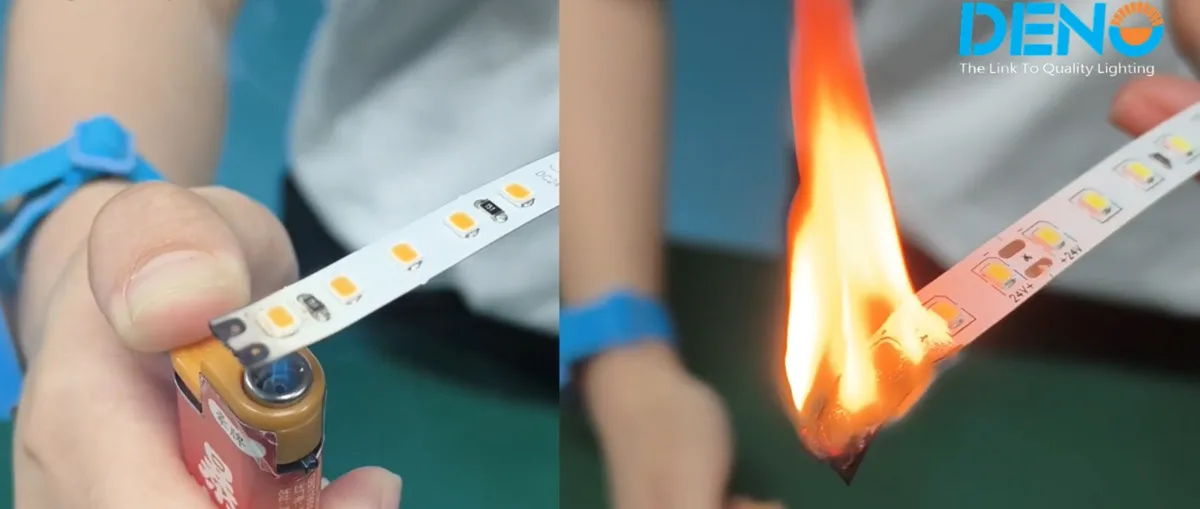
Die-cut vs electroplated PCB for LED strip lights: factory soldering-iron and flame tests show why heavy-copper electroplated FPCB survives 400 °C soldering and self-extinguishes, while die-cut boards melt. A buyer's guide from an LED strip manufacturer.
Engineering summary: Two LED strip lights can share the same voltage, width and LED count on a quotation, yet behave completely differently the moment a soldering iron or open flame touches them. The difference sits underneath the LEDs: the flexible PCB. In our factory demonstration, the electroplated heavy-copper board held its form under a 400 °C soldering tip and its flame died out, while the die-cut board melted and burned strongly. This guide explains the material science behind that result and how to specify a commercial-grade LED strip that survives assembly, rework and years inside a concealed ceiling cove.
Why Does the PCB Matter More Than the LED Count?
As an LED strip light manufacturer operating our own FPCB, roll-to-roll SMT and extrusion lines in Foshan, we see the same pattern in competitor samples sent to us by buyers: the LEDs look identical, but the circuit beneath them is built to a price. The flexible PCB carries every milliamp along the run, spreads heat away from each LED package and must survive soldering of lead wires on site. If the board fails, the best LED on top of it fails with it.
Watch the full side-by-side test filmed at the DENO factory:
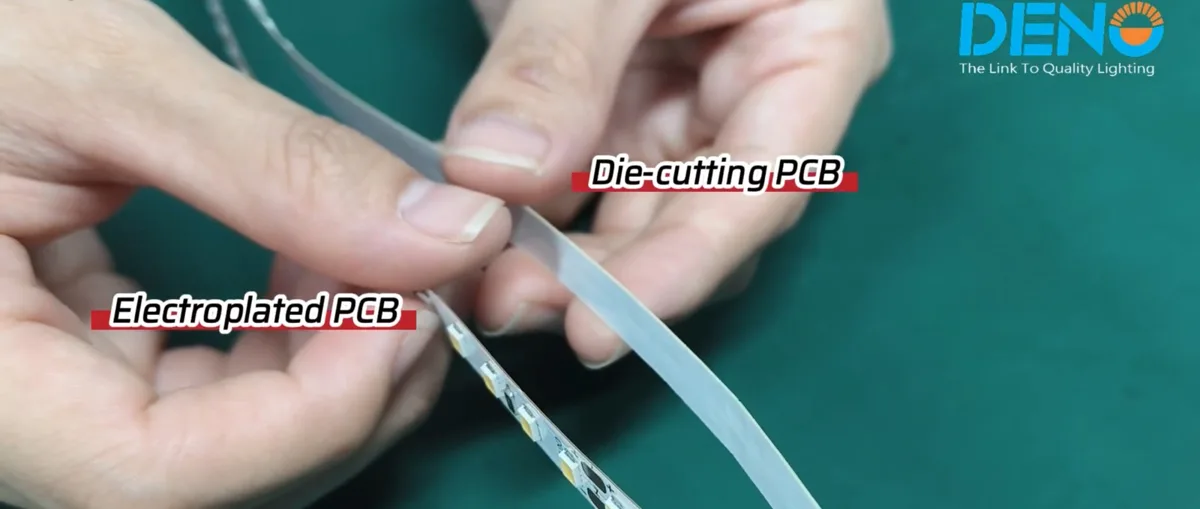
Die-Cut vs Electroplated PCB: What Is the Difference?
Die-cut (stamped) circuits are produced by mechanically punching a conductor foil and laminating it onto a low-cost carrier with an adhesive layer. The process is fast and cheap, but the conductor is thin, the edges are mechanically stressed and the adhesive and carrier film set the thermal ceiling of the whole strip.
Electroplated circuits are built up by depositing copper onto a patterned flexible substrate, so conductor thickness can be engineered to the current the strip actually needs. DENO strip boards use a heavy-copper construction such as 35+70 μm, giving a far larger copper cross-section to carry current and pull heat away from solder pads and LED packages.
Soldering Iron Test: Why Does a Cheap LED Strip PCB Melt?
In the first test a soldering iron set to 400 °C touches each sample. The electroplated board stays intact; the die-cut board melts and blisters within seconds.
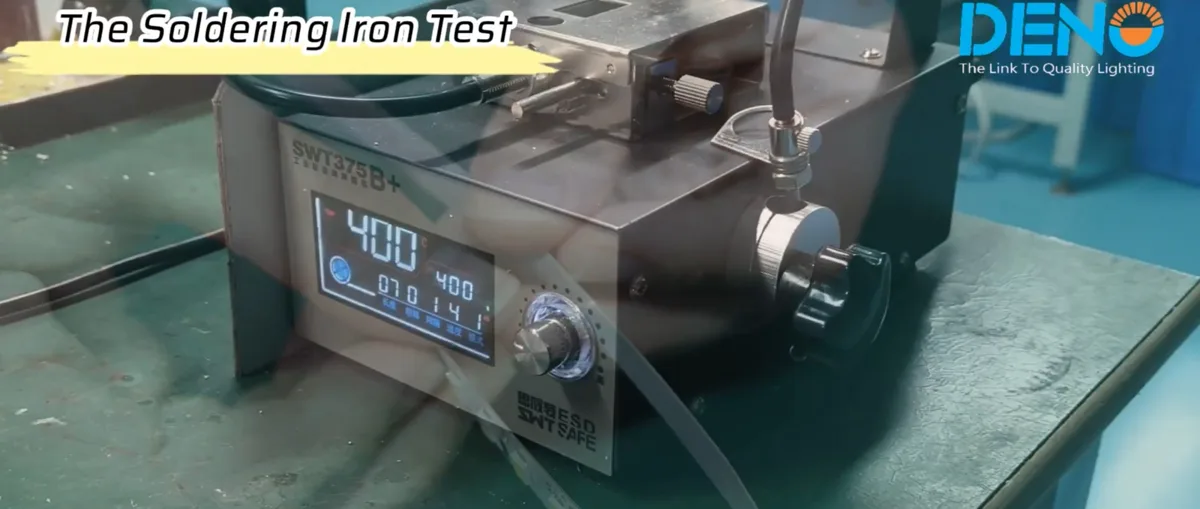
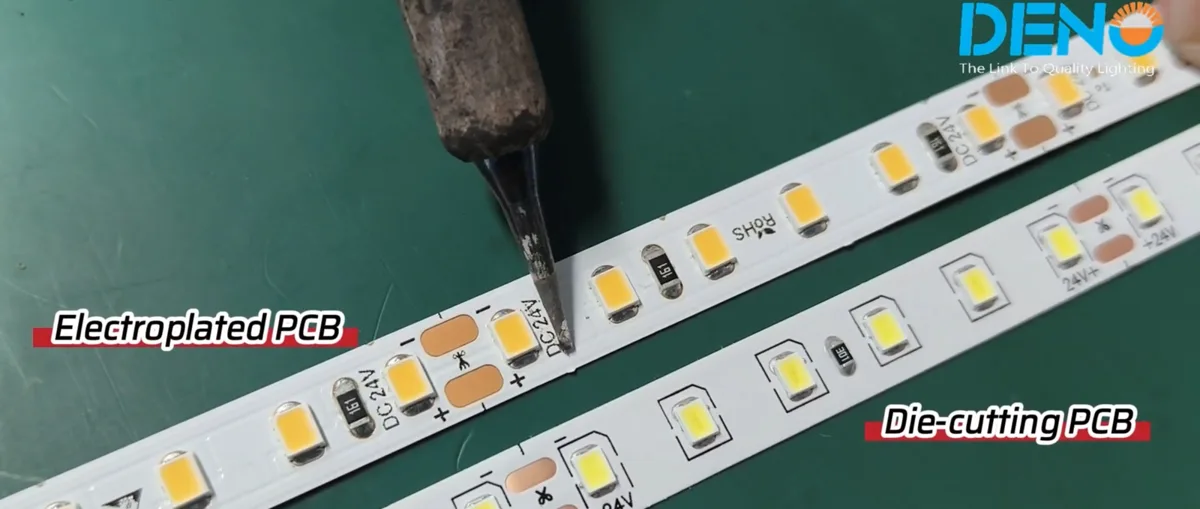
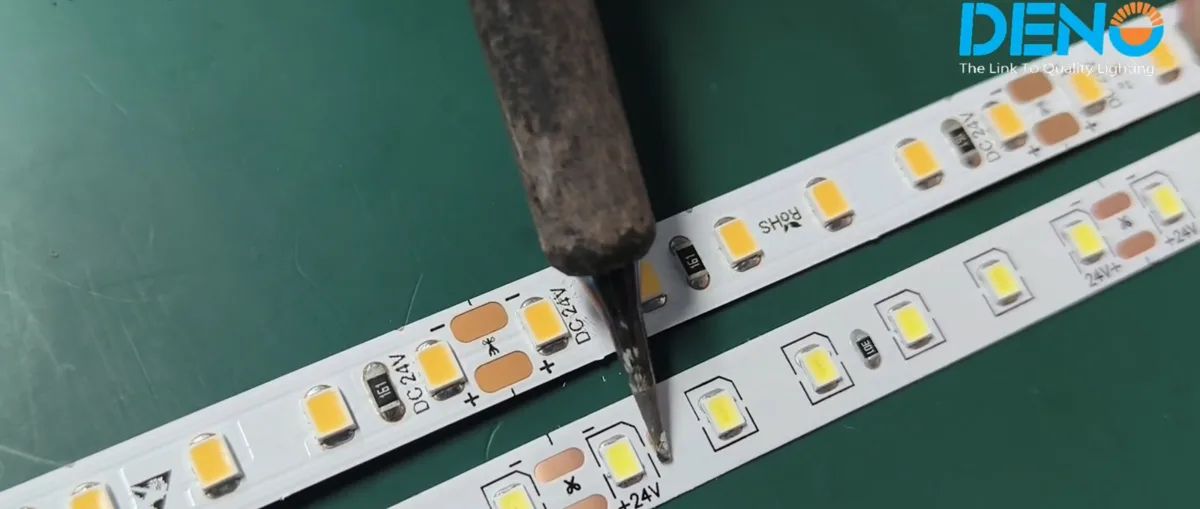
The physics is straightforward. Copper conducts heat at roughly 400 W/m·K. A thick, continuous copper layer acts as a heat spreader: the energy from the tip flows sideways through the copper instead of concentrating in the film beneath it. A thin stamped foil cannot spread that energy fast enough, so the heat drives straight into the adhesive and carrier, which soften, outgas and delaminate. This is exactly what installers experience when a cheap LED strip lifts its pads during lead-wire soldering or on-site rework.
For buyers this translates directly into installation yield: custom cut lengths, soldered connections and field repairs succeed on a board that can absorb soldering heat, and fail on one that cannot.
Specifying a strip that survives soldering and long runs?
See how DENO builds heavy-copper 35+70 μm flexible circuits on our own roll-to-roll lines on the FPCB technology page, or browse our commercial-grade SMD LED strip lights.
Flame Test: Which LED Strip PCB Burns and Which Self-Extinguishes?
In the second test both samples are exposed to an open flame. The die-cut board catches and burns strongly, fed by its adhesive and carrier film. On the electroplated board the flame dies out once the lighter is removed.
Why does this matter? LED strip lights are routinely installed in timber cabinets, plasterboard coves and enclosed aluminium profiles where heat builds up and access is limited. A board material that sustains a flame adds fuel to any fault; a construction that self-extinguishes limits it. Formal flammability classification of materials is defined by laboratory standards such as UL 94, and for project approval buyers should match the report to the exact material and product scope. The video shows clearly why that question deserves to be asked of every supplier.
Engineering Comparison: Die-Cut vs Electroplated LED Strip PCB
| Property | Die-cut PCB | Electroplated heavy-copper PCB (DENO) |
|---|---|---|
| Conductor process | Stamped foil laminated with adhesive | Copper deposited and built up to specification |
| Copper thickness | Thin, fixed by foil stock | Engineered, e.g. 35+70 μm |
| 400 °C soldering iron (demo) | Melts and blisters | Retains form |
| Open flame (demo) | Burns strongly | Flame dies out |
| Voltage drop on long runs | Higher — smaller copper cross-section | Lower — larger copper cross-section |
| Best suited to | Low-cost decorative use | Architectural, hospitality and commercial lighting |
Where Does LED Strip PCB Quality Matter Most?
Concealed ceiling coves and fitted cabinets
Replacing a failed strip behind a finished ceiling costs far more than the reel. The board must handle enclosed heat for years.
Custom lengths and soldered connections
Projects that need lead wires, custom sections or mid-run feeds depend on pads that survive soldering without lifting.
Long runs and repeat orders
Heavy copper reduces voltage drop along the run, and a documented board construction lets future repeat orders match the original installation.
Want to see how we verify board construction?
Our quality control and reliability lab inspects FPCB cross-sections under the microscope before strips leave the factory.
LED Strip PCB Checklist: What to Ask Your Supplier
- Is the flexible PCB electroplated or die-cut for the exact model quoted?
- What is the finished copper thickness and board width?
- What soldering temperature and contact time does the supplier specify?
- Which flammability and safety reports cover this material and finished product?
- Can a traceable sample be supplied, with the board construction written into the purchase order?
Frequently Asked Questions
Why do cheap LED strip PCBs melt when soldering?
Thin stamped foil cannot spread soldering heat, so the energy passes into the adhesive and carrier film, which soften and delaminate. Thick electroplated copper spreads the heat sideways and protects the pad.
Is an electroplated PCB better than a die-cut PCB for LED strips?
For commercial and architectural lighting, yes. In the DENO factory test the electroplated heavy-copper board withstood a 400 °C soldering tip and self-extinguished in flame, while the die-cut board melted and burned.
Does the 400 °C test mean the strip operates at 400 °C?
No. 400 °C is the soldering-iron setting used to stress the board. Operating limits are stated on the datasheet for each LED strip model.
How does copper thickness affect LED strip performance?
More copper lowers resistance, reducing voltage drop along long runs, and spreads heat away from LED packages and solder pads.
Does DENO manufacture its own LED strip PCBs?
DENO is an LED strip light manufacturer with its own production facility in Foshan, running SMD-R2R and SOB-R2R roll-to-roll lines with heavy-copper flexible circuits. See our FPCB technology page for details.
Request a Sample Comparison
Send us your application, voltage, watts per metre, run length, CCT, CRI and IP rating, and we will quote a strip with the PCB construction written into the specification. Contact DENO engineering to start with a documented sample.