2216 High Density LED Strip Light (#1688)
Model: 1688
Overview
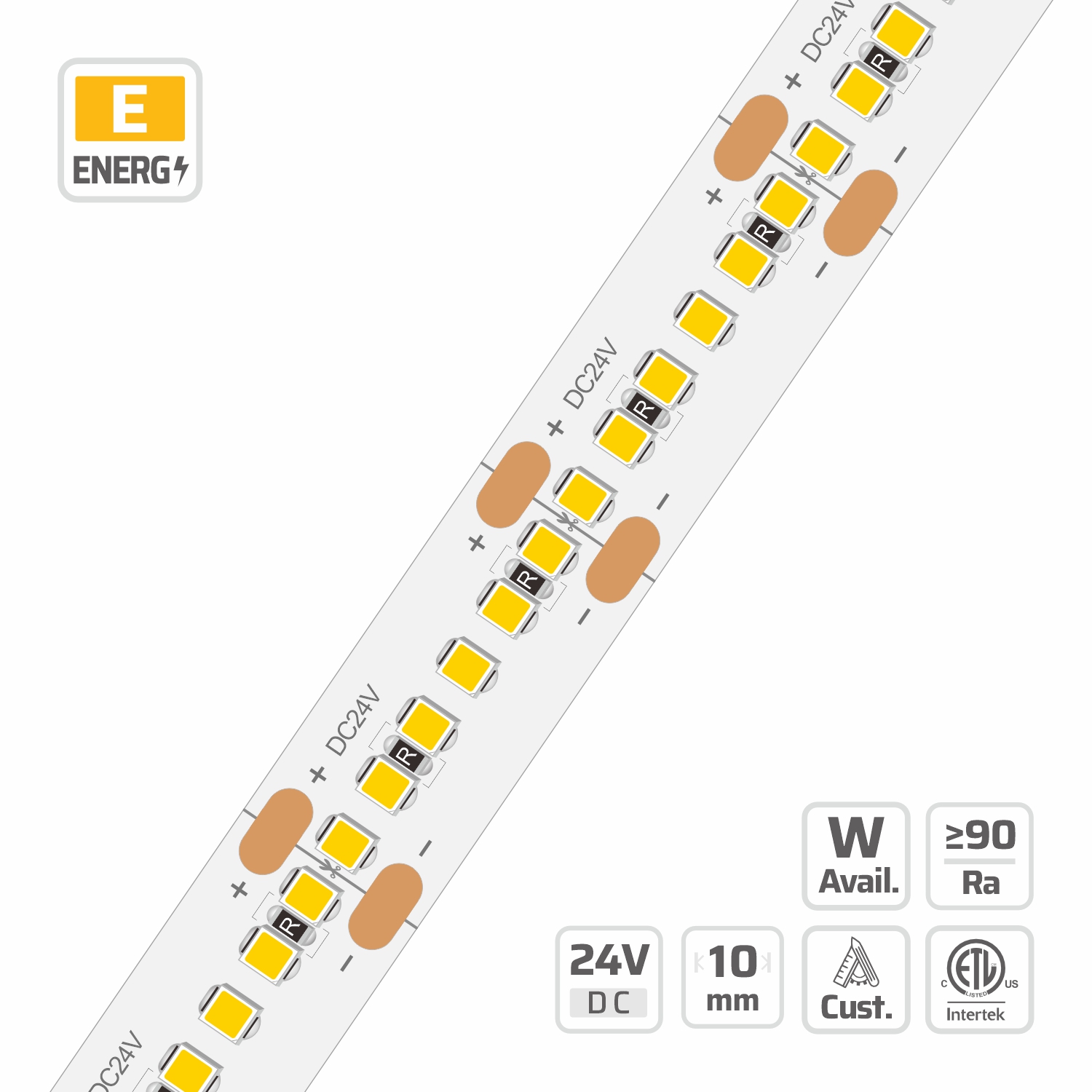
2216 High Density LED Strip Light | 10mm | 24V | 300LEDs | 20mm/cut | #2-1688 is part of the DENO Classic SMD Strips series, engineered around 24V SMD LED strip lights. Key specifications: 2216, 300 LEDs/m, DC24V, 10mm PCB, 2oz copper FPCB, cuttable 6LEDs/20mm. Every reel is produced on DENO's roll-to-roll line with 99.9% pure copper FPCB and ships CE, UL and RoHS compliant for architectural, retail and hospitality projects. OEM and ODM configurations of length, colour temperature and waterproofing are available on request.
Description
#1688 | 2216 High Density LED Strip Light Ultra- Density CRI>90 SMD2220 LED Strips is outfitted with extremely bright LED chips and strong adhesive backing. Special heat resistant PCB layout, copper layer 2Oz that make sure lower voltage drop and excellent heat dissipation.
Ultra High Density Led Strip built for high-density smd strips projects.
Specifications
| LED QTY | 300 LEDs/m |
|---|---|
| PART NO | DL-F20A150V24-2-1688-* |
| SMD TYPE | 2216 |
| CUTTABLE UNIT | 6LEDs/20mm |
| DIMMABLE | Yes |
| LED PITCH | 4.1mm |
| PCB WIDTH | 10mm |
| BEAM ANGLE | 120° |
| LENGTH MAX | 5m |
| COPPER FOIL | 2oz |
| POWER RANGE | 6~24W |
| CIRCUIT TYPE | C.V. |
| INPUT VOLTAGE | DC24V |
Photometric Performance — CCT × CRI Efficacy Matrix
Peak measured luminous efficacy: 131.8 lm/W at 4000K, Ra 90, ErP energy class E (Grade DL (2nd Tier) · 9.6W/m).
All values are measured at the stated power density and ambient 25 °C, reported as luminous efficacy in lumens per watt (lm/W), luminous flux per metre (lm/m) and the corresponding EU ErP (2019/2015) energy class.
Grade DL (2nd Tier) · 9.6W/m
| CCT (K) | Ra 80 — Luminous Efficacy (lm/W) | Ra 80 — Luminous Flux (lm/m) | Ra 80 — ErP Energy Class | Ra 90 — Luminous Efficacy (lm/W) | Ra 90 — Luminous Flux (lm/m) | Ra 90 — ErP Energy Class | Full Spectrum (Ra 95+) — Luminous Efficacy (lm/W) | Full Spectrum (Ra 95+) — Luminous Flux (lm/m) | Full Spectrum (Ra 95+) — ErP Energy Class |
|---|---|---|---|---|---|---|---|---|---|
| 1800 K | — | — | — | 99.7 lm/W | 956.9 lm/m | F | — | — | — |
| 2300 K | — | — | — | 111.1 lm/W | 1066.4 lm/m | E | — | — | — |
| 2700 K | — | — | — | 120.1 lm/W | 1153.3 lm/m | E | 97.4 lm/W | 935.4 lm/m | F |
| 3000 K | — | — | — | 126.4 lm/W | 1213.7 lm/m | E | 102.9 lm/W | 987.6 lm/m | F |
| 3500 K | — | — | — | 128.7 lm/W | 1235.2 lm/m | E | 106 lm/W | 1017.2 lm/m | F |
| 4000 K | — | — | — | 131.8 lm/W | 1264.9 lm/m | E | 108.8 lm/W | 1044.9 lm/m | F |
| 5000 K | — | — | — | 131.8 lm/W | 1264.9 lm/m | E | — | — | — |
| 6500 K | — | — | — | 126.4 lm/W | 1213.7 lm/m | E | — | — | — |
Grade DL (2nd Tier) · 12W/m
| CCT (K) | Ra 80 — Luminous Efficacy (lm/W) | Ra 80 — Luminous Flux (lm/m) | Ra 80 — ErP Energy Class | Ra 90 — Luminous Efficacy (lm/W) | Ra 90 — Luminous Flux (lm/m) | Ra 90 — ErP Energy Class | Full Spectrum (Ra 95+) — Luminous Efficacy (lm/W) | Full Spectrum (Ra 95+) — Luminous Flux (lm/m) | Full Spectrum (Ra 95+) — ErP Energy Class |
|---|---|---|---|---|---|---|---|---|---|
| 1800 K | — | — | — | 98 lm/W | 1176.1 lm/m | F | — | — | — |
| 2300 K | — | — | — | 109.2 lm/W | 1310.7 lm/m | F | — | — | — |
| 2700 K | — | — | — | 118.1 lm/W | 1417.6 lm/m | E | 95.8 lm/W | 1149.7 lm/m | F |
| 3000 K | — | — | — | 124.3 lm/W | 1491.8 lm/m | E | 101.2 lm/W | 1213.8 lm/m | F |
| 3500 K | — | — | — | 126.5 lm/W | 1518.2 lm/m | E | 104.2 lm/W | 1250.3 lm/m | F |
| 4000 K | — | — | — | 129.6 lm/W | 1554.7 lm/m | E | 107 lm/W | 1284.2 lm/m | F |
| 5000 K | — | — | — | 129.6 lm/W | 1554.7 lm/m | E | — | — | — |
| 6500 K | — | — | — | 124.3 lm/W | 1491.8 lm/m | E | — | — | — |
Grade DL (2nd Tier) · 14.4W/m
| CCT (K) | Ra 80 — Luminous Efficacy (lm/W) | Ra 80 — Luminous Flux (lm/m) | Ra 80 — ErP Energy Class | Ra 90 — Luminous Efficacy (lm/W) | Ra 90 — Luminous Flux (lm/m) | Ra 90 — ErP Energy Class | Full Spectrum (Ra 95+) — Luminous Efficacy (lm/W) | Full Spectrum (Ra 95+) — Luminous Flux (lm/m) | Full Spectrum (Ra 95+) — ErP Energy Class |
|---|---|---|---|---|---|---|---|---|---|
| 1800 K | — | — | — | 96.4 lm/W | 1387.7 lm/m | F | — | — | — |
| 2300 K | — | — | — | 107.4 lm/W | 1546.5 lm/m | F | — | — | — |
| 2700 K | — | — | — | 116.2 lm/W | 1672.6 lm/m | E | 94.2 lm/W | 1356.5 lm/m | F |
| 3000 K | — | — | — | 122.2 lm/W | 1760.2 lm/m | E | 99.5 lm/W | 1432.2 lm/m | F |
| 3500 K | — | — | — | 124.4 lm/W | 1791.4 lm/m | E | 102.4 lm/W | 1475.3 lm/m | F |
| 4000 K | — | — | — | 127.4 lm/W | 1834.4 lm/m | E | 105.2 lm/W | 1515.3 lm/m | F |
| 5000 K | — | — | — | 127.4 lm/W | 1834.4 lm/m | E | — | — | — |
| 6500 K | — | — | — | 122.2 lm/W | 1760.2 lm/m | E | — | — | — |
Grade DL (2nd Tier) · 19.2W/m
| CCT (K) | Ra 80 — Luminous Efficacy (lm/W) | Ra 80 — Luminous Flux (lm/m) | Ra 80 — ErP Energy Class | Ra 90 — Luminous Efficacy (lm/W) | Ra 90 — Luminous Flux (lm/m) | Ra 90 — ErP Energy Class | Full Spectrum (Ra 95+) — Luminous Efficacy (lm/W) | Full Spectrum (Ra 95+) — Luminous Flux (lm/m) | Full Spectrum (Ra 95+) — ErP Energy Class |
|---|---|---|---|---|---|---|---|---|---|
| 1800 K | — | — | — | 93.2 lm/W | 1788.9 lm/m | F | — | — | — |
| 2300 K | — | — | — | 103.8 lm/W | 1993.6 lm/m | F | — | — | — |
| 2700 K | — | — | — | 112.3 lm/W | 2156.3 lm/m | E | 91.1 lm/W | 1748.7 lm/m | F |
| 3000 K | — | — | — | 118.2 lm/W | 2269.1 lm/m | E | 96.2 lm/W | 1846.3 lm/m | F |
| 3500 K | — | — | — | 120.3 lm/W | 2309.3 lm/m | E | 99.1 lm/W | 1901.8 lm/m | F |
| 4000 K | — | — | — | 123.2 lm/W | 2364.8 lm/m | E | 101.7 lm/W | 1953.4 lm/m | F |
| 5000 K | — | — | — | 123.2 lm/W | 2364.8 lm/m | E | — | — | — |
| 6500 K | — | — | — | 118.2 lm/W | 2269.1 lm/m | E | — | — | — |
Frequently Asked Questions
What are the key specifications of 2-1688?
2-1688: 2216, 300 LEDs/m, DC24V, 10mm PCB, 2oz copper FPCB, cuttable 6LEDs/20mm. Full photometric data, wiring diagrams and test reports are available in the downloads section of this page.
How long can a single run of this 24V SMD LED strip lights be?
Maximum single run for this model is 5m. Feeding from both ends or using a mid-point tap halves the effective distance per segment, so a 24V SMD LED strip lights can cover twice that length on one circuit when wired accordingly.
Can DENO customise this 24V SMD LED strip lights for a project?
Yes. DENO manufactures the Classic SMD Strips series as an OEM and ODM supplier: reel length, colour temperature, CRI grade, PCB width, waterproofing and private labelling can all be specified. Request a quote for lead time and project pricing.
Which SMD LED strip density should you specify?
For general cove and shelf lighting, 120 LEDs/m on a 24V LED strip is the usual baseline. Move to 180 or 240 LEDs/m when the strip sits close to a diffuser or is seen at a shallow angle, since higher density is what removes visible dots on a 2835 LED strip.
How many LEDs per metre does a dotless LED strip need?
Visible dots depend on LED pitch, diffuser distance and transmittance. Above roughly 480 LEDs/m most diffusers give a continuous line at 10 mm depth, and the 700 LEDs/m high density LED strip stays dot free even behind a shallow, highly transmissive lens.
High Density LED Strip — Buyer Questions
What counts as a high density LED strip?
Anything above roughly 120 LEDs per metre is normally sold as a high density LED strip. DENO builds high-density boards from 240 up to 700 LEDs/m, which puts the LED pitch between 4.2 mm and 1.4 mm — tight enough to read as a continuous line behind a shallow diffuser instead of a row of dots.
Is a 24V high density LED strip better than 12V?
For dense boards, yes in most cases. A 24V high density LED strip draws half the current of a 12V board at the same wattage, so voltage drop is far lower and single runs of 5–10 m stay even in brightness. DENO supplies 12V, 24V, 48V and mains-voltage versions of the same high-density layout; 12V is normally reserved for short cabinet runs or low-voltage furniture requirements.
Do you make a 5V high density LED strip?
Yes. 5V dense LED tape is built for USB-powered displays, shelving and addressable pixel projects where the controller is 5V-native. Because 5V boards lose voltage quickly, DENO limits standard runs to 1–2 m per feed, uses 2 oz or 35+70 μm copper, and adds per-segment constant-current ICs so the far end does not dim.
- Series High Density LED Strips series
- Related series Constant-current dense LED strip boards
- Related series 5V addressable pixel LED strip builds
- Product 11014 12V high density LED strip
Can a high density RGB LED strip stay dot-free?
It can, but the pitch has to be tighter than a white board because each RGB package mixes three separate dies. DENO's high density RGB and RGBW builds place emitters at 2.1 mm–4.2 mm pitch so colour mixing completes within a few millimetres of the diffuser, which removes both the dot pattern and the rainbow fringing seen on standard 60 LEDs/m RGB tape.
- Series High Density LED Strips series
- Related series Dense RGB and RGBW colour tape
- Related series RGBW LED strip lights with a dedicated white die
What is a high density addressable LED strip used for?
High density addressable LED strip (pixel tape) is used for signage, media facades, stair effects and studio lighting where each LED or short segment must be controlled individually. DENO offers addressable builds with up to 700 pixels per metre in SPI protocols such as WS2812B, WS2815 and SK6812, with breakout points every cut unit for reliable data injection on long runs.
What makes the best high density LED strip lights?
Density alone is not enough. The best high density LED strip lights combine tight LED pitch with a 3-SDCM binning window, Ra 90+ (Ra 95+ for full-spectrum), 2 oz or heavier copper for thermal spreading, flicker-free constant-current drive and an FPCB rated for repeated bending. DENO ships photometric data, LM-80 chip data and a full test report with every OEM order so specifiers can verify these claims instead of trusting a datasheet number.
- Series High Density LED Strips series
- Related series Full-spectrum Ra 95+ dense boards
- Guide efficacy, flicker and ErP reference data
How dense can an ultra high density LED strip go?
DENO's ultra high density LED strip tops out at 700 LEDs per metre with a 1.4 mm pitch, drawing up to 30 W/m. Beyond that point a discrete SMD layout stops making sense thermally, and a SCOB (COB) emitter is the better route to a fully dotless line.
- Series High Density LED Strips series
- Related series Dotless SCOB alternative to ultra high density tape
- Related series ultra narrow LED strip boards from 3 mm wide
Can I order a custom high density LED strip?
Yes — LED count, pitch, CCT, CRI, PCB width from 3 mm, copper weight, cut unit and IP rating are all configurable on a custom high density LED strip. DENO is a manufacturer, not a reseller, so a non-standard density or a mixed-CCT dense board can be tooled from an existing FPCB stack-up without a new production line.
- Series High Density LED Strips series
- Related series Custom LED strip light capabilities
- Guide send a dense LED strip specification to DENO
Is high density LED tape the same as a high density LED strip?
They are the same product under two names: “high density led tape” is the common UK/EU term for what North America calls a high density LED strip. DENO ships the identical dense FPCB boards to both markets — 240 to 700 LEDs/m, 3 mm to 12 mm widths, CE/UL/RoHS documentation — so the tape you specify in a UK cove detail is the same board as the strip specified in a US one.
- Series High Density LED Strips series
- Related series micro-cut intervals on dense tape
- Related series narrow dense tape from 3 mm wide
Which dense LED tape suits under-cabinet lighting?
For under-cabinet work choose a dense board at 240–420 LEDs/m in a 5 mm to 8 mm width, 12V or 24V, with a short cut unit so the board matches each cabinet run exactly. At that density a 10 mm deep aluminium channel with a frosted diffuser already reads dot-free at normal worktop viewing distance.
What power supply do I need for a dense LED strip run?
Size the driver from the board wattage: multiply the W/m figure on the datasheet by the run length, then add 20–30 % headroom, so a 20 W/m board over 5 m needs a 100 W load on a 120–130 W constant-voltage driver. Match the driver voltage exactly (24V board, 24V driver), keep it constant-voltage rather than constant-current unless the board carries its own CC ICs, and check that the dimming protocol — TRIAC, 0–10V, DALI or PWM — is supported on both sides before ordering.
Does more LEDs per metre mean a brighter strip?
Not on its own. Brightness is lumens per metre, which is drive current times die count times efficacy — doubling the LED count while halving the current per die gives the same output with a smoother line, not twice the light. Read lm/m and W/m together: DENO dense boards run 8–24 W/m and 700–2600 lm/m, so pick the density for dot-free appearance and the wattage for the light level you actually need.
Can dense LED tape run on 36V or 48V supplies?
Yes. 36V and 48V builds exist specifically for long uninterrupted runs: at 48V the same wattage draws a quarter of the current of a 12V board, so a single feed can cover 15–20 m with even brightness and far fewer injection points. They need a matching SELV driver and, in most territories, the same low-voltage installation rules as 24V; DENO supplies 36V and 48V versions of the standard dense layouts on request.