R2R vs S2S: Which LED Strip FPCB Process Wins?
By DENO LED Lighting ·
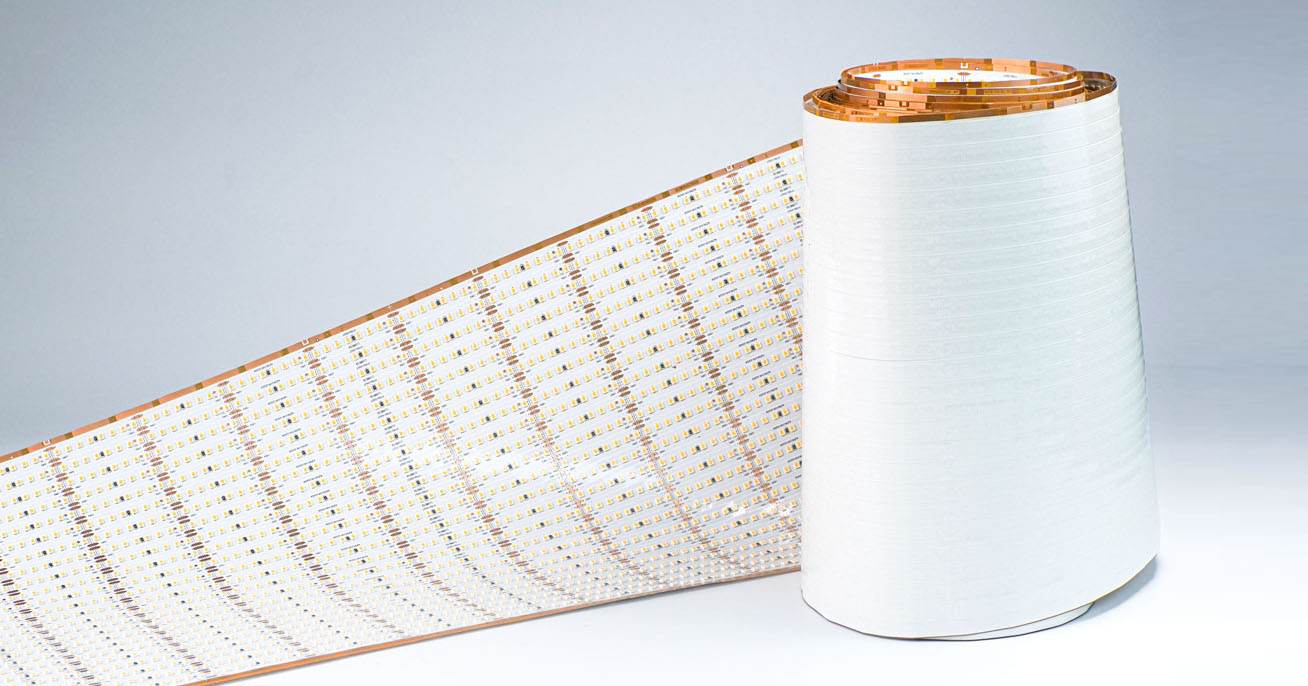
Roll-to-roll (R2R) vs sheet-to-sheet (S2S) FPCB for LED strips: joint count, 30 m continuous runs, voltage drop, yield and where each process belongs.
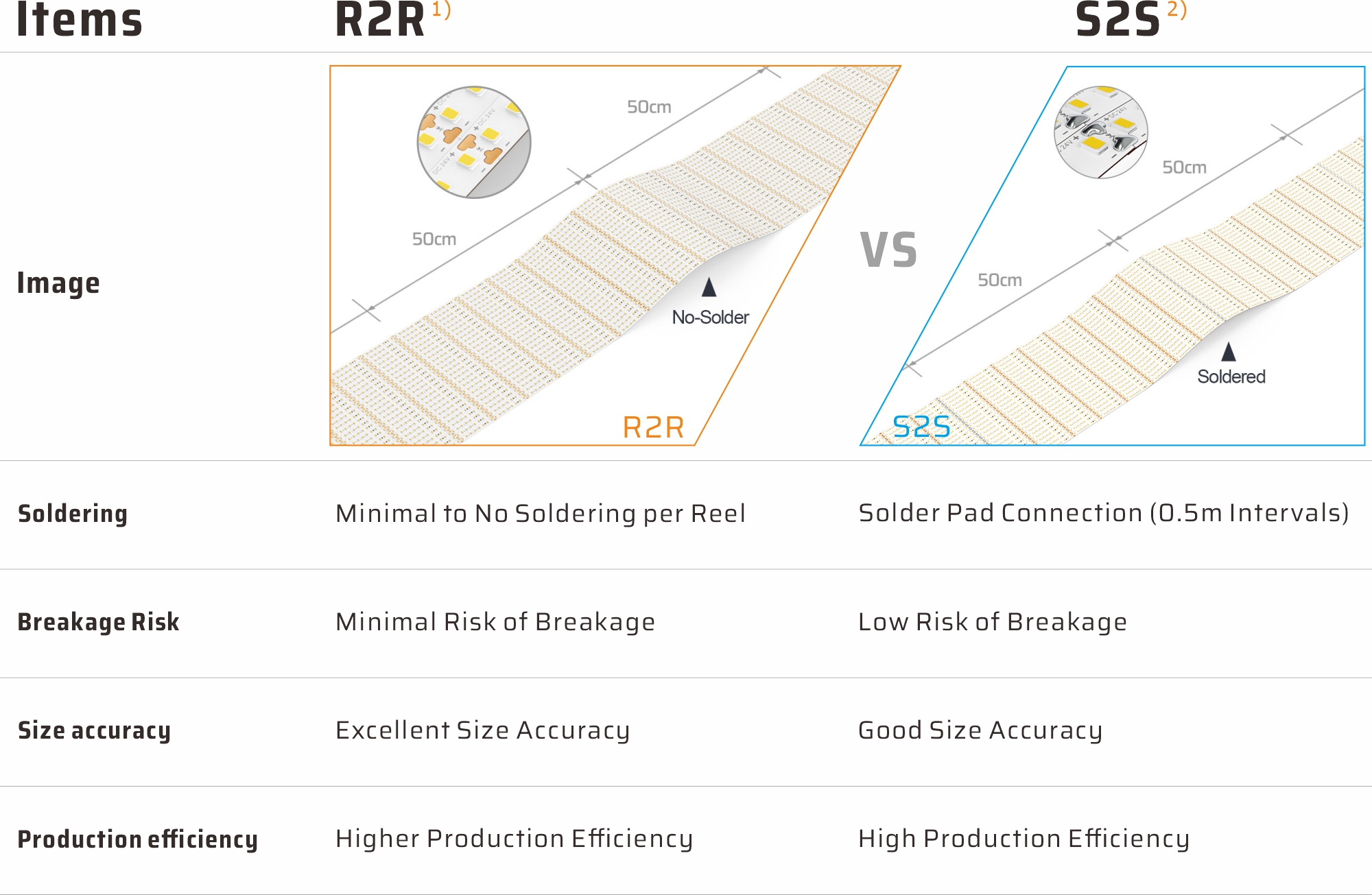
R2R Process:
Produces 30-meter rolls with few to no soldering joints using integrated equipment.
Sheet-to-Sheet Process:
Generates flexible PCBs with solder joints at 0.5-meter intervals.

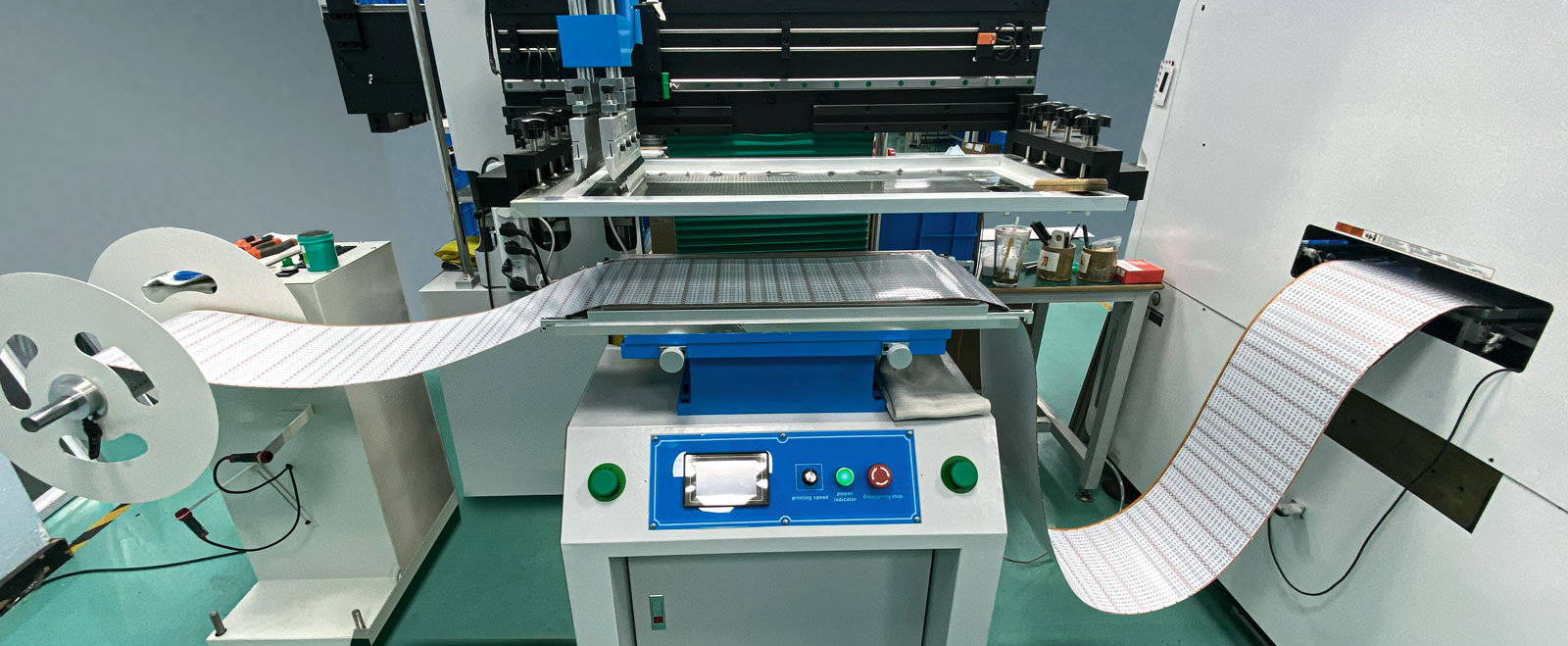
R2R Production Process in Action

R2R vs S2S: the short answer
Roll-to-roll (R2R) manufacturing laminates, exposes, etches and solder-masks the flexible PCB as one continuous web, so a DENO LED strip can be produced in a single 30-metre length with no intermediate joints. Sheet-to-sheet (S2S) production processes the FPCB in discrete panels, typically 0.5 m long, which are then spliced together with solder joints. Everything else that matters in the field - mechanical reliability, voltage drop, colour consistency and waterproof performance - follows from that single difference.
Why solder joints decide long-run reliability
A 30 m S2S strip carries roughly 59 splice points. Each joint is a local change in copper cross-section, a local stress riser during bending, and a place where flux residue can start corrosion once the strip is potted or installed outdoors. In continuous cove lighting, joints are also the first thing to fail after thermal cycling, because solder and polyimide expand at very different rates. An R2R strip has none of these transitions between the input and the far end of the reel.
Electrical behaviour and voltage drop
Joints add contact resistance, and contact resistance adds voltage drop on top of the copper losses you already design for. On 24 V constant-voltage runs the visible result is a bright-to-dim gradient along the strip; on longer runs installers compensate with extra injection points, which increases labour and cable cost. Because R2R copper is continuous and DENO uses 99.9% pure copper foil at controlled thickness, the drop across a run is predictable and can be modelled in the ProCalc voltage-drop tool before the project is quoted.
Process control, yield and colour consistency
Continuous web handling keeps registration tolerance tight along the whole roll, which keeps LED pitch uniform and keeps solder paste deposition consistent. Uniform paste volume means a uniform thermal path from chip to copper, which means less binning drift across a reel. In practice this is why a full R2R reel usually holds tighter colour consistency than the same product built from spliced panels.
Where sheet-to-sheet still makes sense
S2S is not obsolete. For short custom shapes, rigid-flex hybrids, very low volumes and prototype boards with unusual outlines, panel processing is faster to tool and cheaper to change. If a project needs 300 mm modules or non-linear board outlines, panelised production is the sensible route. The mistake is using S2S for long linear runs and then paying for it in joint failures on site.
How to specify the right process
Ask three questions. First, what is the longest uninterrupted run in the installation? Anything above roughly two metres benefits from continuous FPCB. Second, is the fixture sealed, bent, or installed outdoors? Sealing traps flux and moisture around joints, so continuous copper is worth the premium. Third, is colour consistency inspected across the whole batch? Continuous processing narrows the spread. DENO builds long linear, neon and IP-rated families on roll-to-roll lines for exactly these reasons, and can quote either process once the run length and environment are known.
FAQ
How long can one R2R LED strip run be? DENO produces continuous lengths up to 30 m per reel; the practical limit in a project is set by voltage drop and current-carrying capacity, not by the board.
Does R2R cost more? Unit cost is comparable at volume, and total installed cost is usually lower because there are fewer injection points, fewer connectors and less rework.
Can I tell the difference visually? Yes - inspect the back of the strip for splice pads at regular intervals. Evenly spaced solder bridges every 0.5 m indicate sheet-to-sheet construction.
Checklist before you order
Confirm the run length per circuit, the bend radius the detail requires, the environment (dry, damp, immersed) and the acceptable colour tolerance. Then ask the supplier to state, in writing, whether the FPCB is continuous roll-to-roll or spliced panels, and at what interval the splices fall. On a long architectural cove the difference is not academic: a continuous board removes 59 potential failure points from a 30 m run and keeps voltage drop predictable end to end.
How DENO applies roll-to-roll in production
DENO runs its long linear, high-density, neon and IP-rated families on continuous roll-to-roll lines using 99.9% pure copper foil, with electroplated rather than die-cut copper where trace definition matters. Photometric data is captured per batch so specifiers can compare delivered lumens per watt rather than nominal figures. For custom board outlines, private-label runs or hybrid requirements, the OEM and ODM route covers tooling and sampling.
Related reading
Pair this article with the guides on waterproof construction, bonding wire reliability and colour temperature selection to build a complete specification for a linear lighting project.