Full-Spectrum LED Strip and TM-30-15 Explained
By DENO LED Lighting ·
Why TM-30-15 describes full-spectrum LED strip performance better than CRI alone, and how Rf and Rg change the way you specify colour quality.
DENO’s Full-Spectrum Flexible LED Strip Light is an innovative, flexible, and versatile lighting solution designed to deliver exceptional lighting performance and an outstanding visual experience.
In today’s presentation, I will introduce the key advantages and applications of our Full-Spectrum Flexible LED Strip Light. Whether used in commercial spaces, residential environments, or creative decorative projects, it delivers high-quality illumination while creating a more comfortable and natural atmosphere.DENO's Full-Spectrum Flexible LED Strip Light is an innovative, flexible, and versatile lighting solution designed to provide exceptional lighting effects and an outstanding lighting experience for your needs.
In today's presentation, I will showcase the numerous advantages and application areas of our Full-Spectrum Flexible LED Strip Light. Whether it's in commercial spaces, residential environments, or creative decoration projects, this strip light can deliver high-quality lighting effects and create a more comfortable and cozy atmosphere for you.
Whether you are an artist and a pigment palette experts or not, Human's eyes are sensitive to the quality of light and the color. In your experience of life, you can find that a red shirt in the sunlight is much different from the under a fluorescent light. So we will ask why the same color (the same dress, the same color ornament) looks so different in different light (different from: unsaturated, color shift, dim, untrue, etc. )
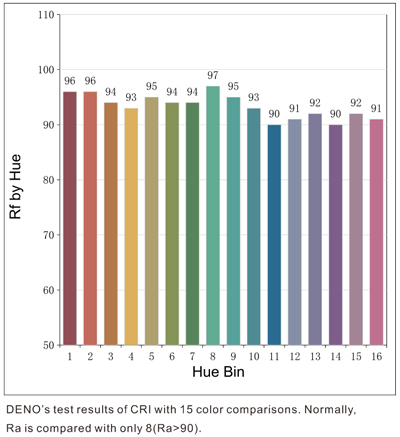
Normally, the standard light source is the sun. Compare with the sun, Color presentation depends on the restore quality of light. Now there are several ways to test the quality of light source:
- Color Rendering Index (CRI)
- IES TM-30-15
- Color Quality Scale (CQS)
- What is the Color Temperature (CCT)
Why CRI alone is no longer enough
CRI (Ra) averages the rendering of eight pastel test colours under a single reference illuminant. It was designed for fluorescent lamps and it can be gamed: a source can score Ra 90 while rendering saturated reds poorly, which is why R9 has to be quoted separately. IES TM-30-15 was written to replace that averaging with a far more complete picture of what a modern LED source actually does to colour.
What TM-30-15 measures
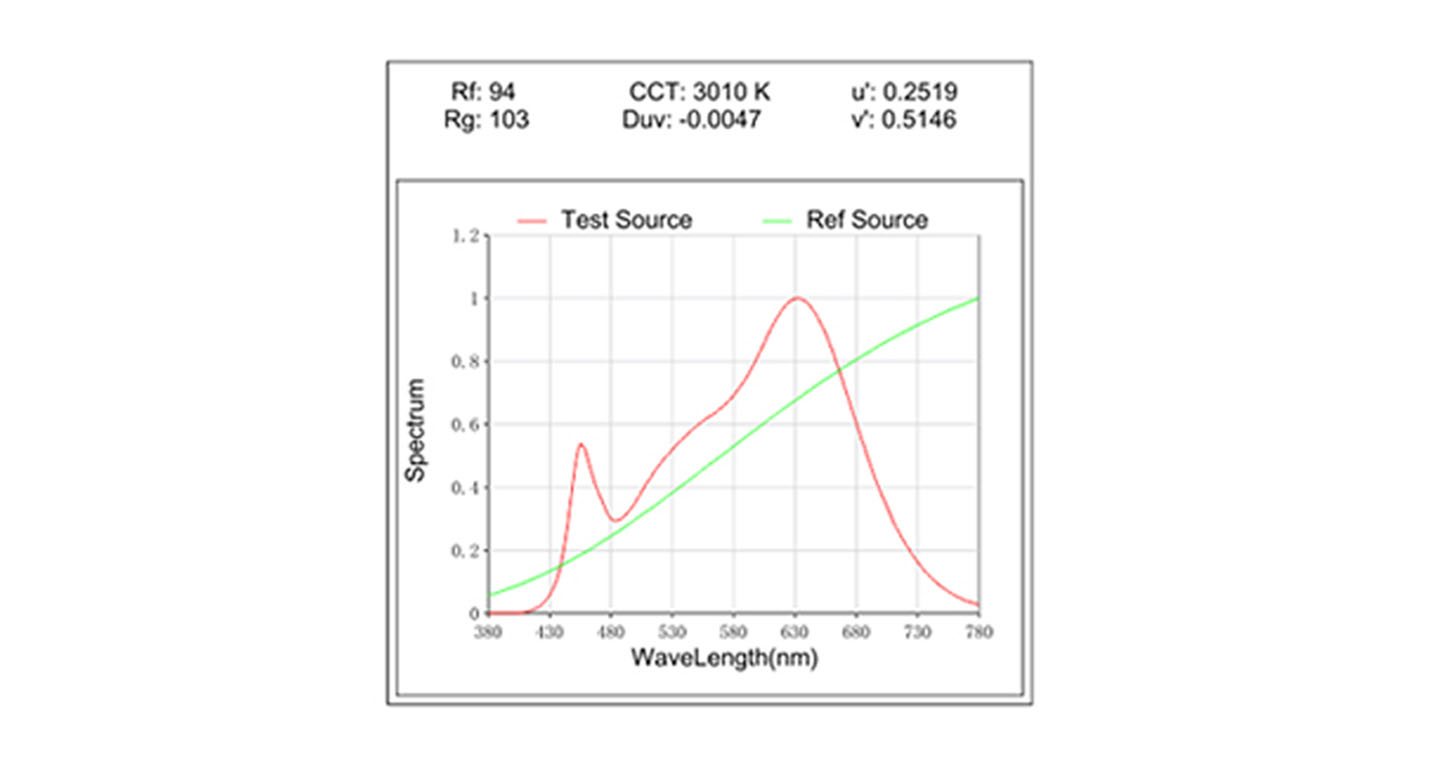
TM-30 uses 99 colour evaluation samples covering the full range of real-world object colours and reports two primary numbers. Fidelity index Rf, on a 0-100 scale, describes how closely the source matches the reference - the direct successor to Ra. Gamut index Rg describes whether the source increases or decreases perceived saturation: Rg near 100 is neutral, above 100 means colours appear more saturated, below 100 means they appear washed out. A colour vector graphic then shows exactly which hue regions are shifted and in which direction.
Reading Rf and Rg together
High Rf with Rg near 100 means faithful, natural rendering - the right target for museums, medical and inspection tasks. High Rf with Rg slightly above 100 makes merchandise look richer without looking artificial, which is why premium retail often prefers it. Low Rg makes food, fabric and skin look tired regardless of the CRI number printed on the datasheet.
What makes a strip full spectrum
Conventional white LEDs use a blue pump and a phosphor blend, which leaves a cyan gap and a weak deep-red tail in the spectrum. Violet-excited, sun-matched full-spectrum packages start from a shorter-wavelength pump and use a broader phosphor system, filling the cyan valley and extending the red end. The measurable result is high Rf, balanced Rg and a spectral power distribution much closer to daylight across the visible range.
Where full spectrum earns its cost
Art galleries and museums, high-end fashion and cosmetics retail, dental and medical examination, print and paint inspection, food display, photography and video studios, and residential projects where the client is sensitive to light quality. It also supports human-centric lighting arguments in offices and healthcare, where spectral content rather than lux is the point.
How to request the data
Ask for a full TM-30-15 report including Rf, Rg, the colour vector graphic and the spectral power distribution, measured at the drive current you will actually use, plus CRI and R9 for comparison with older specifications. DENO supplies this documentation for its full-spectrum families so consultants can compare like with like.
FAQ
Does TM-30 replace CRI? It supersedes it technically, but most specifications still quote both; supply Ra, R9, Rf and Rg together.
What Rf should I target? Rf 90 or higher for colour-critical work, with Rg between 95 and 110.
Is full spectrum less efficient? Efficacy is somewhat lower than a blue-pump equivalent; the trade is spectral quality against lumens per watt.
Full spectrum in practice: what changes on site
Swapping a blue-pump 3000 K strip for a violet-excited full-spectrum strip at the same CCT changes the appearance of every material in the room. Reds and deep skin tones gain depth, greens separate from each other instead of collapsing into one hue, and printed colour matches the proof more closely. Because the change is spectral rather than photometric, a lux meter will not show it - only a TM-30 report or a side-by-side mock-up will.
Specification wording you can copy
Require: violet-excited full-spectrum LED strip, CCT as scheduled, CRI 95 minimum with R9 above 80, TM-30-15 Rf 90 minimum and Rg between 95 and 110, 3-step MacAdam consistency, with a full spectral power distribution report supplied per batch at the specified drive current. This wording prevents substitution with a nominally equivalent blue-pump product.
Related reading
See the colour temperature selection guide for pairing CCT with application, and the quality comparison article for the construction details that keep spectral performance stable over time.