Can You Dim LED Strip Lights? PWM, CCT and Dim-to-Warm Explained
By DENO LED Lighting ·
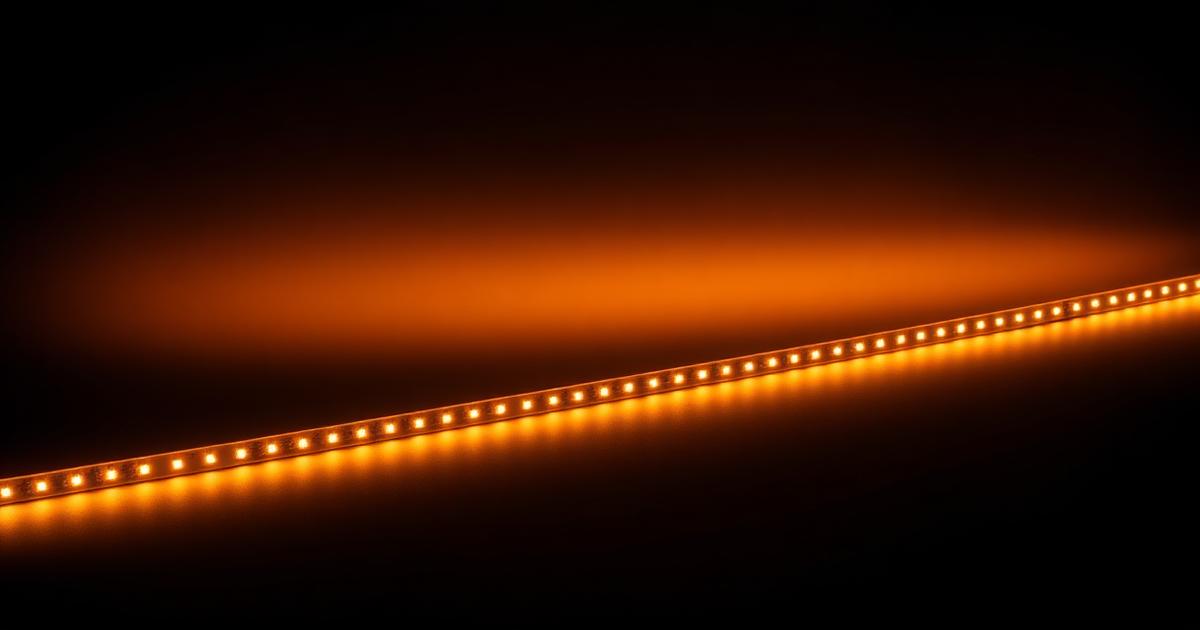
Every LED strip light can be dimmed — the question is how. PWM vs analogue dimming, flicker thresholds, and when to specify dim-to-warm or tunable white instead.
Yes — every LED strip light is dimmable. The dimming happens at the driver or controller, not in the strip, so the real question is which dimming method the project needs and whether the driver supports it.
PWM vs analogue dimming
PWM switches the LEDs fully on and off thousands of times per second and varies the on-time. It holds colour temperature perfectly across the whole range and dims smoothly to near zero. Analogue (CCR) dimming lowers the drive current instead — silent and flicker-free, but colour can shift slightly at deep dim levels and it rarely goes below about 10%.
Flicker: the specification most people miss
If the space will be filmed — studios, retail with video, sports halls — the PWM frequency has to be high enough to stay invisible on camera. Aim for a driver running above 3 kHz, and check the flicker metrics (Pst LM and SVM) against the ErP requirements rather than trusting a "flicker-free" claim on a box.
When dimming alone is not the answer
Dimming a fixed-CCT strip makes it darker but not warmer, which is why dimmed LED lighting can feel clinical compared with a dimmed halogen lamp.
To mimic incandescent behaviour, specify a dim-to-warm LED strip light — the colour temperature drops from around 3000K to 1800K as you dim.
To control brightness and colour temperature independently, specify a CCT tunable LED strip light , driven on two channels.
For per-segment or pixel-level control, look at built-in IC LED strip lights and pixel LED strip lights .
Practical rules
Match the dimmer protocol to the driver: 0-10V, DALI, TRIAC, DMX or push-dim. A TRIAC wall dimmer will not dim a 0-10V driver.
Keep the load above the driver's minimum. A driver loaded at 5% of capacity often flickers or drops out at low levels.
Dim at the driver, never by lowering the supply voltage to a constant-voltage strip.
Specifying the right combination
Tell us the control protocol and the dim range you need and we will match the strip, driver and controller as a tested set from the LED strip light catalogue .