Can You Cut LED Strip Lights? Cut Points, Tools and Rules
By DENO LED Lighting ·
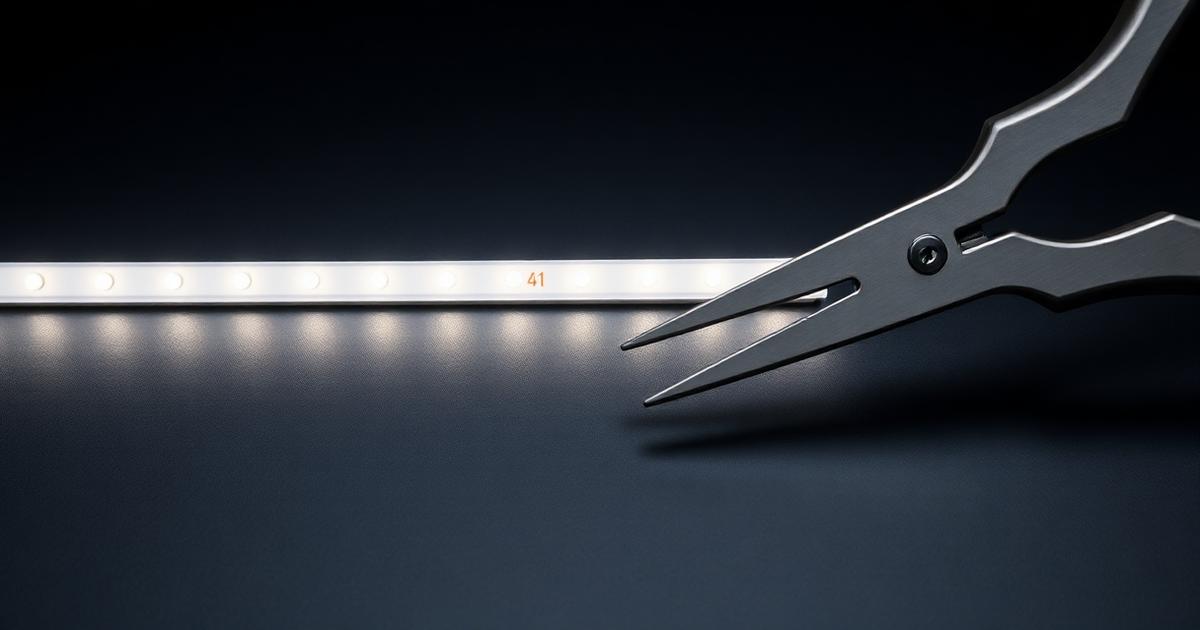
Yes — but only on the marked cut points. Here is how cut pitch works on 24V, 48V and constant-current LED strip lights, and how to keep the warranty valid.
Yes, almost every LED strip light can be cut — but only at the printed cut marks. Each cut mark sits at the end of a complete electrical segment. Cut anywhere else and you break the circuit, killing the segment you cut through and often the rest of the run.
Where the cut points are
A cut point is marked with a scissors icon and a pair of exposed copper solder pads. The distance between two cut points is the cut pitch , and it is fixed by the strip's internal circuit design — not by anything you can change on site.
12V strips — typically 3 LEDs per segment, cut pitch around 50mm to 100mm.
24V strips — typically 6 LEDs per segment, cut pitch around 25mm to 100mm depending on LED density.
36V and 48V strips — longer segments, cut pitch often 50mm or more. See the 48V LED strip light range and the 36V LED strip light range for exact pitches per model.
Constant-current IC strips — each segment carries its own driver IC, so the cut pitch is set by the IC layout. Browse built-in IC LED strip lights .
When you need a very short cut pitch
Millwork, display cases, handrails and stair nosings often need a strip that lands on an exact millimetre. Standard 50mm pitch wastes length and forces a visible dark gap at the end of the run. Our micro-cut LED strip lights bring the cut pitch down to as little as 3.3mm, and ultra-density LED strip lights combine a short pitch with a continuous, dot-free output.
How to cut a strip correctly
Power down and disconnect the driver before cutting.
Cut on the centre line of the mark with sharp flush scissors, so both halves keep half of each copper pad.
For an IP65/IP67/IP68 strip, cut, then reseal the open end with an end cap and silicone glue. An unsealed cut end is the single most common cause of field failure on wet-location runs.
Re-terminate with solder or a clamp connector rated for the strip's width and current.
What you cannot do
You cannot rejoin two cut segments and expect the original run length — the maximum run is limited by voltage drop, not by the connector. Before you plan the layout, run the numbers in our voltage-drop and run-length calculator .
Choosing a strip that fits your cut plan
If the installation has many short, exact-length pieces, choose the cut pitch first and the wattage second. Our engineers can confirm the cut pitch, segment voltage and end-cap kit for any model in the full LED strip light catalogue before you order.